





























Shadows shape life for the people still standing in 2050. Once the sun drops, the streets turn into a hunting ground for the Wasted. They are warped remnants of humans, born from MiVis, a food substitute sold as a lifeline and remembered as a catastrophe. For anyone trying to outlast the wasteland, the Carmageddon competition is the gate to something better than slow decay.
34BigThings leans on the Unreal Engine to paint this rain-soaked setting in industrial grime, with an atmosphere that feels slick, heavy, and mean. As a successor to the 1997 arcade classic, the project shifts its energy toward a relentless loop of vehicular combat and high-speed survival. The world feels charged with scorched rubber and ozone.
Each race plays like a test of endurance where steel collides with bodies, and every mistake gets priced in bent frames and lost momentum. The goal never reads like a shiny podium finish. It reads like permission to keep going. Winning demands speed, aggression, and control in equal measure, with the road’s violence treated as the rule of the era. Survival becomes a daily fee paid in gasoline and blood while the wasteland collapses under the weight of old mistakes.
The Cycle of Survival
Progress runs on a node-based map built to force constant tactical calls. Every attempt starts with one vehicle and a branching route where each step asks a simple question: chase the promise of loot, or reduce the risk of getting erased. Randomized events and shifting shop inventories keep runs from settling into a single routine, so your next stop can change the shape of the run in a hurry.
Two separate economies sit at the core of that structure. Credits fuel the current attempt. You earn them by racing, then spend them at mid-track shops on weapon swaps, armor repairs, and short-term consumables such as Golden Tickets. Those tickets open a rare escape hatch by letting you skip dangerous nodes, and the map still funnels you toward boss fights.
Beatcoins handle the long game. This permanent currency carries across death, letting you unlock fifteen vehicles and buy lasting stat improvements between runs. The mode structure then sets different demands depending on the event type. Standard races commonly ask for a top-three finish to advance. Elite races tighten that requirement into a first-place win, often packed into a single lap that leaves little time for recovery. Survival events shift the pressure onto the clock, pushing you to reach the end before time expires or your chassis gives out.
Each region caps off with a timed boss fight built around pure destruction. These battles do not revolve around crossing a finish line. The task is to wipe out a heavily armed rival before the timer hits zero, with failure arriving immediately if you fall short. That final gate makes route selection feel like a running calculation.
An Elite race can promise richer rewards, while a repair shop can decide if you even arrive at the boss with a functional car. Planning matters as much as reflexes. You can hoard resources early to stabilize the run, or you can spend aggressively to clear the next obstacle, and every choice carries the threat of the run ending early in a pile of scrap.
Engines of Destruction
The vehicles carry a weight that comes through in movement and impact. You begin with the Eagle GF 429, an average-stats starter that works as a primer for the wasteland’s demands. From there, progression opens into more specialized machines. The Warhog is a massive truck designed for ramming, while the Firecracker plays as a light drifter that pays for agility with fragile durability.

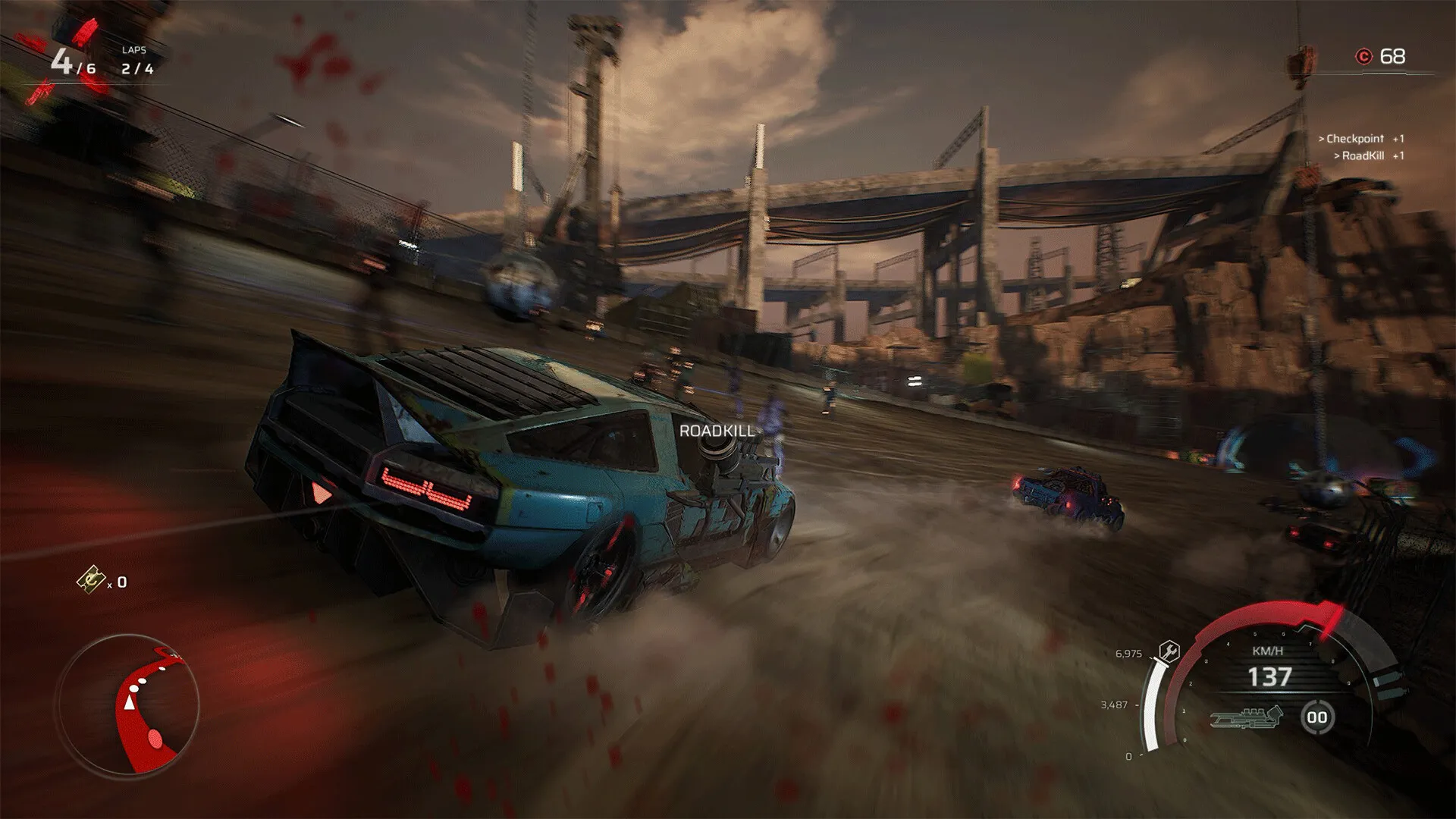
Physics shape how each vehicle reads on the road. Turning at low speed feels stubborn and uncooperative, so you need velocity to keep the car responsive. Drifting stops being a stylistic flourish and turns into a requirement, especially in the sharper corners found in cave systems and wrecking yards. The handling pushes you toward commitment: build speed, throw the car into the turn, manage the slide, then brace for contact.
Combat expands that sense of commitment through thirteen weapon classes. The loadouts range from familiar machine guns and shotguns to high-tech homing lasers and missile racks. The SQR-NE55 VISION74 stands out on handling, paired with a laser that rewards maintaining a steady lock to reach its damage potential.
One firing rule drives a lot of combat decision-making. Hitting the fire button locks you into the full burst or clip, and you cannot cut it short to conserve ammunition. That single constraint changes how you aim, since every trigger pull asks for certainty, timing, and clean alignment.
Defense and positioning get extra tools through side barges mapped to the shoulder buttons. These shunts act as sudden lateral dashes, letting you slam opponents into walls, shove them into hazards, or save yourself by slipping out of a bad angle. Damage stays present through all of it.
Your car visibly wears each collision, and the game keeps you engaged with the repair economy: you hunt for repair nodes on the track, or you take opponents out and grab the health drops they leave in the wreckage. The metal-on-metal grind becomes part of the rhythm, and the gradual visual breakdown of your vehicle keeps a running record of what you have survived so far.
The Hazards of the Wasted
These tracks go past simple circuits and land closer to engineered death traps. Swinging wrecking balls and industrial pipes turn driving lines into moving puzzles, and the environment punishes sloppy control with immediate consequences. One standout stage asks you to traverse thick metal tubes where a single mistake can stop your momentum cold. Cave systems add their own punishment through rocky outcrops that chew up your chassis the moment your steering slips.

The Wasted themselves add volatility to every event. Standard mutants reward aggression by giving you a speed boost when crushed. Special variants change the rules in harsher ways. Explosive types can wreck your vehicle if they detonate nearby. Other mutants latch onto your chassis, dragging you down and leaving you exposed to rival fire at the worst possible time. The result is a battlefield where threats come from the route, the rivals, and the infected bodies wandering into the chaos.
Technical performance holds steady through that mess. The game keeps a stable frame rate on PC and consoles, even with dense particle effects and flying car parts, and that stability matters for any system built around split-second decision-making. Sound design supports the tone with heavy metal riffs and crushing drums that match the mechanical brutality on screen, building an oppressive atmosphere that fits the rain and rust.
A few safety valves keep the pace from collapsing into frustration. If you flip the car or get pinned against a wall, a respawn mechanic resets you after a short cooldown. A Last Stand system gives you a ten-second window to find a repair pickup after your health hits zero. These features help runs stay readable during the worst pileups, while still treating mistakes as costly.
The experience stays strictly solo, and the absence of multiplayer leaves a clear gap. That single-player focus sharpens the game’s mood: the 2050 wasteland feels lonely, and the lack of online friends or rivals reinforces the idea that trust begins and ends with your own machine.
The Review
Carmageddon: Rogue Shift
Carmageddon: Rogue Shift successfully adapts the classic vehicular combat formula into a modern framework. The roguelite structure provides a steady sense of growth through its dual currency system and unlockable roster. The lack of multiplayer and repetitive event types limit the long term appeal. The heavy handling and visceral combat feel satisfying. It remains a focused and technically stable experience for fans of the genre.
PROS
- Satisfying heavy vehicle physics and drifting mechanics
- Deep permanent progression system using Beatcoins
- Stable technical performance during chaotic combat
- Atmospheric and gritty Unreal Engine visuals
CONS
- Complete absence of online or local multiplayer
- Limited variety in racing event types
- Rigid weapon system prevents ammo conservation
- Steep difficulty during the initial few runs