















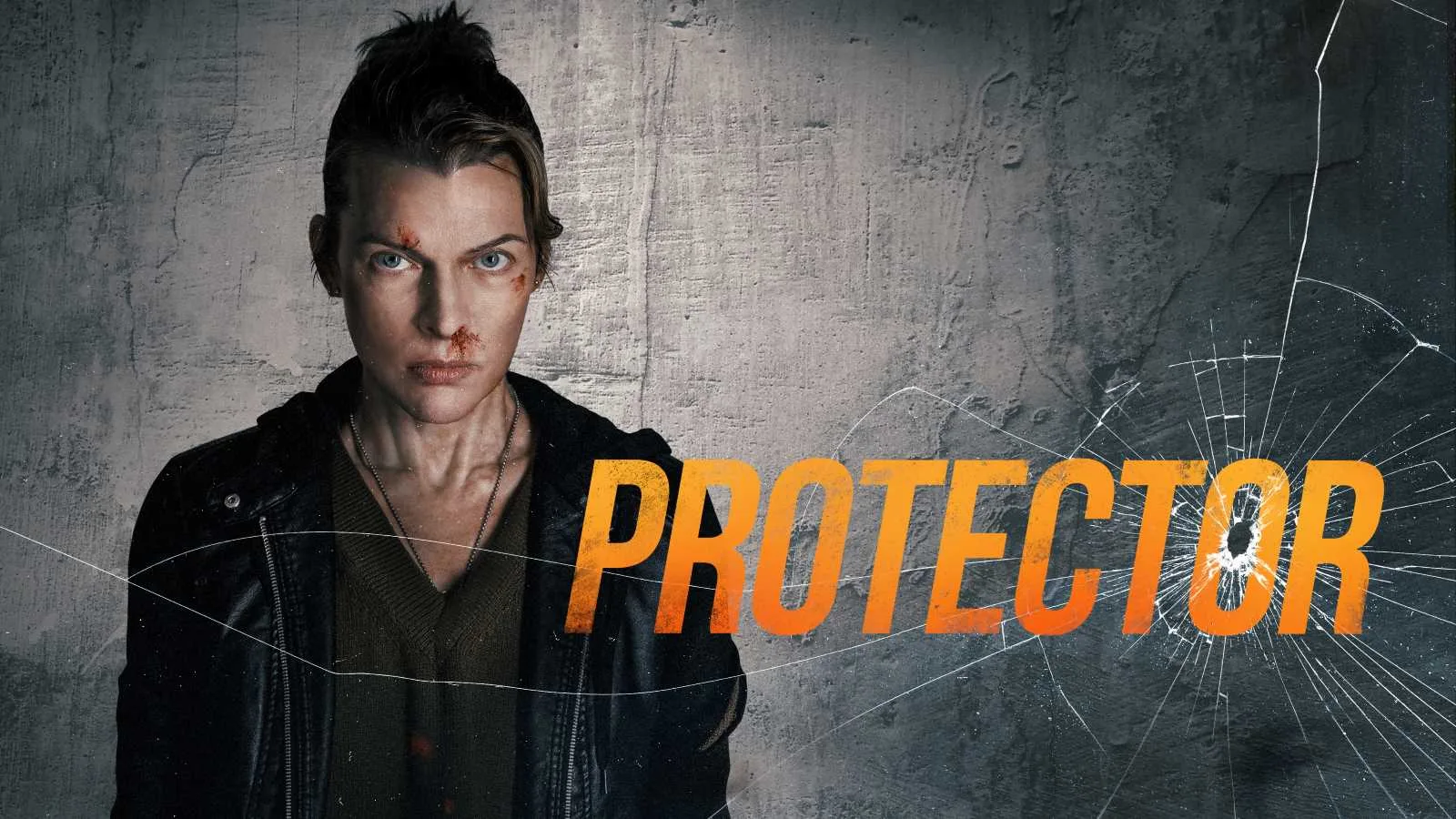

Milla Jovovich at 50 remains one of cinema’s more durable action presences, a fact that carries genuine weight in a genre that tends to exhaust or discard its leads well before that mark. Across decades and franchises, she has maintained a physical credibility that few peers can claim. Protector, directed by Adrian Grünberg (Rambo: Last Blood, Get the Gringo) and written by Bong-Seob Mun, arrives as her latest test of that credibility, casting her as Nikki Halstead, a retired special forces soldier who must retrieve her kidnapped teenage daughter from a human trafficking ring within 72 hours.
The genre template is, to put it mildly, familiar. Liam Neeson’s Taken series cast its long shadow over this territory more than fifteen years ago, and Protector plants itself squarely within that shadow, swapping the grieving father for a guilt-ridden mother without substantially reconsidering what that exchange might mean. The film occasionally reaches for something stranger and more psychologically ambitious, particularly in its closing passages, but it cannot reconcile those impulses with the workmanlike formula it spends most of its runtime dutifully executing. A genre film with flashes of a more interesting version lodged inside it, Protector is a curious, frequently frustrating piece of work.
Seventy-Two Hours, Several Missing Scenes
The setup is brisk to a fault. An opening montage sketches Nikki’s dual life: decorated soldier, absent mother. Her husband Paul’s death from leukemia forces her return to domestic life and to her daughter Chloe (Isabel Myers), now 16 and carrying the accumulated resentment of a childhood spent waving goodbye to a parent perpetually bound for the Middle East. The mother-daughter tension is real enough as a premise. As rendered here, it is thin. A handful of charged exchanges and a montage do not a relationship make, and the film’s emotional stakes depend almost entirely on a bond the audience is asked to assume rather than feel.
The inciting incident follows genre convention precisely: Chloe slips out on her birthday, is drugged at a bar, and vanishes into the machinery of a trafficking syndicate called, without irony, “The Syndicate.” Nikki straps a countdown timer to her wrist and begins the hunt. The 72-hour device is borrowed directly from its predecessors, trimmed by a day for added urgency, and applied with a rigidity that eventually becomes its own problem. The timer does not reset when story conditions shift. The climax treats individual seconds as precious. The film takes its own dramatic device so literally that it stops functioning as drama and starts functioning as arithmetic.
Then there is the matter of what Protector simply refuses to show. At a crucial midpoint, Nikki storms a Syndicate-controlled brothel, rescues a number of trafficked women, and burns the entire operation to the ground. None of this appears on screen. The audience learns of it through narration and fragmentary flashback frames, an omission so jarring it temporarily derails the film’s rhythm entirely. A later sequence, in which Nikki dispatches a team of SWAT officers, receives the same treatment. One might generously read these gaps as deliberate narrative strategy; the film’s twist ending offers a post-hoc rationale. The rationale does not quite convince.
That twist, arriving in the final minutes, repositions Nikki as a psychologically fractured figure rather than a clean-cut avenger, casting backward light on what has preceded it. The seeds are scattered with reasonable care. The revelation still lands with insufficient force because the film has not built the psychological architecture to support it. It feels less like the culmination of a designed structure and more like a late-stage gamble on a hand that was never strong enough to win.
Darkness as Default, Style as Affectation
Adrian Grünberg is a director with a demonstrable feel for masculine brutality, earned through Get the Gringo and Rambo: Last Blood. Protector suggests that feel does not transfer automatically to a tighter, more intimate canvas. His visual grammar here is imported wholesale from his earlier work: random zooms lurch into close-ups without apparent motivation; slow-motion punctuates moments of violence with an emphasis that feels declared rather than earned. The effect is of a filmmaker insisting on a style the material has not requested.
Cinematographer Vernon Nobles Jr., continuing his collaboration with Grünberg, produces results that are similarly mismatched. Much of Protector is photographed in a desaturated palette pressed so far toward darkness that fight choreography becomes genuinely difficult to read. This is not chiaroscuro. Chiaroscuro is deliberate, expressive, a controlled play of light and shadow that carries meaning. What Nobles Jr. and Grünberg produce here is closer to underexposure: shadow without purpose, obscuring the physical work that Jovovich and her stunt team have clearly committed to the film’s action sequences. In neo-noir, darkness is a moral language. Here, it reads more like a budget decision dressed up as an aesthetic one.
When the action is legible, it earns its keep. Jovovich is shown absorbing punishment and losing ground before recovering, a grounded quality the genre too rarely permits its leads. An early improvised weapon involving a car key is a neatly brutal touch. A sequence built around a skateboard and a five-point harness is the film’s most inventive passage, an odd contraption of a setpiece that briefly suggests the more playful film lurking somewhere beneath the surface. A confrontation in a slaughterhouse generates genuine unease, though Mun’s script cannot resist inserting expository dialogue into the scene, deflating whatever tension the setting so carefully constructs.
The editing in action sequences is choppy in a way that feels unintentional rather than kinetic. Fights begin mid-stride and resolve abruptly. The rhythm that distinguishes choreography from chaos is rarely present.
Jovovich Carries; Everyone Else Idles
Jovovich is the film’s primary reason for existing, and she earns that billing. She works in two registers simultaneously: the coiled, hypercompetent soldier running on adrenaline and procedural memory, and the guilt-saturated mother for whom this mission is as much psychological reckoning as rescue operation. The transition between those registers is handled with more precision than the script deserves. When the performance finally breaks open in the film’s later passages, frantic and fractured beneath the bruises and blood, it lands with real force.
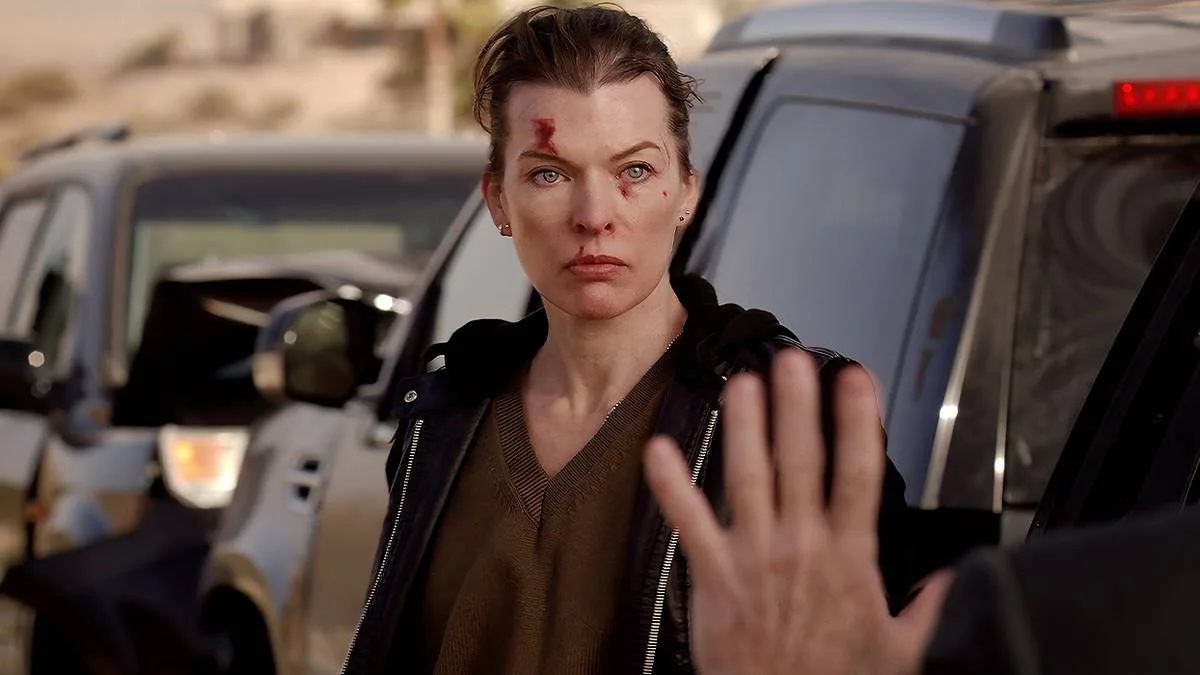
The voice-over narration she delivers throughout is a more complicated proposition. Occasionally it works: a dry observation about pain being temporary while infections decidedly are not, delivered mid-self-surgery, earns a wry smile. More frequently, the narration is over-explanatory, walking the audience through information they have just watched unfold, written in a film noir register that sits oddly against the film’s action-movie DNA. Noir narration implies a world of moral fog, of complicity and ambiguity. Protector is largely uninterested in those shades. The narration and the film occupy different generic spaces and never fully negotiate the gap.
The supporting cast offers little purchase. Isabel Myers as Chloe is given barely enough screen time to register as a person before disappearing into the plot as an object of rescue. Matthew Modine appears as Colonel Lavelle, Nikki’s former commanding officer, in a role that exists primarily to lend the twist some institutional weight. He brings his usual professionalism; the role gives him nothing to do with it. The villains are catalogue entries: “The Butcher,” “The Chairman.” Gabriel Sloyer, playing the latter, is assigned the unenviable task of projecting menace without material. He does not succeed, though through no apparent fault of his own. The local police subplot, in which law enforcement pursues Nikki rather than the trafficking ring operating openly in their city, is wrapped up with such minimal effort that the script appears to briefly forget it was there.
The Better Film That Never Quite Arrived
The casting of Jovovich does shift the avenging-parent formula in ways the film only partially acknowledges. Her vulnerability is rendered more openly than the Neeson template permits; she bleeds, she falters, she stitches herself up in parking lots. The physical toll is present on screen in a way the genre, with its male leads, tends to elide. This is a genuine distinction. It is also almost entirely a function of performance rather than writing. The script has not been conceived with its female lead in mind in any structurally meaningful way; swap the protagonist’s gender and the bones of the film remain unchanged.
Human trafficking serves as the film’s engine of villainy, a recurring device in this particular genre corner. Protector handles it with less sensationalism than some peers, though the screenplay’s repeated use of degrading language toward women, deployed to mark the villains as irredeemably bad, grows wearying well before the final act. Establishing moral stakes once is craft. Repeating the gesture a dozen times is the absence of other ideas.
The film’s law enforcement subplot carries an implicit ideological current: the police as obstruction, the military-trained individual as the only legitimate force. Protector does not interrogate this. It simply operates within it, comfortable in its own politics.
What remains genuinely interesting about the film is the ghost of a better version, one in which the late twist arrived earlier, was given room to breathe, and reorganised the film’s moral geometry with the psychological depth the final minutes briefly promise. The pivot toward something Shyamalan-adjacent, a fractured psyche recast as unreliable narrator, is a genuine creative swing. The film as constructed cannot support it. The scaffolding was never built for that weight.
Protector is a high-octane action thriller that premiered at the 30th Busan International Film Festival on September 19, 2025, before making its theatrical debut in the United States on March 6, 2026. Starring Milla Jovovich as a mother on a mission, the film follows a retired commando who must utilize her lethal skills when her daughter is kidnapped. As of April 2026, the film is currently playing in select theaters across North America and South Korea and is expected to be available on major digital VOD platforms in the coming months.
Where to Watch Protector (2025) Online










Full Credits
Title: Protector
Distributor: Magenta Light Studios, Ascendio Entertainment
Release date: March 6, 2026 (United States), September 19, 2025 (Busan International Film Festival)
Rating: R (for strong violence and language throughout)
Running time: 92 minutes
Director: Adrian Grünberg
Writers: Bong-Seob Mun
Producers and Executive Producers: Matthew Helderman, Ford Corbett, Todd Lundbohm, George Furla, Arianne Fraser, Shaun Sanghani, Kenneth Kim, Ho-Sung Pak, Bob Yari, Bong-Seob Mun, Bang-Ok Joo, Ceasar Richbow, Paul W. S. Anderson, Milla Jovovich
Cast: Milla Jovovich, Matthew Modine, D. B. Sweeney, Don Harvey, Arica Himmel, Michael Stahl-David
Director of Photography (Cinematographer): Vern Nobles Jr.
Editors: Christian Wagner
Composer: Don Cherel
The Review
Protector
Protector gives Jovovich a role she handles with more skill than it warrants, and that gap between performance and material defines the film's central frustration. Grünberg's direction is visually murky and rhythmically uncertain. The script skips over its own action sequences, buries its most interesting idea in the final minutes, and mistakes repetition for emphasis. The twist hints at a psychologically richer film. That film did not get made.
PROS
- Jovovich delivers a committed, physically credible performance
- The twist ending generates genuine retrospective curiosity
- The skateboard setpiece shows flashes of real inventiveness
- Fight choreography, when visible, is grounded and credible
CONS
- Key action sequences happen entirely off-screen
- Direction is visually murky and stylistically inconsistent
- Supporting cast is wasted; villains are paper-thin
- The twist arrives too late to meaningfully redeem the preceding runtime
- Dialogue is flat and over-explanatory
- Mother-daughter relationship never earns its emotional weight