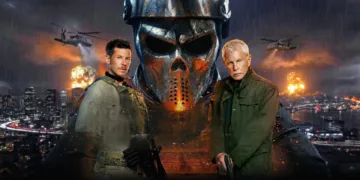































The soldier remains a relic that refuses erasure. Inside modern cinema’s industrial machine, few artifacts have persisted with the stubborn endurance of the Sniper franchise. Across three decades and twelve entries, it has carved out a rare longevity. Sniper: No Nation emerges from the chaos in Costa Verde and places its protagonists in a condition of sudden, total abandonment.
The Global Response and Intelligence Team has been dismantled. Brandon Beckett and Agent Zero have lost their official standing. The government they served has disavowed them. Their refuge is a decaying military base in Terra Nueva, a location that shapes the film’s entire mood.
This is a story about men functioning inside a geopolitical vacuum. The title names their condition with blunt force: soldiers without a state, stripped of backup, stripped of clear orders, forced to face the chill of isolation. The film sets these stakes with cold efficiency.
It sidesteps the polished heroics common to comparable action films and fixes its gaze on survival after institutional erasure. The mission no longer belongs to national interest. It belongs to the preservation of the people abandoned in the ruins. The film discards the comfort of traditional patriotism and settles into the austere reality of the dispossessed.
Hardened Legacies and the Mercenary Logic
Brandon Beckett has moved from impulsive youth into a man shaped by grim experience. Across eight appearances, that evolution feels earned. He carries the fatigue of someone who has lived too long inside the cycle of state-sanctioned violence.
His acting now has a firmer physical command, a presence marked by weight, restraint, and wear. His partnership with Agent Zero gives the narrative its grounding force. Their rapport rests on professional respect and shared trauma, becoming the emotional spine of the story. In a shifting terrain of betrayal, their chemistry supplies the one steady human current.
Thomas Beckett’s return carries historical significance. He is a veteran who understands the cost of their chosen life, offering guidance to his son while helping clear their damaged names. Their exchange concerns inheritance, burden, and the transfer of a heavy torch.
Frost enters as a cynical cleaner, offering sanctuary that feels temporary, fragile, and loaded with conditions. The Iron Legion gives the threat its shape. This mercenary squad moves with brutal, mechanical logic after Roman Diaz hires them to crush the Phoenix Rebellion.
That opposition forces action. The capture of allies such as Zondi and Angel turns the conflict into a personal crisis, shifting the mission into a rescue operation. Beckett must measure loyalty to his team against the instinct for self-preservation. The characters gain definition through these decisions. Their allegiance moves toward individuals, away from institutions that have already discarded them.
The Visceral Mechanics of Treacherous Terrain
Trevor Calverley takes the director’s chair with a cinematographer’s eye, and that background is visible in every frame. The visual palette is cold, spare, and utilitarian, mirroring the desperate condition of the disavowed team. The film emphasizes combat as a physical ordeal. Action has moved toward close-quarters engagements and hand-to-hand struggle, giving the violence a bruising immediacy.

The opening sequence announces this direction through a boat firefight in zero-visibility conditions. Beckett identifies targets through sound while fighting through physical distress. The scene establishes kinetic realism with a sharp, punishing clarity. Limited locations create a pressure-cooker effect, making the audience feel the same isolation imposed on the characters. The camera studies battlefield debris and the frantic motion of men driven to their limits.
The film balances long-range marksmanship with coordinated tactical assaults. These sequences carry a professional detachment that suits the material. The Iron Legion becomes a credible obstacle through heavy armor and disciplined tactics. Their presence makes each encounter feel dangerous. The direction avoids excess ornament and concentrates on movement, positioning, and the impact of each shot. The violence gains weight through this practical attention. Survival feels tangible, difficult, and costly.
Ethics of the Void and the Fractured Resolution
The film’s middle section changes pace with purpose. It gives sustained attention to political dialogue and the logistics of the underground. This planning material underlines the difficulty of operating after state protection collapses. The narrative studies loyalty inside a broken system and asks what remains for a soldier once the cause has been removed. Tension gathers in quiet conversations held in shadowed rooms, where the mental battle becomes as severe as the physical one.
These ideas surface through the team’s attempts to stay ahead of their pursuers. Intelligence gathering becomes a chain of high-stakes gambles. The protagonists depend on their wits and the few allies left within reach. The third act sends them into a high-stakes rescue mission inside Costa Verde. The shift from hiding to action carries mounting dread, giving the operation the feeling of a final descent.
The ending marks a bold break from franchise norms. It withholds tidy resolution and closes on a dark, unsettled note, leaving many characters’ fates uncertain. Splitting the finale into two parts carries real risk. It disrupts the expectation of a self-contained action narrative. The final moments are charged with loss and instability, leaving the protagonists in extreme vulnerability. The cliffhanger points toward a future where traditional victory may have slipped out of reach.
Sniper: No Nation premiered on April 7, 2026, marking the twelfth installment in the long-running action franchise. The film continues the high-stakes journey of Brandon Beckett and Agent Zero, who find themselves disavowed and hunted by their own government following a catastrophic operation in Costa Verde. Forced to operate off the grid, they reunite with the legendary Thomas Beckett for a desperate rescue mission. The movie is currently available to watch on major digital platforms, including Prime Video, Apple TV, and Vudu, and can also be purchased on DVD.
Where to Watch Sniper: No Nation (2026) Online








Title: Sniper: No Nation
Distributor: Sony Pictures Home Entertainment, Destination Films
Release date: April 7, 2026
Rating: R
Running time: 92 minutes
Director: Trevor Calverley
Writers: Sean Wathen, Michael Frost Beckner, Crash Leyland
Producers and Executive Producers: Lance Samuels, Sean Wathen
Cast: Chad Michael Collins, Ryan Robbins, Tom Berenger, Manuel Rodriguez-Saenz, Josh Brener, Nico Panagio, Brandon Auret, Dominique Maher
Director of Photography (Cinematographer): Brendan Barnes
Composer: Daniel Caleb, Sean Ou Tim
The Review
Sniper: No Nation
This film functions as a stark examination of the soldier as a discarded tool. It trades typical heroics for a cold study of survival and loyalty within a political vacuum. The tactical realism and grounded performances anchor the experience. The fractured narrative structure demands patience. It stands as a calculated and somber chapter in a long legacy.
PROS
- Gritty and physical combat choreography.
- Mature character growth for the series lead.
- Effective integration of the elder Beckett.
- High tactical tension in the opening.
CONS
- Significant narrative deceleration in the second act.
- Lack of closure due to the split finale.
- Sparse production scale and repetitive environments.