




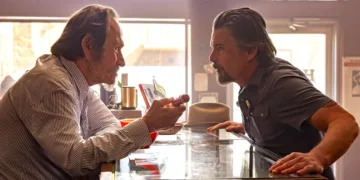






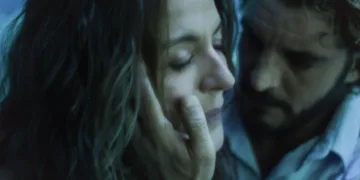











Director Guillaume Canet begins Karma in the hush of a northern Spanish village, where domestic warmth carries the faint glow of a half-remembered refuge. Jeanne, played by Marion Cotillard, shares a slow candlelit dance with Daniel, played by Leonardo Sbaraglia, while Stephen Sanchez’s melodies soften the room around them.
The image suggests peace, yet that peace is already cracked. Jeanne lives with severe alcoholism and recurring anxiety attacks, and the most stable ritual in her life comes from caring each day for Mateo, her six-year-old godson, a child on the autism spectrum.
That fragile order collapses beside the river. During an afternoon outing, Jeanne loses consciousness and wakes to find Mateo gone. The disappearance turns her private disarray into public suspicion. Investigators detect contradictions in her account, and the gaps in her memory place her directly under police pressure. Unable to explain what happened, Jeanne crosses into France, carrying guilt, panic, and the dangerous gravity of an unresolved past.
The Architecture of Confinement
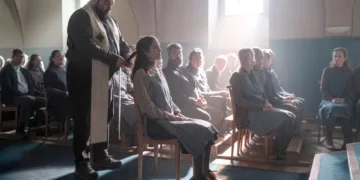
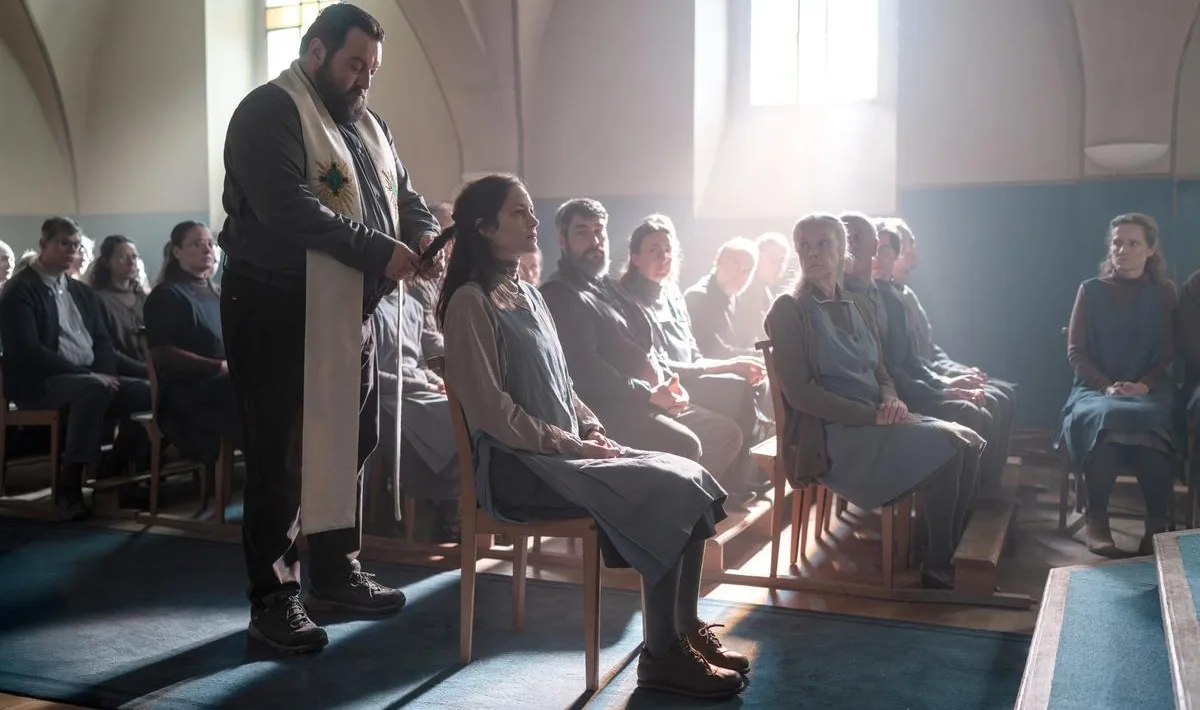
Jeanne’s flight leads her to Saint-Céré, an isolated religious commune in France where she grew up and from which she escaped seven years earlier. Founded in 1963 by three families, the community has preserved itself through generations of insular marriage, a closed social organism feeding on obedience and repetition. Its rules are severe. Children live apart from their parents, who receive a brief fifteen minutes of daily contact. Family, in this world, becomes a rationed privilege.
The film’s physical spaces make that ideology visible. Stables, dormitories, and factory workrooms feel stripped of softness, arranged with a cold practical austerity that presses against the body. The production design gives Saint-Céré the texture of deprivation: plain surfaces, narrow routines, and architecture that seems built to drain individuality from anyone trapped inside it.
Inside this setting, Karma makes its sharpest structural turn. The missing-person mystery gives way to a direct study of an abusive cult system. The change reshapes the film’s rhythm. Once Jeanne arrives, the commune’s nature is exposed with little delay, and the earlier uncertainty drains from the story. What begins as a tense domestic thriller, dense with fractured memory and moral doubt, becomes a clear account of religious coercion and captivity.
That clarity weakens the suspense. The commune’s menace arrives fully announced, leaving limited room for discovery. The film asks the audience to watch subjugation, endurance, and escape play out along familiar lines. The psychological puzzle that first gives the story its charge loses force as the narrative settles into a plainer register of institutional cruelty.
The Weight of Screen Presence
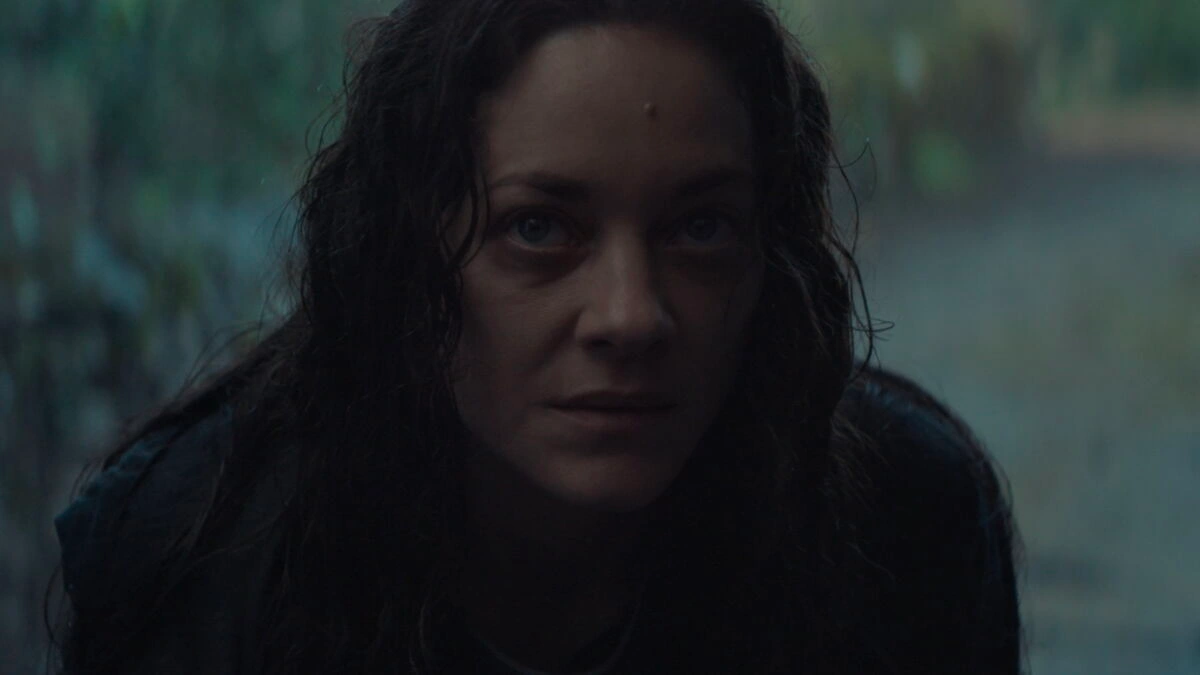
Much of the film’s dramatic power rests on three performances asked to carry material that often feels thin on the page. Marion Cotillard gives Jeanne a body shaped by fatigue and dread. Her work is intensely physical: lowered posture, watchful stillness, sudden eruptions of pain that seem torn from a place long kept sealed. Even when the script loses tension, Cotillard holds the frame with the force of someone trying to keep collapse at a distance.
Denis Ménochet brings a colder discipline to Marc, the commune leader. His performance avoids theatrical excess. Marc smiles, speaks calmly, and wraps domination in the language of spiritual care. The menace comes from restraint, from the way control appears settled into him as habit. Ménochet makes Marc disturbing because his authority feels practiced, social, almost administrative in its cruelty.
Leonardo Sbaraglia gives Daniel a stubborn, driven quality as he follows Jeanne across borders and risks legal trouble to uncover the hidden life she left behind. Daniel’s devotion has weight because Sbaraglia plays it as action rather than speech.
The screenplay gives little history to the bond between Jeanne and Daniel. Their first meeting remains absent, and the source of their endurance through crisis stays largely unwritten. The emotional stakes depend on the actors’ faces, voices, and silences, with the cast supplying layers the text leaves bare.
Textures of Light and Noise
The film’s strongest formal language comes through Benoît Debie’s cinematography. His camera often moves close to Cotillard’s face, searching for flickers of fear, shame, and trauma before they become spoken emotion. These close-ups give Jeanne’s psychological deterioration a visible texture, turning inner fracture into minute physical evidence.
Debie also uses the surrounding environment with a clear symbolic eye. A sequence in which Daniel stops his car in thick fog creates one of the film’s most striking images. The headlights divide the frame, throwing confusion and isolation into stark visual form. The scene understands how uncertainty can occupy space, how weather and light can become extensions of a damaged mind.
The sound design proves less controlled. The score leans heavily on electric keyboard and thick organ tones, often pressing too hard against the drama. Music floods domestic scenes and competes with the quieter work of the performers. The soundtrack tells the audience what to feel with a force that flattens the delicacy of Cotillard’s and Sbaraglia’s exchanges.
That heavy sonic pressure pushes the tragedy toward artificial melodrama. The camera seeks tremors, glances, and fractured stillness; the music announces anguish in broad strokes. The result is a film whose visual intelligence repeatedly suggests a subtler and harsher work than the one shaped by its louder dramatic instincts.
The psychological thriller premiered on May 15, 2026, at the Cannes Film Festival. Viewers can watch the production through its French distributor, Pathé, while international distribution options remain under development. Netflix participated in the production of the feature, providing a streaming framework for select regions as commercial expansion continues.
Full Credits
Title: Karma
Distributor: Pathé, Netflix
Release date: May 15, 2026
Running time: 149 minutes
Director: Guillaume Canet
Writers: Guillaume Canet, Simon Jacquet
Producers and Executive Producers: Gregory Jankilevitsch, Geneviève Lemal, Klaudia Smieja
Cast: Marion Cotillard, Leonardo Sbaraglia, Denis Ménochet, Luis Zahera, Aron Ramo
Director of Photography (Cinematographer): Benoît Debie
Editors: Laure Gardette
Composer: Yodelice
The Review
Karma
Karma functions as an uneven vehicle driven by exceptional performances rather than structural depth. The script trades a sharp psychological mystery for a predictable narrative of confinement, dampening the early narrative impact. Benoît Debie’s close-up camera work stabilizes the visual space, yet an intrusive keyboard score frequently compromises the dramatic tension. It stands as a compromised exercise in tension, relying on the immense screen presence of Marion Cotillard and Denis Ménochet to sustain its narrative weight.
PROS
- Marion Cotillard's intense physical portrayal of suppressed agony.
- Denis Ménochet's quiet, menacing depiction of leadership without theatrical clichés.
- Benoît Debie's precise camera work capturing intimate facial micro-expressions.
CONS
- A major structural pivot that sacrifices psychological mystery for a routine cult plot.
- Thin script mechanics that leave key character relationships without foundational backstory.
- An overbearing, intrusive keyboard score that pushes subtle scenes into manufactured melodrama.