












The remote marshlands of the French countryside give Léa Mysius’s The Birthday Party a severe and watchful landscape, a place where silence seems to have weight. Adapted from Laurent Mauvignier’s novel, the film turns a surprise 40th birthday gathering into a rural snare, tightening domestic space until celebration curdles into exposure.
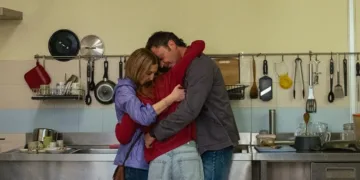
The household contains Nora, an executive at the regional planning authority facing severe professional anxiety and an impending promotion; Thomas, a dairy farmer slowly crushed by the inherited property he can barely sustain; and Ida, their perceptive preteen daughter. Nearby stands the home and workplace of Cristina, a wealthy Italian painter whose minimalist, cavernous studio sits like a cool architectural rebuke to the farm’s cluttered distress.
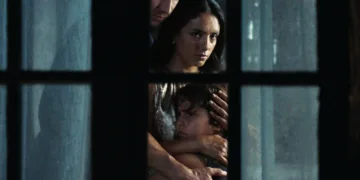
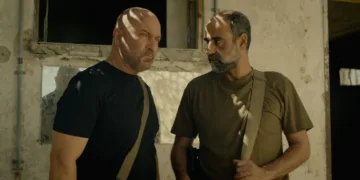
The crisis begins with casual innocence. Ida uploads a social media video of the family dancing in the barn, and the clip attracts tens of thousands of views. The digital glare sends Nora into immediate panic. That panic becomes prophecy when three armed brothers, Franck, Flo, and Bègue, arrive at the property to force Nora into a reckoning with a deeply buried former life.
Character Dynamics and Narrative Construction
The screenplay builds pressure through the excavation of domestic secrecy, shaping its early passages as a slow psychological siege before the invasion acquires physical form. Long before the brothers enter the home, the family has already begun to fracture.
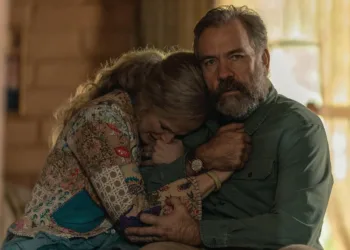
Thomas carries a crushing hidden debt, borrowing repeatedly to keep the farm alive, and his estrangement appears in his visits to prostitutes on the way home from gathering party supplies. Nora’s rigid professional surface conceals a complete evasion of her husband, with a rose tattoo on her body serving as a mute sign of another history.
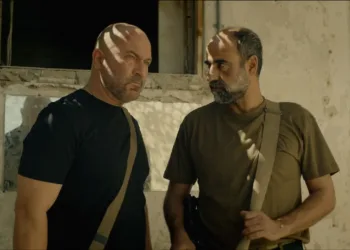
Franck, Flo, and Bègue arrive as strategic intruders, armed with precise knowledge of the family’s financial collapse and personal background. Their threat comes from intimacy, from the grotesque feeling that the private self has been inventoried by hostile hands. The narrative then divides into two psychological territories. Inside the farmhouse, Franck moves with slow, calculating assurance, pressing Nora into repeated denials of her original identity as Leila.
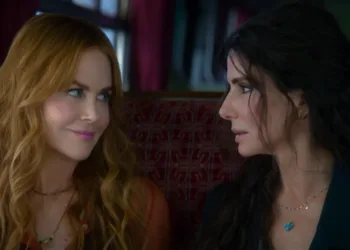
Across the yard, Cristina’s open-plan studio becomes the site of a quieter test of control. Left with Bègue, the most unstable and intellectually fragile brother, Cristina quickly reads his hunger for validation. She occupies the room with deliberate calm, using a shared joint, wine, and music to soften his aggression.
Her sympathetic cooing over the insults he receives from his siblings turns his low confidence into a fragile aperture for survival. The scene gains its force from how performance becomes defense, a social ritual converted into a tactical language.
The script’s architecture weakens once the tension needs sustained intensification. Awkward circumstantial subplots intrude on the design. The sudden arrival of Nora’s oblivious office coworkers pushes the characters into a stretch of strained, implausible play-acting, breaking the claustrophobic pressure the film has so carefully assembled. These choices blunt the suspense and pull the story from intimate psychological combat toward a familiar, extended hostage situation.
Technical Execution, Cinematography, and Visual Language
The film’s visual and auditory design carries much of its moral temperature. Cinematographer Paul Guilhaume gives the rural world a distinct texture, bathing the marshlands in steel-blue gloom and grainy, high-contrast light. The image draws on Goya’s artistic philosophy about nature’s absence of true color and its constant struggle between bright sun and deep shadow. That idea suits a film obsessed with hidden lives, false surfaces, and the violence produced by concealment.
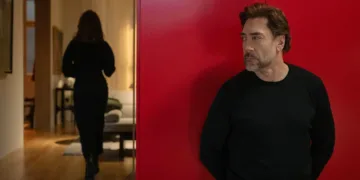
Space itself becomes an instrument of unease. The film depends on the charged relation between Nora’s dense, chaotic farmhouse and Cristina’s minimalist modern studio, an extension of glass and steel. Mysius studies the flashes of light and muffled sounds that cross the empty yard between the two homes, making architecture feel nervous, porous, and accusatory. Distance becomes a medium through which danger travels.
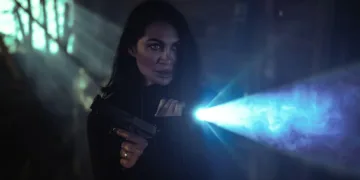
The blackness of night in Western France supplies a field for sharp, artificial wounds of color. The frame is pierced by blinking red indicators on distant wind turbines and by the bright blue tracksuit worn by Bègue. These visual interruptions echo the rupture of the family’s quiet routine, keeping menace alive inside the image even during moments of stillness.
The film’s most audacious formal gesture arrives in a surreal sequence that departs from standard genre grammar. The camera sweeps suddenly between the two households, draining color from the screen until the image turns black and white.
The characters appear in a strangely textured, static formation produced through thousands of detailed 3D scans. This tableau freezes everyone in time, giving visual form to the paralysis created by systemic lies. Family members and captors become trapped inside a monochrome purgatory, and the domestic arrangement reveals its buried rot with brutal clarity.
Performance Analysis and Third-Act Critique
The film’s uncomfortable atmosphere depends strongly on the sharply different acting registers of its principal cast, and those achievements remain vivid even as the final act exposes severe limitations. Hafsia Herzi gives Nora a powerful emotional austerity. Her flinty gaze and quiet, pained, whispered delivery communicate internal shame with remarkable precision. She balances vulnerability with a fierce protective instinct, keeping feeling buried just below the surface as Nora bargains for her daughter’s safety.
Monica Bellucci brings magnificent control to Cristina, giving the lonely, melancholy artist a regal stillness and a deep regret tied to her own past parenthood. Her scenes with Bègue carry a dangerous elegance. Through gaze, measured voice, and careful attention to his need for approval, she disarms a volatile criminal by making manipulation look almost tender.
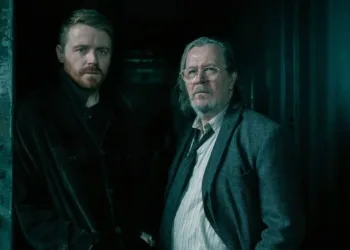
Opposite her, Benoît Magimel gives Franck an imposing physical authority. In semi-transparent shades and a tan suit, the older brother who commands the group radiates menacing flamboyance, making his quiet words land with chill force. Alane Delhaye answers that energy with a twitchy, raffish portrait of Bègue, turning psychological instability into something visibly electric.
The third act suffers a severe structural collapse. The carefully accumulated momentum dissipates under implausible screenplay choices that strain basic credibility. The writing leaves its realistic psychological method behind, pivoting into forced symbolism and conventional action gestures that arrive with little impact.
The finale’s credibility is damaged by specific narrative failures. A character receives a fatal gunshot wound and suspends the bodily reality of that injury long enough to address personal emotional issues and matters of the heart. Another character abruptly reveals expert rifle proficiency, landing shots that feel imported from a traditional Western. The sudden leap in ability feels unearned and convenient, violating the world’s established rules and weakening the realism needed for a truly devastating ending.
The Birthday Party is a tense French suspense drama that recently made its global premiere in the official competition section at the Cannes Film Festival on May 22, 2026. Following its major festival debut, the movie is scheduled for a wide theatrical rollout in France by distributor Le Pacte on September 16, 2026, while the distribution company 1-2 Special has secured the North American rights for its subsequent release across international markets.
Full Credits
Title: The Birthday Party (Histoires de la nuit)
Distributor: Le Pacte, 1-2 Special
Release date: May 22, 2026
Running time: 114 minutes
Director: Léa Mysius
Writers: Léa Mysius, Laurent Mauvignier
Producers and Executive Producers: Jean-Louis Livi, Marie-Ange Luciani
Cast: Hafsia Herzi, Benoît Magimel, Bastien Bouillon, Monica Bellucci, Tawba El Gharchi, Paul Hamy, Alane Delhaye, Servanne Ducorps, Tatia Tsuladze
Director of Photography (Cinematographer): Paul Guilhaume
Editors: Yorgos Lamprinos
Composer: Florencia Di Concilio
The Review
The Birthday Party
The Birthday Party functions as a technically precise, atmosphere-heavy exercise in tension that unfortunately surrenders its psychological sharpness to genre conventions. Léa Mysius demonstrates a masterful control over visual language and early character friction, but the narrative momentum stalls under the weight of an implausible, trope-reliant final act. Strong performances provide grounding, yet the conclusion feels engineered rather than earned.
PROS
- Restrained, deeply layered performances from Hafsia Herzi and Monica Bellucci.
- Moody, high-contrast chiaroscuro cinematography by Paul Guilhaume.
- A highly effective, slow-burn setup that establishes authentic domestic dread.
CONS
- A wobbly third act filled with screenwriting clichés and unrealistic character actions.
- Awkward, momentum-killing subplots that disrupt the claustrophobic hostage scenario.
- Predictable narrative progression that flattens the complexity of the invaders.