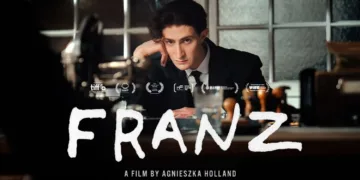


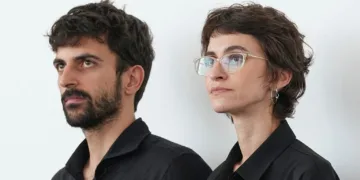
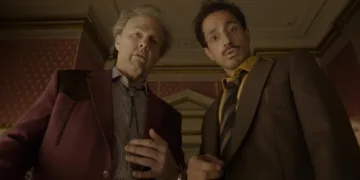
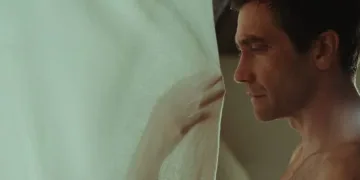
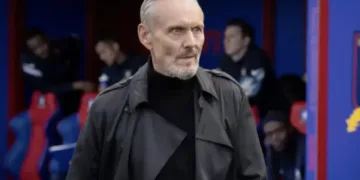










A manuscript, meant for the fire, survives its own death sentence. This is the central paradox from which the specter of Franz Kafka emerges, and it is the wound Agnieszka Holland’s film Franz picks at with relentless, feverish energy. What does it mean to witness a life that demanded to be forgotten? Holland’s work is not a portrait but an autopsy, a séance that summons its subject against his will.
The film rejects the neat causality of biography for the splintered logic of a nightmare, presenting a life not as a line to be followed but as a space to be haunted. It is an act of profound and unsettling archaeology, digging through the layers of myth to find a man, only to discover that the myth has already consumed him. At the center of this temporal vortex is Idan Weiss’s Kafka, a figure of such quiet transparency he seems perpetually on the verge of vanishing.
The Tyranny of the Camera’s Eye
Holland’s formal approach is an assault on narrative cohesion, a deliberate shattering of the biopic’s comforting illusions. The film’s structure is a non-chronological cascade of moments, where the shame of a childhood swimming lesson bleeds directly into the manufactured reverence of a modern museum tour.
This temporal collapse suggests a grim determinism, a universe where every past humiliation is a prelude to a posthumous one. The camera is an active participant in this psychic disturbance. Its sudden, violent crash zooms mimic a gasp or a moment of intrusive panic, refusing to let us settle. The visual texture feels brittle, as if the celluloid itself is about to snap under the strain of its subject’s anxiety.
This sense of being perpetually observed is amplified by the film’s most direct violation: the fourth-wall break. Figures from Kafka’s life—his sister, his friend Max Brod, his fiancée Felice—turn their gaze upon us. They are not merely narrators; they are witnesses in a trial that never ends, their testimonies building a prison of remembrance.
Their faces, caught in documentary-style interviews, are masks of memory, speaking from a strange limbo. The anachronistic pulse of indie rock on the soundtrack serves as another layer of disorientation, a reminder that the future is always listening, always ready to appropriate the past for its own melancholic purposes.
The Specter in the Marketplace
Amidst the structural chaos, a fragile image of the man takes shape. Idan Weiss portrays Kafka not as a tortured genius in the romantic sense, but as a being whose very physical existence feels like an apology. His body is a question mark, hunched against the anticipated blows of the world, whether from his overbearing father or the indifferent bureaucracy of the insurance office.

This father-son dynamic is presented as the film’s primal wound, a relentless force of patriarchal judgment that shapes Kafka’s perception of all authority, human and divine. His romantic entanglements are extensions of this failure to connect. They are desperate epistolary projects, attempts to build a bridge of words across a chasm of alienation, doomed to collapse under the weight of his own fear.
This intensely private man, who lived through the mediated intimacy of letters, is then subjected to the ultimate exposure. Holland’s sharpest critique is reserved for Kafka’s legacy, the grotesque second life he was forced to endure.
The film’s cuts to present-day Prague reveal a world where his name sells coffee mugs and fast food. “Kafka Burgers” is not a throwaway joke; it is a moment of profound metaphysical horror. It represents the final, absurd stage of commodification, where a unique and tormented consciousness is rendered into a digestible, marketable product. The man’s soul becomes a trinket, his dread a tourist attraction. His existence is a brand, and we, the viewers of this film, are its complicit consumers.
The Harrow’s Beautiful Failure
Holland’s maximalist cinema is a dangerous, unstable compound. By throwing every conceivable technique at the screen, she creates a film that pulses with a restless, intellectual energy. It is never boring. It is, however, emotionally remote.

The constant formal invention can feel like a shield, protecting us from the raw pain of the life it depicts. It is a work that deconstructs its subject so thoroughly that, at times, only the fragments remain. This ambitious method leaves little room for quiet contemplation, often sacrificing emotional resonance for conceptual brilliance.
Yet, this very brokenness might be the film’s most honest gesture. A polished, coherent biopic of Franz Kafka would be a lie. The film’s success is found in moments where its chaotic style perfectly fuses with its subject’s singular vision. The sequence depicting a reading of “In the Penal Colony” is the work’s dark, beating heart.
As Kafka’s calm voice narrates the story’s clinical brutalities, Holland visualizes the Harrow, the intricate torture machine, with terrifying clarity. We see the audience’s polite revulsion juxtaposed with the serene, almost ecstatic expression on the author’s face. It is here that the film transcends analysis and becomes a pure conduit for the Kafkaesque worldview: an aesthetic appreciation for the terrifying logic of impersonal systems.
Franz is a necessary failure, a film whose flaws are inseparable from its virtues. It attempts an impossible task and, in its ragged, brilliant, and incomplete state, it reveals more about the void between a life and its story than any conventional success ever could. Does it, in the end, participate in the very violation it critiques? Perhaps. And perhaps that is the point.
Elaboration on the ‘In the Penal Colony’ Scene
The sequence visualizing “In the Penal Colony” is a masterful piece of cinematic translation. Holland presents Kafka at a public reading, his gentle voice describing the story’s ghastly centerpiece: a torture and execution device known as the Harrow.

The film cuts away from the polite, increasingly horrified faces of the audience to a direct, unflinching depiction of the machine at work. The camera lingers on the cold steel, the massive needles descending upon a victim’s body, and the mechanism designed to etch the law one has broken onto their skin until they die. The scene is shot with a cold, almost surgical precision that mirrors the prose.
The power of the sequence comes from its layering: the civilized setting of the literary salon, the gruesome reality of the imagined punishment, and Kafka’s own beatific expression as he narrates. It is the one moment where the film stops analyzing Kafka and instead embodies the chilling logic of his imagination.
Franz is a biographical drama film that follows the life and work of the writer Franz Kafka, from his birth in 19th-century Prague to his death in 1924. Directed by Agnieszka Holland, the movie had its world premiere at the Toronto International Film Festival on September 5, 2025. It is also set to be released in Czech cinemas on September 25, 2025, and in Germany on October 23, 2025. It has been selected as Poland’s submission for the Best International Feature Film at the 98th Academy Awards. At this time, it is not available to watch on demand.
Full Credits
Director: Agnieszka Holland
Writers: Agnieszka Holland, Marek Epstein
Producers and Executive Producers: Agnieszka Holland, Šárka Cimbalová, Mike Downey, Kevan Van Thompson, Daniel Bergmann, Jeff Field, Emir Külal Haznevi, Uwe Schott, Jorgo Narjes, Marcin Wierzchosławski, Alicja Jagodzińska-Kałkus
Cast: Idan Weiss, Jenovéfa Boková, Peter Kurth, Ivan Trojan, Sandra Korzeniak, Carol Schuler, Sebastian Schwarz, Aaron Friesz, Katharina Stark, Josef Trojan, Jan Budař, Emma Smetana
Director of Photography: Tomasz Naumiuk
Editors: Pavel Hrdlička
Composer: Mary Komasa, Antoni Komasa Łazarkiewicz
The Review
Franz
Agnieszka Holland's film is a daring, intellectually furious experiment that succeeds in capturing the spirit of its subject by shattering the vessel of conventional storytelling. It is a work of immense formal ambition and thematic weight, though its relentless deconstruction keeps the viewer at a clinical distance, admiring the intricate machinery of a life without fully feeling its tragedy. Franz is a brilliant, cold, and necessary cinematic autopsy, a film that values its unsettling questions far more than any comforting answers. It is a profound and difficult work.
PROS
- Formally inventive, avoiding the tired clichés of the biographical genre.
- A deeply intellectual and thematically rich exploration of its subject.
- Features a subtle, compelling central performance by Idan Weiss.
- Successfully translates the disorienting, absurd nature of Kafka's worldview to the screen.
- Offers a sharp critique on the commodification of an artist's legacy.
CONS
- The approach creates an emotional distance from the characters.
- Its relentless stylistic tics can feel alienating and overwhelming.
- The fragmented narrative structure hinders a deep emotional connection.
- At times, it feels more like an academic thesis than a human story.