

















![Kingdom Hearts Collection [I-III] Review](https://gazettely.com/wp-content/uploads/2026/10/Kingdom-Hearts-Collection-I-III-1-360x180.webp "Kingdom Hearts Collection [I-III] Review: KHII Holds Steady as Newer Entries Fluctuate 33")







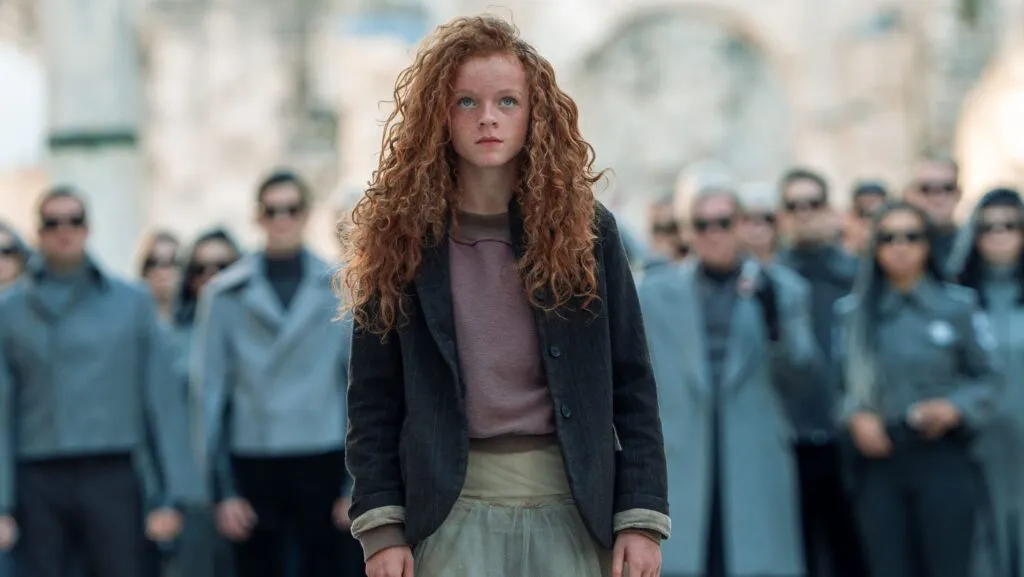

Light behaves differently in the world of Momo. In the sun-bleached ruins of an amphitheater, it pools and softens, clinging to the warm stone. It is a tangible presence, a measure of the day’s slow passage. Elsewhere, in the city’s newly efficient corridors, light becomes sharp, clinical, and gray, casting hard-edged shadows that seem to consume the space around them.
Christian Ditter’s film begins with this visual schism, a world cleaving into two distinct aesthetic philosophies before a single plot point is established. At the center of the warmth is Momo, a young orphan whose function is not to act but to exist. Her profound gift for listening creates a gravitational field of community.
Into this field step the Grey Men, figures of pure function who move through the world like incisions. They are agents of a new kind of temporal economy, promising a future built from the sacrificed moments of the present. The story is thus framed as a battle over the very quality of light, a struggle between the textured, lived-in moment and the flat, sterile plane of perpetual productivity.
The Currency of the Present
The methodology of the Grey Men is a masterpiece of psychological predation. They are otherworldly entities, rendered not as monsters but as the ultimate bureaucrats, their presence draining the color from the frame. Their weapon is a seductive piece of technology, a glowing bracelet that gamifies existence, persuading the populace to bank their “wasted” time.
It is a modern Faustian bargain offered at a kiosk. The film smartly updates the novel’s critique of finance capitalism, transmuting it into a more insidious commentary on the contemporary cult of self-optimization. The enemy is no longer a caricature of a greedy banker but the digital panopticon in which we are all encouraged to perform our own efficiency, our lives reframed as a series of metrics to be improved.
Momo’s friend Gino becomes the primary case study, his earnest ambition weaponized against him. Seduced by the promise of an audience, he is transformed into a lonely influencer, his life force transmuted into a sterile stream of digital content for unseen consumers. His story serves as a bleakly accurate parable for the hollow rewards of a quantified self, a soul sold for engagement. Yet, for all its thematic relevance, the film’s central mechanism remains a frustrating abstraction.
The physics of its own metaphysics are never defined. Time is stolen, but the script is uninterested in the particulars, leaving the process feeling less like a tangible threat and more like a vaguely menacing corporate wellness program. This lack of a rigorous internal logic is a critical flaw, reducing the stakes from a cosmic battle to a philosophical disagreement.
The Listener at the Story’s Center
Momo functions as the story’s unmoving moral center, a fixed point in a world spinning out of control. Her power is stillness, a passive resistance in a society obsessed with acceleration. This makes her a fascinating but deeply problematic cinematic protagonist.

Film is a medium of action and change, yet Momo’s primary function is to absorb the chaos of others through her quiet, unwavering presence. She is less a character on a journey and more an existential position, a living embodiment of “being” in a world that only values “doing.” The script presents her as a figure of pure virtue, a determined agent of good from the first frame. This choice denies her any meaningful internal arc. She has no doubts, no selfish desires, no past to reconcile. She is a symbol, and symbols do not grow.
Alexa Goodall’s performance provides a charismatic surface; her striking features and bright, curious eyes command the camera’s attention. The screenplay, however, offers her little beneath that surface to explore, locking her into a state of unwavering, one-note resolve. Her allies exist purely as narrative functions.
Beppo, the elderly street sweeper, is an archetype of mindful labor, a man who measures his life in breaths and steps rather than in minutes. He grounds her in a physical, deliberate world. Later, the eccentric Master Hora appears, a necessary if slightly tired device. He is the whimsical wizard from central casting, arriving just in time to deliver a crucial dose of exposition, explaining the rules of a game the film has been hesitant to define.
A Spectacle Against the Clock
Visually, the film is a study in contrasts. Director Christian Ditter and his cinematographer construct a world of striking dichotomies. The warm, ochre tones and soft, diffused light of Momo’s amphitheater stand in stark opposition to the cold, desaturated palette of the city under the Grey Men’s influence.
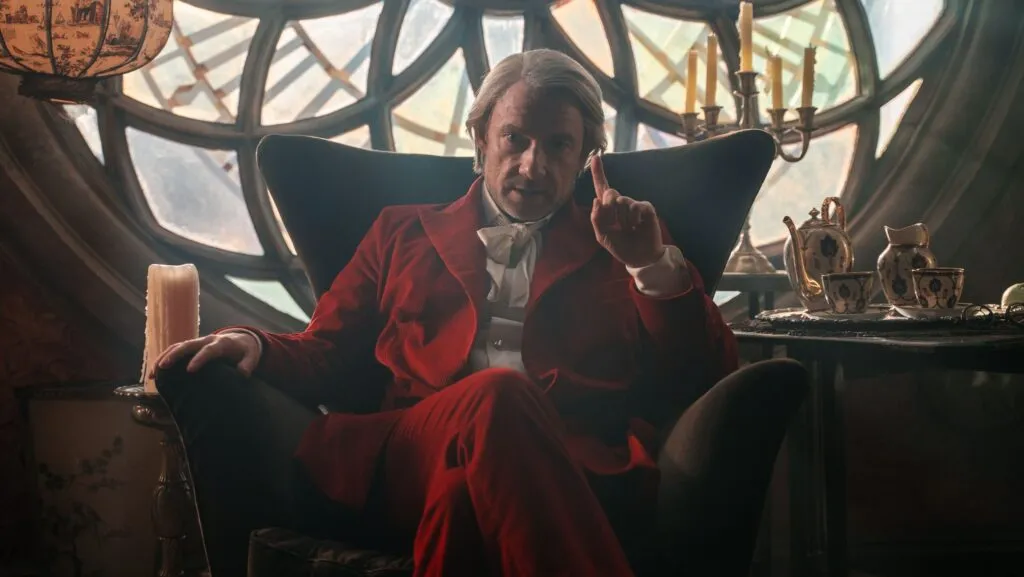
Their domain is one of hard lines, sterile surfaces, and expressionistic shadows that recall a German Expressionist nightmare. As their control grows, the camera’s framing becomes more rigid, more symmetrical, trapping characters in compositions that emphasize their powerlessness. The production design is frequently impressive, a polished and expensive-looking façade.
There is, however, a deep, structural irony at play. A film whose central thesis is the virtue of slowing down is itself in a breathless hurry. It sprints through its ninety-minute runtime, its editing favoring a frantic energy that allows no single moment to breathe. This rushed pacing actively undermines its philosophical weight, creating a jarring dissonance between form and function.
The film tells you to stroll while it runs a marathon. Consequently, the commentary feels superficial, blaming a vague self-optimization mania while sidestepping the deeper economic anxieties that make people feel their time is a resource to be hoarded. The resolution is a neat, unearned return to the status quo, a narrative reset button that ignores the systemic rot the story briefly exposed. It is a hollow victory in a beautifully crafted but empty frame.
Momo is the 2025 fantasy film adaptation of Michael Ende’s beloved best-selling novel of the same name. Directed by Christian Ditter, the story centers on Momo, a young orphan girl who lives in the ruins of an old Roman amphitheater. She possesses the special gift of truly listening to people. When the mysterious Gray Masters—a powerful corporation that secretly steals time from humans—begin to invade the city, Momo, along with the timeless Master Hora, must embark on an adventure to save the time of humankind. The film had its world premiere as a gala presentation at the Zurich Film Festival and is scheduled for theatrical release in several territories, including Germany and Switzerland, starting in October 2025. Streaming availability in the United States and other regions will follow the theatrical run.
Full Credits
Director: Christian Ditter
Writers: Christian Ditter, Michael Ende (original novel)
Producers and Executive Producers: Christian Becker, Rat Pack Filmproduktion, Constantin Film, Pakt Media
Cast: Alexa Goodall, Araloyin Oshunremi, Claes Bang, Laura Haddock, Martin Freeman, Kim Bodnia, Jennifer Amaka Pettersson, David Schütter
Composer: Fil Eisler
The Review
Momo
Momo is a visually stunning paradox. It presents a philosophically rich fable about the value of time with breathtaking craft, contrasting warm, lived-in spaces with cold, expressionistic dystopia. However, its narrative sprints through the very ideas it asks us to savor. The film's impressive spectacle is undermined by a shallow thematic exploration, a rushed pace, and a protagonist who functions more as a static symbol than a person. It is a beautiful clock with missing gears: mesmerizing to look at, but it fails to truly capture the essence of time.
PROS
- Visually impressive with strong production design and cinematography.
- A relevant and timely update of the source material's themes for the social media age.
- Features a charismatic lead performance from Alexa Goodall.
CONS
- The philosophical commentary remains surface-level and underdeveloped.
- A rushed, frantic pacing that contradicts the film's message about savoring time.
- The protagonist lacks an internal arc, functioning more as a symbol than a character.
- Core plot mechanics are left vague and abstract.