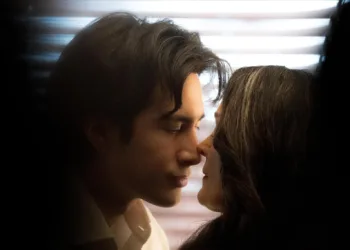








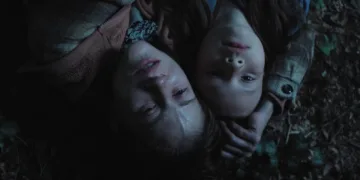














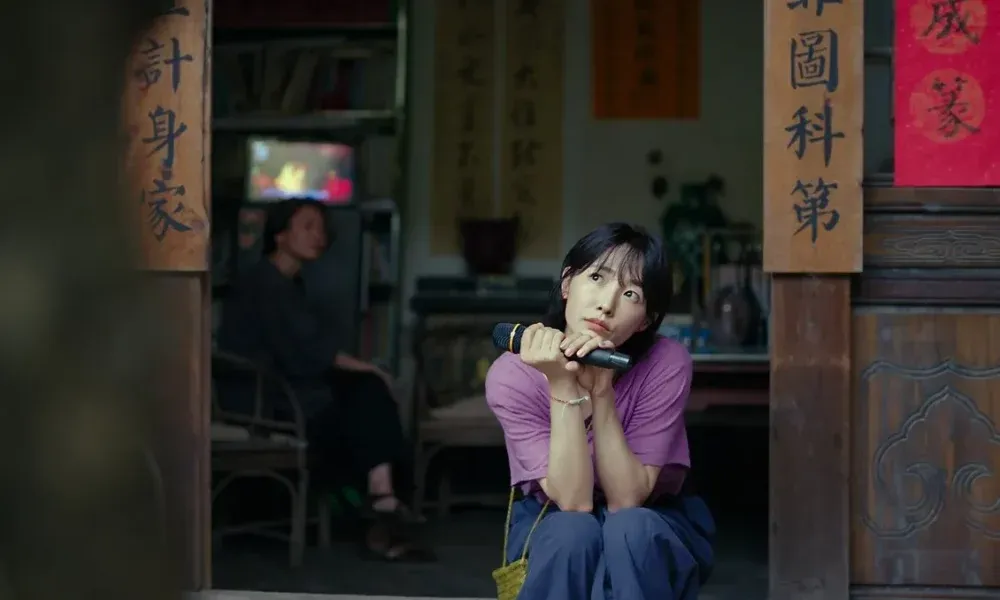

Zhang Lu often stages intense emotional crises against shifting borders and changing landscapes, but Gloaming In Luomu concentrates that scale inside one fragile psyche. The film eases in with stillness, a settled, gently melancholic quiet that feels closer to a game that loads you into a space and lets you breathe before it asks you to move. Bai, played by Bai Baihe, is a former dancer who carries the wreckage of a career damaged by alcoholism.
Her reason to move arrives three years late in the form of a cryptic postcard from her missing boyfriend, Wang, mailed from the remote historic town of Luomu in Sichuan province. Her trip to Luomu functions less like a detective case and more like a personal pilgrimage toward a final state she cannot yet name. The town itself quickly takes on the quality of a design framework for that inner shift. “Gloaming” names the soft, fading light of dusk just before darkness, a brief and unstable interval.
The film lives inside that zone of suspension, neither day nor night, neither full presence nor complete absence, and it treats that limbo as its main dramatic engine. Plot reveals give way to an emphasis on mood, a thick ennui and emotional stasis shared by people who drift through Luomu. Bai’s quiet pursuit of someone who may never reappear turns what could look like a simple travel story into an extended study of grief that has stalled and refuses to move forward.
The Weight of Unresolved Trauma and Shared Solitude
The film tracks how people live with catastrophe by keeping its focus on unresolved emotional damage. Bai’s search for Wang quickly fuses with her need to seal off her own fractured history. Her dependence on alcohol, which halted her progress as a dancer, hangs over every choice she makes and shapes the way she moves through Luomu.
Her aimless walking through the town plays like an external map of internal agitation, a kind of slow open world where the objective never quite appears on the screen. She does not remain alone. The local inn pulls her into an unwanted little party of companions who gather around that space.
The focal figure in this party is the innkeeper, Liu, played by Liu Dan, a former philosophy professor from Harbin. Liu carries herself with worldly ease, often with a glass of wine in hand, and channels an intellectual kind of sadness that feels carefully curated. The film pairs her with Bai as immediate spiritual kin.
Both women work through private darkness and turn to alcohol for relief that never fully delivers. Their conversations have a distinctive rhythm. Exchanges are brief, circuitous and filled with small talk that appears trivial on the surface. Over time those seemingly idle lines start to chip away at the protective shells each woman maintains and expose the buried stories and emotional weight they carry.
Zhang Lu threads in sharp little bursts of levity that stop the melancholic tone from suffocating the characters. The film is dotted with odd moments, including a scene built around a strange singing cup and another where characters break into a sudden dance to a techno driven version of the Korean folk song “Arirang.” These eccentric beats work like surprise mechanics that interrupt the monotone of despair and remind the viewer that spontaneity still exists in these lives.
Longing, the search for connection and the feeling of living between a closed past and an uncertain future shape the emotional design. The film suggests that human contact, however brief or accidental, supplies the only reliable light inside this encroaching gloom. Bai and Liu, joined by the local drunk Peng and the inn assistant Huang, form a fragile, short lived community built on shared solitude and a quiet recognition of each other’s pain.
The Director’s Hand: Pacing, Tableau, and Ambiguity
Gloaming In Luomu stands as a clear expression of Zhang Lu’s style, visible first in the demanding pace and careful compositions. The director stretches time with a glacial rhythm and consistently treats mood as a higher priority than action.

The viewing experience asks for patience and rewards it with immersion in a thick atmosphere. The film carries a literary sheen and relies on a chain of static tableaux that feel composed with meticulous care. Many shots resemble paintings or theatrical stage pictures, which gives the film a sense of controlled observation that can come across as slightly stage bound.
Luomu carries historical and cultural weight, but Zhang refuses to let the setting swallow the intimacy of the drama. The town functions as a significant Buddhist site and trekking base, and it holds its own quiet history. References to author Lu Xun and to the May Fourth Movement slip in as faint threads within the setting. They stay there, as texture. The director fixes attention on the present tense inner conflicts of the characters and resists turning the film into an essay about national history.
The most striking stylistic choice lies in the film’s commitment to deep ambiguity, where firm lines between reality and hallucination begin to dissolve. Bai’s state of mind, shaken further by heavy drinking, appears through conversations with a spectral figure and through sounds that intrude without visible sources.
Non diegetic audio elements, such as the distant roar of trains, the pounding of horse hooves and the whispers of Wang’s voice, repeatedly slide into the soundtrack. These cues disturb the viewer’s trust in what appears on screen and hint that Bai may be moving through a personal form of purgatory or through an anxious mental landscape that she projects onto Luomu.
The town turns into a liminal game space in which memory and fantasy occupy the same field. The design recalls narrative focused games that let environments warp in response to a fragile protagonist, where every corridor and sound cue nudges the player deeper into a mind in crisis. The film ends on an enigmatic image of Bai making a small but decisive choice about the way ahead. That final move gathers the central tension into a single gesture, the pull between a life frozen by past harm and a cautious step toward something quieter and more hopeful.
Cinematic Architecture: Blue Visuals and Emotional Soundscapes
The film’s emotional power arrives through a tight fusion of technical craft, which turns Luomu into a full character and makes Bai’s inner life visible. Piao Songri’s cinematography stands out for its exquisite polish. Images feel lush and evocative, capturing the quiet beauty of the town while maintaining a certain distance through their calculated precision.
The camera usually stays still or hangs back, watching Bai from afar as she drifts through streets and alleys. That preference for distance reinforces her isolation, as if the film builds a gap between character and viewer into the visual rules of its world. Shallow focus operates as a guidance system, steering the eye toward specific emotional beats and quietly sidelining peripheral activity.
Luomu appears as a disorienting maze of compact passageways and spectral ruins. Production designer Zheng Yican strengthens that impression through a decisive use of color. Blue and indigo tones saturate the frame. This recurring palette gives a simple, immediate visual form to the idea of gloaming, a twilight emotional condition that matches Bai’s stalled state.
Wang Ran’s sound design deepens this mood. The same non diegetic sounds that blur reality and hallucination also function as expressions of Bai’s anxiety and her fixation on someone who has vanished. Imagined trains, ghostly echoes of Wang’s speech and other stray noises work like an emotional undertow that keeps tension alive, even when the images themselves appear calm.
Bai Baihe’s performance anchors this structure. She plays Bai with a careful balance of restraint and severity, capturing both the dull ache of addiction and the sharper spikes of grief. Her work links the film’s conceptual rigor and visual precision to a clear emotional throughline. Image, sound and performance share a single direction, and Gloaming In Luomu becomes a transportive experience that remains firmly connected to feeling.
Gloaming in Luomu is a 2025 Chinese drama film written and directed by the acclaimed Korean-Chinese filmmaker Zhang Lu. The film premiered on September 21, 2025, in Competition at the 30th Busan International Film Festival, where it won the prestigious Busan Award for Best Film. The story follows a former dancer, Xiaobai (Bai Baihe), who travels to the remote town of Luomu in Sichuan province after receiving a cryptic postcard from her boyfriend who vanished three years earlier. While the film has secured world sales through Beijing Monar Films, a broad theatrical or streaming platform release has not yet been announced as of today, December 1, 2025.
Full Credits
Title: Gloaming in Luomu
Distributor: Beijing Monar Films (World Sales), Chengdu Lu Films Co. Ltd. (Production Company)
Release date: 21 September 2025 (World Premiere, 30th Busan International Film Festival)
Running time: 99 minutes (1 hour 39 minutes)
Director: Zhang Lu
Writers: Zhang Lu
Producers and Executive Producers: Peng Jin (Producer)
Cast: Bai Baihe, Liu Dan, Huang Jianxin, Lei Xiayong, Wang Chuanjun
Director of Photography (Cinematographer): Piao Songri
Editors: Liu Xinzhu
Composer: Wang Ran
The Review
Gloaming In Luomu
Gloaming In Luomu demands patience, rewarding viewers who appreciate slow-burn cinema focused on atmosphere and internal character arcs. Director Zhang Lu successfully merges precise visual artistry—the blue-hued cinematography and static compositions—with a poignant study of grief and emotional stasis. Bai Baihe’s understated performance is crucial, grounding the film's deliberate ambiguity and blending of fantasy with reality. While the demanding pacing may deter viewers accustomed to conventional plot progression, the film offers a meditative, deeply felt experience that lingers long after the final, quiet choice is made.
PROS
- Beautiful, precise, and atmospheric cinematography (Piao Songri).
- Profound and subtle exploration of loss, alcoholism, and unresolved trauma.
- Bai Baihe grounds the film's abstract elements with a nuanced lead performance.
- A masterful balance of heavy themes and unexpected moments of humor and spontaneity.
CONS
- The slow-burn approach can be demanding and may frustrate viewers seeking traditional plot progression.
- The blending of fantasy and reality, along with the enigmatic ending, can be intentionally confusing.
- The meticulous, static tableaux can sometimes create a barrier between the audience and the action.
- Focuses almost entirely on mood and dialogue rather than physical events ("mood over deed").