
















![Kingdom Hearts Collection [I-III] Review](https://gazettely.com/wp-content/uploads/2026/10/Kingdom-Hearts-Collection-I-III-1-360x180.webp "Kingdom Hearts Collection [I-III] Review: KHII Holds Steady as Newer Entries Fluctuate 34")








Rachel lives among manicured lawns and high expectations in the sun drenched suburbs of Los Angeles. She is an actress, so she reads life through story beats and turning points. At home, her sense of self is anchored in being a devoted Jewish mother. She has reached forty, and the date arrives alongside frantic preparations for her daughter Sammie’s bat mitzvah.
Rachel takes pride in her heritage and runs a household where faith serves as a daily reference point, from daily routines to the way she imagines her family’s place in the world. Her life feels rehearsed and steady until her friend Gerry suggests a commercial DNA test as a casual lark.
That sense of control shifts once the results come back. They arrive like an uninvited rewrite. Rachel learns she is fifty percent Jewish, and the data carries a second shock: the man she loved as her father was not her biological parent. The film stays close to Rachel’s inner weather as she absorbs the news, letting the glossy suburban setting function as a bright set built to hide mess.
Outward success and inner confusion pull in opposite directions, and the story uses that pressure to show how one piece of information can crack a person’s sense of self. The premise keeps circling a single question: how does someone reconcile a lifelong history with a newly revealed genetic truth?
The DNA Discovery and Biological Truths
The narrative steps away from the familiar comforts of Los Angeles and follows Rachel toward the clinical beginnings of her life. Her mother, Lenore, supplies the missing pieces by revealing that artificial insemination was used in the late 1970s. The revelation lands with heat because the facts of Rachel’s birth were kept quiet for four decades. Anger rises as she realizes how long the secret has shaped her without her consent. The film watches her move from disbelief to urgency, driven by a need to find her biological father and reclaim the part of her story that was held back.
That search leads to a bleak dead end. Rachel learns her biological father is no longer alive, and people who knew him describe an unpleasant man. The film lets that information hit in layers. Rachel grieves someone she never met, and she also has to let go of the fantasy she began building once the test results opened a door. It is grief with no shared memories, built from questions, assumptions, and a sudden silence.
The story then expands Rachel’s world through an ever growing list of half siblings discovered through the testing site. Bobby appears as a half brother whose life looks far from Rachel’s wealthy, religious upbringing. He becomes the first of many relatives who do not share her faith or her socioeconomic status, and the flood of new names arrives with the constant ping of phone updates from the DNA service. Those notifications act like a steady beat in the soundscape, and it reminded me of a jazz drummer keeping time while the tune keeps shifting under the melody. The family tree grows in real time, and Rachel has to adjust with every new alert.
These new relatives come from a wide range of backgrounds, including gentile and Muslim branches. Some work in artistic or service jobs that sit far from the high end lifestyle Rachel knows in California. The film uses these encounters to register the scale of a multicultural heritage and the strange shock of seeing family expand so quickly. Rachel starts to see her heritage as a sprawling map with side streets and sudden intersections. The influx of relatives pushes her to define family through something other than shared tradition or physical resemblance.
Family Dynamics and Cast Performances
The film’s strength comes through in how the cast captures the friction of a household in transition. Lisa Brenner plays Rachel with a tight, familiar strain that many parents will recognize, the look of someone trying to keep a big day on track while her private world tilts. Linda Lavin, in her final performance, anchors the film as Lenore.

Lenore insists on the name Lola, commands every room with a boisterous presence, peppers her speech with Yiddish phrases, and pushes Rachel’s patience to the limit. Their scenes carry a specific kind of tension, a mother who cannot stop mothering and a daughter trying to locate her own voice.
The supporting characters deepen the domestic chaos with a sense of cultural life that feels lived in. Dante Basco plays Marcus, a Filipino doctor and Rachel’s steadfast husband, and his calm approach lowers the temperature during arguments. He suggests herbal remedies and scent therapy for Rachel’s anxiety, small gestures that show care in a house that often runs hot. Kat Cunning plays Sara, a lesbian folk singer whose free spirited energy shifts the family dynamic. The film presents a home where different beliefs and lifestyles share space, collide, and keep finding a way to stay at the same table.
A recurring conflict involves Rachel’s paralyzing fear of public speaking. Her acting background sits next to a terror of delivering her speech at the bat mitzvah, and that contradiction gives the story a clean dramatic through line. The script lets the characters clash while keeping an undercurrent of genuine love, and the performances make even the loudest exchanges feel grounded in long relationships. Brenner and Lavin, in particular, sell the idea that love can survive revelations that shake the foundation, and their chemistry turns a run of comedic misunderstandings into a warm study of connection.
Redefining Community and Faith
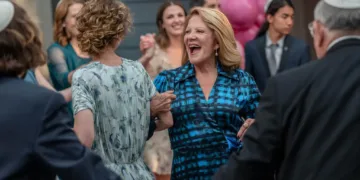
The film reaches its emotional high point at the bat mitzvah ceremony. Rachel stands in front of a crowded room to deliver the speech that has been hanging over her like a deadline. She pushes through her phobia and speaks with a clarity that matches her changing understanding of herself. The room becomes a visual portrait of her expanded world, with Marcus’s Filipino family seated alongside newly found half siblings and the Jewish community Rachel has long been part of. It plays as a simple, legible moment that makes the film’s themes visible without needing extra explanation.
That scene carries the film’s argument about belonging. Faith appears as a welcoming space for people who choose to show up and stay. The storytelling style echoes television in its rhythm, leaning on humor and relatable situations to handle social change while keeping the focus on family.
The closing stretch stays with the joy of the group as they celebrate Sammie’s rite of passage together. The film stresses the value of acceptance and the ties people choose to nurture, even after biology has rewritten the family tree, and it leaves its characters with a sense of belonging that comes from presence, care, and commitment.
One Big Happy Family premiered in theaters across the United States on October 3, 2025, distributed by Electric Entertainment. The film follows the chaotic journey of a woman who discovers via a DNA test that her biological father is not the man who raised her, leading to a profound and humorous exploration of her identity just as she prepares for her daughter’s bat mitzvah. Currently, as we approach the end of 2025, the movie is completing its theatrical run and is expected to become available on major digital streaming platforms for home viewing in the coming weeks.
Full Credits
Title: One Big Happy Family
Distributor: Electric Entertainment
Release date: October 3, 2025
Rating: NR
Running time: 83 minutes
Director: Matt Sohn
Writers: Lisa Brenner
Producers and Executive Producers: Lisa Brenner, Grace Lay, Steve Lee
Cast: Lisa Brenner, Linda Lavin, Dante Basco, Kat Cunning, Josh Fadem, Lumi Pollack, Tim Russ, Sabrina Cofield, Dylan Chance
Director of Photography (Cinematographer): Ryan Little
Editors: Brian Gonosey
Composer: Joseph LoDuca
The Review
One Big Happy Family
This film succeeds as a heartfelt tribute to the late Linda Lavin. Her performance provides a necessary anchor for a story that occasionally feels thin. The narrative effectively highlights a modern, inclusive view of heritage. While the script relies on familiar tropes, the warmth of the cast creates a sincere experience. It serves as a gentle reminder that love defines a household far more than genetic markers.
PROS
- Linda Lavin delivers a memorable and charismatic final performance.
- The story presents a positive and diverse representation of modern Jewish life.
- The chemistry between the central family members feels genuine and warm.
- It offers a lighthearted take on the complex world of commercial DNA testing.
CONS
- The dialogue feels predictable and lacks sharp wit.
- The pacing is uneven with some plot points receiving too little attention.
- Certain characters remain underdeveloped and function mostly as background figures.
- The visual style is basic and resembles a standard television broadcast.