




























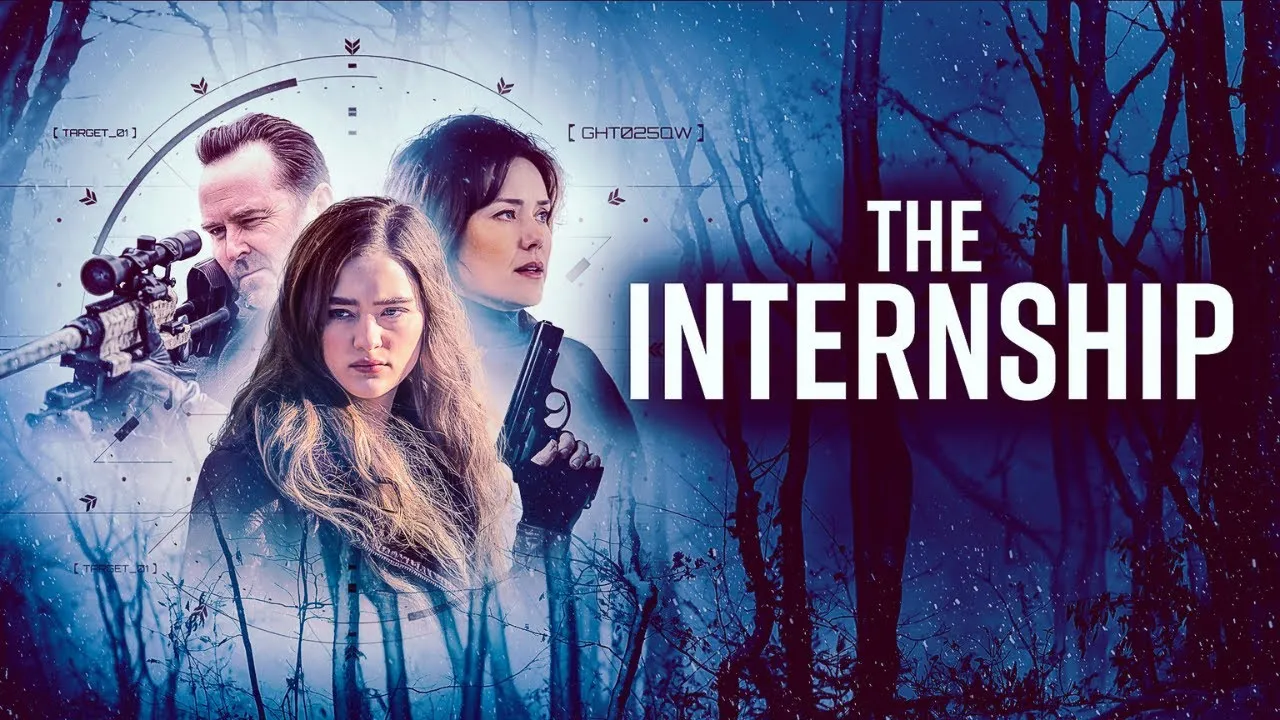

Directed by James Bamford, The Internship plays as a high-stakes spy thriller built for a marketplace already crowded with secret-assassin-program stories. It follows Renee, operating under the lethal codename Catalyst, a young woman raised inside a clandestine CIA project that treated children as weaponized assets.
Years after the program was mothballed, Renee resurfaces with a singular mission: break into a high-security Russian FSB facility and steal the Intern List. She wants the document because she wants her life back. She aims to reunite the surviving members of her cohort, stop running, and start pushing back against the handlers who stole their childhoods.
With young faces like Lizzy Greene and Sky Katz alongside action veterans Megan Boone and Sullivan Stapleton, the film tries to splice gritty espionage with a charged, youth-forward energy, framing its conflict around rogue agencies and the lethal orphans they manufactured.
Clandestine Pedagogy and the Ghost of Hegemony
The film’s driving premise comes from a rogue CIA initiative led by Henry Byrne, a spymaster whose moral compass reads like it got magnetized to the nearest power outlet and never recovered. The program aims to produce child super-spies, turning adolescence into a beta phase for state-sponsored homicide.
The movie sketches a grim philosophical comparison between American and Russian methods. The CIA’s pipeline yields functional killers who feel hollowed out. The Russian FSB’s attempt at replication ends in psychological collapse. The implied message lands with a chill: American exceptionalism, reframed as administrative competence at industrial-scale trauma.
Renee’s decision to steal the Intern List, tied to former KGB headquarters, functions as an act of self-repossession. The document becomes a proxy for identity, a way for her to move from “subject” to “author” in the story of her own fate. When she begins assembling her peers, the film introduces a vocabulary that sounds like a weapons catalog wearing human skin. Caliber. Dagger. Rubicon. Apothecary.
These names describe tasks more than people, as if the individuals were filed down until only their utility remained. (Call it “Function-Identity Overload,” the condition where the codename eats the person and leaves the job title standing upright.)
The plot moves through safe houses and cold confrontations, then into the business of decoding cryptic markings tied to the stolen files. Bamford’s film leans hard on a double-twist in the final act, using revelations as duct tape for a story that can feel fragmented in motion. The twists attempt retroactive order, giving earlier chaos a set of rules after the fact. It also plays like a franchise starter kit. The narrative behaves like a software patch: it corrects visible errors and quietly installs the framework for whatever comes next.
Hyper-Kinetic Geometry and the Ocular Obsession
Bamford’s stunt-coordination background sits right at the surface, and the movie often feels like a chain of carefully engineered impacts. The opening bloodbath at the FSB headquarters stands as the clearest technical peak, packed with raw, visceral charge that later stretches struggle to match. Action beats swing between loud firearm exchanges and close-quarters hand-to-hand brutality. A recurring fixation appears during these fights: eye-related trauma, returned to with a persistence that feels intentional even when it reads as pure shock-value. Maybe it signals a thematic attack on “oversight” and “vision.” Maybe it simply plays as the kind of jolt a VOD audience is expected to remember the next day.
The visual approach runs on aesthetic whiplash. Stylized slow motion and ramped-up rapid-motion cutting share space with character title cards in teletype fonts that practically yell “Spy Movie” at the screen. Those flourishes sit beside more conventional, lower-budget cinematography that keeps reminding you what this production can afford. (That mismatch becomes “Budgetary Dissonance,” the moment ambition starts writing checks the wallet cannot cash.)
The settings swing from snowy forest cabins, boxed in by isolation, to industrial warehouses defined by functional emptiness. These spaces serve as clean backdrops for explosions and vehicular crashes that punctuate the runtime with blunt-force punctuation. The scale of destruction often feels designed to keep your eyes busy when the world-building thins out. The physical feats can drift into the absurd.
Characters dodge bullets by sound. Characters survive horrific wounds and answer with a stoic grimace, as if pain were a genre note someone forgot to include. The result nudges the film away from grounded spy tension and toward a dark superhero mythos, where the body becomes an invincible vessel for state power.
The Stoic Youth and the Burden of Legacy
Lizzy Greene plays Renee with relentless, flat-line stoicism. The performance skips the usual coming-of-age emotional signposts and presents a woman whose personality seems to have been surgically removed by instructors who trained her to function first and feel never.
She fits the “female Jason Bourne” mold through quiet intensity, even when the script fails to give her enough texture to shape a fuller human portrait. There is tragedy baked into her efficiency. She has mastered a craft with no honest place in civil society, and the film never lets you forget what it cost to get her there.
Megan Boone’s Candace Dalton and Sullivan Stapleton’s Nelson provide a needed tether to something like adulthood. Their history as former lovers and disillusioned operatives adds weary gravitas, a sense of people who remember the rationale that once justified their work. Nelson, especially, finds a likable groove as a burger-grilling veteran who has clearly seen too much and learned to cope with routine. Their presence highlights a generational divide inside the spy fantasy: older operatives who remember why they fought, and younger operatives who learned only the how.
The supporting interns fight for footing and rarely find it. Sky Katz puts in effort, yet the group rarely sparks as a unit, and their interpersonal energy can feel oddly absent. (It reads like “Negative Chemistry,” where the cast members repel each other in scenes meant to bond them.)
That chill could reflect the isolating nature of their training, though it still makes for a chilly watch. Steven Berkoff, as FSB director Dimitri Lebedev, arrives from another tradition entirely, leaning into old-school villainy with a scenery-chewing gusto that feels like a boisterous Cold War ghost. The script also falls back on familiar archetypes, with the “tech genius” who slices through global security firewalls via a few casual tablet swipes.
Tactical Illiteracy and the Echo of the Sitcom
The dialogue lands in a strange mix of “tough guy” posturing and exposition, sometimes delivered through teletype scrolling. The one-liners can sound like artifacts from a mid-90s action catalog, with “I know how to hurt people” delivered in a way that edges into B-movie sincerity. The line is funny and not funny, a tonal coin flip. The writing aims for high-stakes tension and repeatedly slides into clichés that the film seems aware of, yet still embraces.
The internal logic repeatedly buckles under scrutiny. These characters are introduced as elite CIA-trained assets, yet their decisions can read as bafflingly reckless. The hacking sequences push this problem into the foreground. They operate under “Digital Mysticism,” treating technology as spellcasting instead of a tool. That lack of tradecraft grounding blunts the film’s bid for grit, because the movie keeps asking you to accept competence while showing chaos.
Genre signals clash in ways the film never fully resolves. The script can feel like a 2010s network crime drama filtered through a “Gen Alpha” scrolling rhythm, with humor beats that frequently fail to land and leave a mild headache in their wake. Tonal instability becomes the most persistent flaw.
The film wants to study Machiavellian systems, painting the CIA and the FSB as ruthless entities that treat people as disposable variables. That cynical worldview carries bite. Then the script reaches for light banter and undercuts the burn. The movie sketches a world where morality equals survival, yet it keeps tossing jokes into the fire.
The Identity Crisis of the Modern VOD
The Internship carries a deep identity crisis. It casts recognizable faces associated with Nickelodeon and Disney Channel, then drops them into a landscape of R-rated violence and constant profanity. The mismatch creates a “Demographic Disconnect” that can leave younger fans and adult action viewers equally uncertain about who this is for. The film wants the shape of a gritty YA property, and it forgets that YA tends to need a heart that can hold the edge without collapsing into posturing.
Uneven pacing and a plot that is, frankly, bunk do not stop the movie from keeping forward motion. Bamford’s film has a “low-rent charm” that propels it through sequences even when the logic strains. Energy stays present, even as plausibility goes missing. It plays like “Top-Notch Video Store Fare,” the kind of thing you might have found on a dusty shelf in 1994 and rented because the cover promised explosions, and the night felt long.
The world-building does enough work that the sequel-bait ending feels like more than a cynical wink. The final national-security revelations land with bleak weight, suggesting the “interns” are far from the only pieces being moved around the board. The film settles into perpetual “Proof of Concept,” functioning as a prologue that keeps the main story just out of reach. Accept the bullet-dodging by sound. Accept the magical hacking. A grim kind of fun shows up. The experience stays hollow and loud, and it mirrors the characters it depicts.
This action thriller arrived for audiences on January 13, 2026, through a digital release orchestrated by Paramount Global Content Distribution. The film is currently available for purchase or rental on major digital storefronts and streaming platforms. It presents a gritty look at a clandestine government program, offering a sharp departure from traditional spy cinema through its focus on a younger, weaponized generation.
Full Credits
Title: The Internship
Distributor: Paramount Pictures, Paramount Global Content Distribution, Paramount Home Video
Release date: January 13, 2026
Rating: R
Running time: 91 minutes
Director: James Bamford
Writers: J.D. Zeik, Steven Paul
Producers and Executive Producers: Steven Paul, Scott Karol
Cast: Lizzy Greene, Megan Boone, Sky Katz, Philip Winchester, Alix Villaret, Ollie Roddy, Sullivan Stapleton, Kaine Buffonge, Jonas Armstrong, Errol Trotman-Harewood
Director of Photography (Cinematographer): Ivan Vatsov
Editors: Shaun Lang, Tony Dean Smith, Robert A. Ferretti
Composer: Rich Walters
The Review
The Internship
The film is a study in "Budgetary Dissonance," attempting to launch a sprawling franchise from a foundation of "low-rent charm" and tactical absurdity. While it offers visceral, high-intensity action for fans of second-rate B-movies, the "Negative Chemistry" among the young leads and a "Digital Mysticism" approach to plot logic hinder its loftier ambitions. It functions as a loud, hollow, yet strangely energetic piece of modern VOD content. It is a prologue that promises a depth it never quite reaches, leaving the viewer with an experience that is efficient, cynical, and ultimately plain.
PROS
- High-intensity stunt work and choreography, particularly the opening sequence.
- Strong, grounded performances from veterans Sullivan Stapleton and Megan Boone.
- Unapologetically cynical and Machiavellian portrayal of global intelligence agencies.
CONS
- Jarring tonal shift between the "Young Adult" casting and the R-rated violence.
- Lack of interpersonal chemistry and "stoic" performances from the lead team.
- Deeply unrealistic "hacking" scenes and illogical tactical decision-making.