
























Alec’s days run on a kind of low-grade tension that never announces itself, yet never lets up. In a coastal English town, he drifts through school as a quiet sixth former. After the final bell, he switches into a different mode: the steady, clinical routine of a camera operator.
He works for his father, Dylan, filming and editing the family’s homegrown adult content. Alec treats this like a system with strict rules, keeping school life sealed off from the work that pays the bills. That separation starts giving way once he’s paired with Nina for a school multimedia project. Nina comes in outspoken and principled, bringing a clear feminist lens to research about how digital content shapes their generation.
Working with her presses on the part of Alec he keeps locked down. For years, he has watched sex through glass and framing, reading bodies as angles, light, and cues. Nina pulls him toward something messier: feelings that do not follow a shot list. He has to face what it means to be a quiet technician for his father’s world while wanting a real connection with Nina, one that can’t be edited into place.
The Mundane Business of the Taboo
At home, Alec and Dylan live inside a role reversal that never stops feeling off. The parent behaves on impulse, chasing gratification with the impatience of a kid. Dylan performs narcissism with the ease of habit, treating the work with a casual boredom that makes it feel even stranger.

Early on, bodies coated in gold paint flash a glossy image that nods to the high-glamour look of Goldfinger. The pose drops fast the moment the take ends. The room slides into ordinary life: tea, complaints about aches, the small talk that follows any shift at a job.
Alec becomes the stabilizer by default. He does the editing, keeps track of logistics, and holds the emotional temperature steady while Dylan follows riskier whims to keep an online following fed. Their apartment looks worn down, marked by stained walls and furniture that feels neglected.
The spaces where they film go for synthetic neon and manufactured sheen. That split in setting mirrors what Alec has absorbed. He has learned to see women as subjects to frame and manage, not people to know. Dylan’s habit of crossing limits pushes Alec into the “adult” role, even as Alec stays stuck with the thin, warped language of intimacy his father has modeled for him.
Shifting Perspectives and Ethical Breaks
Nina becomes the spark that makes Alec question what he has accepted as normal. She rejects commercialized intimacy and keeps returning to mutual respect and partnership. The school project acts like a bridge between Alec’s private routine and the values his education is meant to teach, giving him enough distance to look at the industry with a colder eye.
One of the sharpest shifts comes when Nina meets Lizzie, a regular performer in Dylan’s productions. Nina and Lizzie find an unexpected point of connection, talking through what it means to exist inside a male-dominated field. The conversation puts Nina’s classroom thinking next to the day-to-day survival Lizzie has practiced for real. It also leaves Alec with fewer places to hide, since two parts of his life are now sharing the same air.
The story turns darker when Dylan chooses to film a scene involving a live octopus, chasing shock value to drive digital engagement. The decision reads as exploitation dressed up as “content,” and it tears a rift through the set. Comfort and consent stop being treated as priorities. Alec starts recognizing the cruelty that comes from Dylan’s detachment, the way a performer can become a prop as soon as the camera is running. With Nina close, Alec begins pushing back against the degrading language that circulates in the business, and that shift carries into how he relates to the women around him.
Behind the Lens and Toward the Light
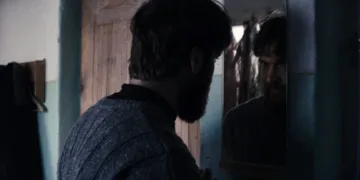
The film’s visual approach tracks Alec’s internal change through the act that defines his life: looking. The filming sessions lean into brash neon and synthetic nylon textures, building a manufactured atmosphere that feels sealed off from ordinary touch. The seaside cliffs where Alec and Nina spend time together are shot in soft, desaturated natural light, giving their scenes room to breathe. Handheld camerawork adds a rawness to their time together, making the awkward pauses and small calibrations between them feel physical, like two people learning new rules in real time.
Alec keeps fighting the habits he’s trained into himself. He slips into seeing bodies as marketable frames, a reflex drilled by years behind Dylan’s camera. With Nina, his attention keeps drifting toward the angles he has been taught to capture, and that keeps him from meeting her eyes when it matters. The mechanical gaze becomes its own obstacle, a system that blocks intimacy through repetition.
As Dylan’s desperation escalates and the family structure starts giving way, Alec reaches a point where he has to pick a different life. The turning point lands in a quiet action: he stops recording. Turning off the camera becomes his refusal to keep playing the voyeur. He chooses vulnerability that requires no audience. He steps away from the lens and moves toward a connection that stays private, consensual, and real.
Truly Naked premiered at the Berlin International Film Festival on February 16, 2026, as part of the Perspectives section. Directed by Muriel d’Ansembourg, this British-Dutch-Belgian co-production is a coming-of-age drama set in a quiet seaside town, exploring the complex life of a teenager involved in his father’s independent adult film business. Following its festival debut, the film has secured several international sales and is expected to be available for wider viewing on streaming platforms later this year.
Full Credits
Title: Truly Naked
Distributor: Totem Films, various international distributors for German-speaking territories and Korea
Release date: February 16, 2026
Running time: 102 minutes
Director: Muriel d’Ansembourg
Writers: Muriel d’Ansembourg
Producers and Executive Producers: Els Vandevorst, Isabella Depeweg, Antonino Lombardo, Tom Dercourt, Christophe Bruncher
Cast: Caolán O’Gorman, Andrew Howard, Alessa Savage, Safiya Benaddi, Lyndsey Marshal
Director of Photography (Cinematographer): Myrthe Mosterman
Editors: Emiel Nuninga
Composer: Evgueni Galperine, Sacha Galperine
The Review
Truly Naked
Truly Naked succeeds as a grounded coming-of-age story by focusing on the quiet, psychological toll of a life lived behind a lens. It avoids typical sensationalism, choosing instead to examine how a mechanical view of sex can stall emotional maturity. While the school-based subplots occasionally feel convenient, the strong performances and sensitive direction create a meaningful look at the necessity of real vulnerability. It is a thoughtful exploration of how we must unlearn a clinical gaze to find a human connection.
PROS
- Natural and chemistry-filled performances by the young leads.
- A non-judgmental, researched approach to a difficult subject.
- Effective use of visual contrast between neon interiors and natural landscapes.
- A nuanced portrayal of the parent-child role reversal.
CONS
- Some narrative elements and school projects feel slightly contrived.
- The third-act shift toward a cautionary message feels a bit abrupt.
- Certain supporting characters serve more as thematic mouthpieces than fully realized people.