





















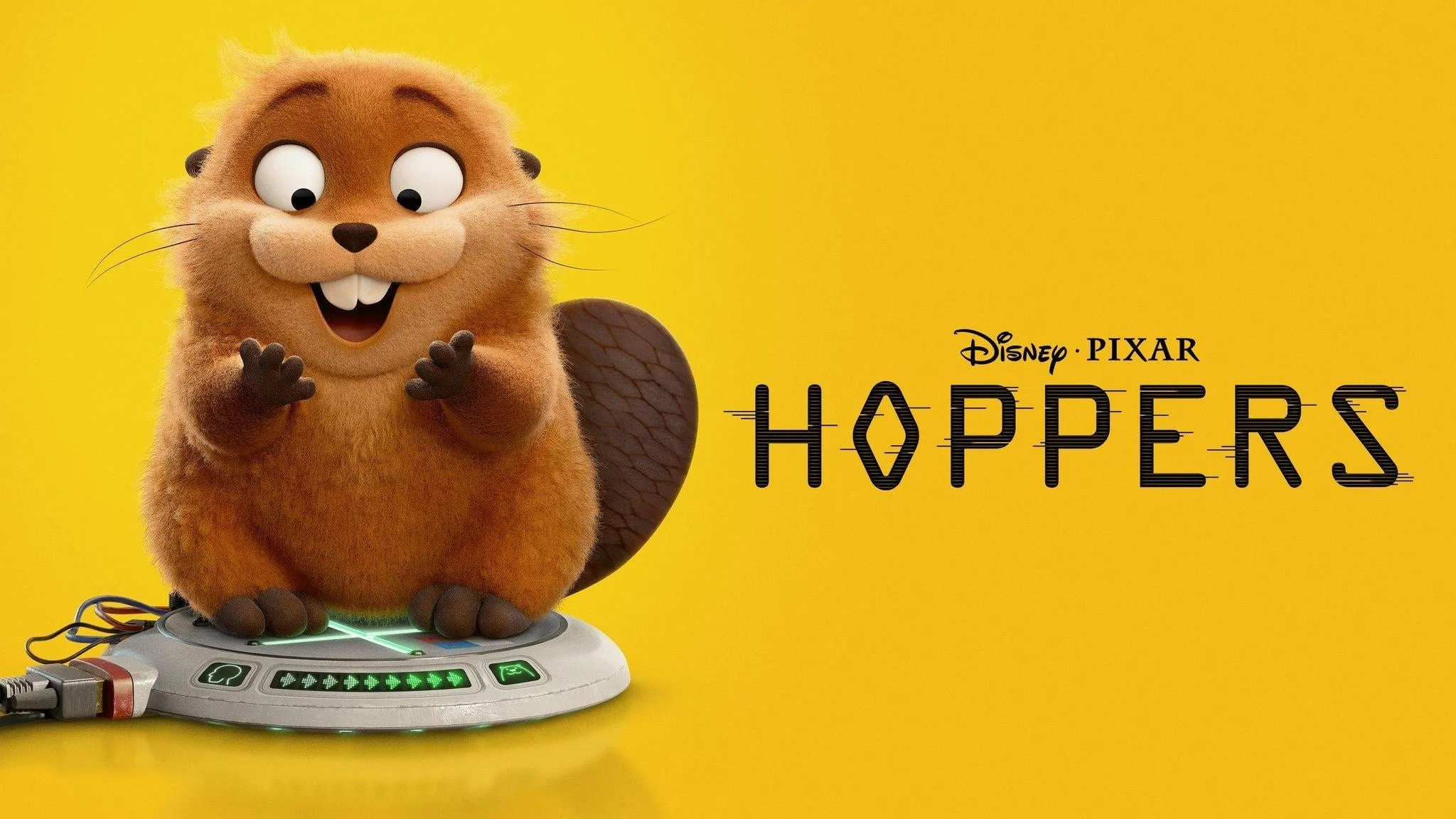

Pixar’s Hoppers arrives with a premise so gloriously peculiar that it feels like a studio dare. It gives us environmental conflict, municipal vanity, grief, political spin, and a teenager who enters the body of a robotic beaver to save a woodland glade from a beltway project. That sentence sounds like satire written by a city planner after three days without sleep. In practice, it becomes a brisk, odd, highly animated story about moral feeling in an age of smooth public destruction.
At the center is Mabel Tanaka, a young activist whose attachment to a patch of living land carries memory, mourning, and fury in equal measure. Her love for the glade is personal long before it becomes political. That matters. The film gives her a cause, yet it begins with a wound.
Daniel Chong shapes the material with a restless comic pulse. The movie is energetic, eccentric, and surprisingly willing to let its family-friendly shell crack open for flashes of menace and absurdity. One part creature comedy, one part eco-fable, one part civic farce, Hoppers keeps asking how a person turns private feeling into public action without letting rage hollow them out from inside. Strange question for a cartoon beaver caper. Good one, too.
The Mechanics of Mayhem
The central idea is simple enough to explain and weird enough to stay funny. Mabel discovers that her professor, Dr. Sam, has invented “hopping” technology that transfers human consciousness into a mechanical animal body. Mabel uses it to inhabit a beaver and enter the glade as a covert participant in animal society. From there, the film gains velocity. She can speak with animals, recruit them back into the threatened habitat, and try to stop Mayor Jerry’s development scheme from steamrolling the place into civic oblivion.
The script understands that its premise is absurd, so it does the smartest thing possible. It keeps moving. A lesser film would stall out in exposition, desperate to explain every wire and lever. Hoppers treats explanation as a nuisance and chaos as an ethic. That gives the movie room for physical comedy, political gamesmanship, undercover tension, and a running stream of jokes built on species difference and social misunderstanding.
This is where the film becomes especially lively. Mabel enters the glade with activist certainty and discovers a world that refuses to organize itself around her ideals. The animals are funny, territorial, petty, communal, hungry, sometimes noble, sometimes ridiculous. Their society has structure, yet it lacks the sentimental neatness common to talking-animal stories. Mabel wants a coalition. The glade offers a brawl with bylaws.
Also Read





The pacing thrives on that instability. Council scenes, chase sequences, civic escalations, and interspecies negotiations keep the movie in motion. It has a manic snap that recalls the better strain of modern animated comedy, where rhythm itself becomes a source of laughter.
Still, the writing has weak spots. Some early emotional groundwork feels familiar, almost prefab in shape. The final stretch reaches for spectacle with greater confidence than narrative precision. Mayor Jerry works best as a symbol of polished public selfishness, yet the film occasionally softens his menace at moments where greater sharpness might have helped. Hoppers is stronger in propulsion than architecture. It can build a comic set piece faster than it can lock every thematic beam into place.
Mabel and the Politics of Anger
Mabel is the reason the film holds. She is not a blankly adorable lead drifting toward self-knowledge on schedule. She starts with identity intact. She loves animals, distrusts authority, breaks rules, acts first, regrets later, and carries herself with the stubborn voltage of a person who has already decided the grown-ups are selling her a damaged moral vocabulary. In animated cinema, which often confuses likability with passivity, that edge counts for a lot.
Her bond with her grandmother gives the story its emotional grammar. Those scenes by the glade do quiet work. Nature becomes a site of stillness, memory, and scale. The grandmother teaches Mabel to look, listen, and feel herself as part of something larger than her own agitation. That lesson lingers after loss. In adulthood, grief remains present as a weather system inside her, changing the pressure of every decision.
This is where Hoppers gets more philosophically alert than its premise first suggests. Mabel’s anger is treated as both ethical spark and cognitive trap. She is angry for good reasons. Habitat destruction, public deceit, civic vanity, and institutional indifference deserve anger. Yet the film refuses to flatter rage as pure moral clarity. It shows anger as fear wearing armor. It energizes her. It narrows her. It helps her act. It also makes cooperation harder.
That tension gives the movie much of its force. Mabel must learn that animals are not props in her campaign, nor extensions of her pain. They are their own messy constituency. Her emotional movement happens in increments: trust earned, control loosened, solidarity learned. A few later beats aim for a level of catharsis they do not quite reach. Even so, Mabel remains vividly drawn because the film lets her stay difficult. She is driven, bruised, and sometimes wrong. Good. Heroes should be allowed that much.
Beast Politics and Other Civic Disorders
The animal world in Hoppers is no sentimental republic of human values in fur. That is one of the film’s slyest strengths. These creatures can speak, scheme, argue, and organize, yet they remain ruled by appetite, instinct, and bizarre local logic. Predator and prey coexist through a code that feels functional, alarming, and very funny. The humor comes from bluntness. Death is part of the system. So is vanity. So is aerobics, apparently.

King George emerges as the film’s strongest supporting character. He has warmth, optimism, and a slightly frayed regal calm that turns him into the story’s moral hinge. His communal ethic gives the film its clearest picture of social life as practice rather than slogan. Know your neighbors. Greet people. Protect the shared space. Eat when you must. It is Rousseau by way of pond management, then filtered through a children’s comedy.
The wider council pushes the film into a more satirical register. The Insect Queen, her scheming offspring, and the assorted species leaders turn politics into spectacle, grievance, and absurd negotiation. That feels familiar for reasons Pixar need not underline. Public life in the twenty-first century often resembles a conference of creatures each convinced the ecosystem exists to validate their appetite. Hoppers turns that fact into a running joke.
Mayor Jerry represents another layer of civic comedy. He is charm weaponized. Jon Hamm’s vocal performance gives him a salesman’s ease, the sort that treats destruction as a branding exercise. He stands for development logic in its friendliest mask: flatten the place, smile at the cameras, call it progress. Dr. Sam, by contrast, supplies the movie’s endearing scientific eccentricity, a catalyst whose invention unleashes the whole lovely mess. The supporting cast is drawn in broad lines, yes, yet broad lines can still sketch a persuasive caricature of a culture.
Fur, Water, Steel, and the Shape of Coexistence
Visually, Hoppers is a pleasure. The natural textures have weight and softness at once, with water, moss, bark, and fur rendered in a style that balances tactile richness with cartoon elasticity. The design of the animals is especially clever in the way it shifts according to who can understand them. Seen through one frame, they read as creaturely and almost realistic. Seen through another, they become expressive social presences with enlarged feeling. It is a neat formal device. It turns communication itself into an aesthetic condition.
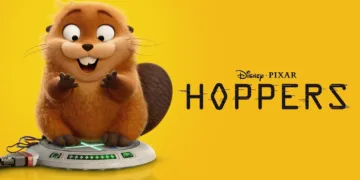
The robotic-beaver conceit could have been awkward. Instead, the film makes it readable, funny, and faintly uncanny. Good choice. The uncanniness matters. Mabel enters the natural world through technology, carrying a manufactured body into a threatened habitat. That image quietly sums up a great deal about contemporary environmental life. We seek contact with the nonhuman through apparatus, data, simulation, and managed access, then act surprised when the living world refuses to behave like a user interface.
The film’s comic energy gains from its willingness to get weirder and harsher than expected. Some slapstick lands with real bite. Some chase material veers into surreal delirium. Predator-prey logic is treated with a matter-of-fact comic frankness that gives the movie texture. Tonally, the film does wobble here and there. Still, the wobble is part of its personality. Clean tonal harmony is overrated. A movie about ecological disorder and political strain should have some splinters in it.
Its environmental message is plain, yet the film is smartest when it trusts conflict and behavior to carry the idea. Habitat loss, human expansion, activist burnout, empathy, collective responsibility, all of this passes through action rather than sermon. The movie’s deepest claim is modest and difficult: coexistence is not pure feeling. It is labor. It is compromise. It is attention. It is learning that your cause cannot survive if it turns every other living thing into scenery.
Hoppers does not achieve perfection in its world-building, and parts of its late movement feel looser than they should. Still, it has comic invention, emotional sincerity, visual charm, and a scrappy moral intelligence. It is eccentric in a productive way. A lively little eco-farce with teeth. And a tail.
Hoppers is an original animated science fiction adventure comedy produced by Pixar Animation Studios that officially premiered at the El Capitan Theatre on February 23, 2026, before its wide theatrical release on March 6, 2026. The story follows Mabel Tanaka, a 19-year-old animal lover who uses experimental “hopping” technology to transfer her consciousness into a lifelike robotic beaver. Her mission to infiltrate the animal kingdom and save a local glade from a greedy mayor leads her to become an unlikely leader in a rebellion of forest creatures. As of today, March 2, 2026, the film is fresh from its festival screenings and is available to watch in theaters worldwide starting this week.
Where to Watch Hoppers (2026) Online






Full Credits
Title: Hoppers
Distributor: Walt Disney Studios Motion Pictures
Release date: March 6, 2026
Rating: PG
Running time: 104 minutes
Director: Daniel Chong
Writers: Daniel Chong, Jesse Andrews
Producers and Executive Producers: Nicole Paradis Grindle, Pete Docter
Cast: Piper Curda, Bobby Moynihan, Jon Hamm, Kathy Najimy, Dave Franco, Meryl Streep, Eduardo Franco, Aparna Nancherla, Sam Richardson, Melissa Villaseñor, Isiah Whitlock Jr., Steve Purcell, Ego Nwodim, Nichole Sakura, Karen Huie, Vanessa Bayer, Tom Law
Director of Photography (Cinematographer): Jeremy Lasky, Ian Megibben
Editors: Axel Geddes
Composer: Mark Mothersbaugh
The Review
Hoppers
Hoppers is a funny, odd, unexpectedly sharp Pixar entry that turns a gleefully strange premise into a story about grief, anger, empathy, and shared space. Its plotting can get shaky in the late stretch, and some of the world-building stays light, yet its comic energy, visual charm, and emotional honesty carry it a long way.
PROS
- Inventive premise
- Strong lead character
- Memorable supporting animals
- Lively comic rhythm
- Memorable supporting animals
- Rich animation and expressive design
CONS
- Thin world-building in spots
- Final act gets messy
- Villain lacks full bite
- A few emotional beats feel familiar