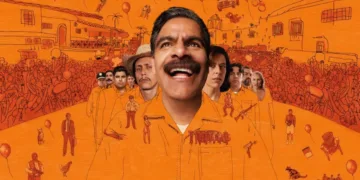































The title Son-in-Law opens with a sly misdirection. It gestures toward the comic grammar of household tension, the awkward rituals of marriage, the small disasters that gather around a wedding weekend. Gerardo Naranjo turns that promise into something colder: an inquiry into political ascent inside a broken state. The film begins with the ugly residue of an execution, a car punched by a thousand bullets and a gun placed in a dead man’s hand. That violent overture fixes the moral climate in which José Sánchez will live.
The story then cuts back to 1985, where José appears as an ungainly teenager in San Diego, unable to complete a simple drug transaction. Failure pushes him across the border to Mexico, where he seeks discipline from an uncle who spends most of his time planted before a television. By 2005, José has become a law student entangled with the daughter of a powerful political family.
His access to that circle comes through scandal, and he soon settles inside their transportation empire. He receives grand titles with little practical authority. Across the fictional state of Albacruz, the film charts his climb toward the office of Attorney General. His career takes shape through fortunate accidents, moral evasions, and compromises that grow easier with each promotion.
The Vacuity of Influence
Adrián Vázquez plays José Sánchez with a blankness that chills the air around him. He steadies the film through a flat, unreadable calm while violence closes in on every side. The performance proposes a man separated from the damage his choices create. That flatness prevents the film from shaping José as a seductive antihero.

His rise feels bureaucratic, almost accidental, an accumulation of permissions granted by people with fewer scruples and greater force. In the early San Diego scenes, his youth carries a craving for acceptance, a social hunger that later hardens into calculated apathy. His adult cynicism arrives quietly, almost administratively. He carries none of the magnetism usually attached to cinematic climbers.
He succeeds through endurance, by remaining seated after others have left the room. The movement from ponytailed law student to executive with a pushbroom mustache marks a drift from possibility into stagnation. His body grows heavier, aided by a prosthetic belly that gives his new status a blunt physical shape. The prosthetic makes visible the cost of a life spent in sterile offices and ceremonial dinners.
The persona of “El Serpiente” forms as José’s political reach expands. He survives as a fluent talker, using language as fog. His emptiness makes him an ideal instrument for Albacruz and its machinery. He handles the people around him with an eerie composure that allows incompetence to pass for command. His marriage to Lucía operates as a contract of mutual utility. She supplies pedigree and capital; he supplies a public face for the family’s interests. Their union remains a shell maintained for appearances.
Supporting figures sharpen the texture of this world. Jero Medina’s El Lobo brings the story a necessary grit, standing for direct, violent power that José attempts to regulate through paperwork and political choreography. David Gaitán contributes to the same field of staged authority, taking part in the theater José later tries to control. Vázquez’s performance clarifies the danger of a man without fixed beliefs: he becomes a reflective surface for the corruption of everyone who draws near him.
The Mechanics of Narrative Fracturing
The film’s structure mirrors the disorder of the systems it studies. Naranjo uses a nonlinear timeline to link José’s small early failures with the immense corruption of his later career. The 1985 sequence built around a single ecstasy pill establishes incompetence as a governing pattern.
That scene exposes his poor grasp of the rules in the world he wants to enter. The leaps to 2005 and 2015 show how time and money can cover those original defects without healing them. The “Ten Years Later” title cards mark stages in his thinning individuality and expanding political function. The script by James Schamus, Alexandro Aldrete, and Gabriel Nuncio withholds a clean psychological map for José. That refusal shifts attention toward the external systems that shape his conduct.
The first half moves with nervous speed, driven by quick flashes and montages that echo the instability of José’s early life. The rhythm creates disorientation, keeping the audience close to the protagonist’s confusion. Once the narrative settles into his work as a high-ranking official, the tempo slows. Scenes stretch out and grow heavier, matching the bureaucratic weight of the offices he now occupies. This change in rhythm traces his passage from frantic climber to installed functionary.
The episodic design makes his rise feel like a set of fragments held together by luck. The opening image in the orange jumpsuit keeps returning as a grim frame for every later achievement. The prison setting turns each success into a prelude to confinement. The narrative tightens around the characters like a knot, reducing the space for escape and redemption with each new bargain.
Sterile Frames and Auditory Violence
The film’s visual language draws sharp lines between domestic life and political performance. Naranjo uses sterile office interiors to render administrative power as cold and lifeless. These rooms have hard angles, flat lighting, and an absence of warmth. The border settings and strip clubs move with a looser, more volatile energy. The cinematography keeps José at a distance, watching his actions with clinical patience. Static shots during tense political meetings stress the suffocating air of those rooms.
The camera records the theatrical habits of public life in Albacruz, where every gesture seems prepared for an audience. Public spaces become stages, and the characters step into roles already waiting for them. The framing frequently isolates José inside large, empty rooms, giving visual form to his loneliness.
Sound gives the film much of its bitter force. Heavy silence alternates with sudden violence, creating a rhythm of dread. The initial thousand bullets leave a visceral echo that carries into the quieter scenes. Dialogue moves between Spanish and English, matching the bicultural terrain of the border.
This linguistic movement becomes another mode of performance, since José adjusts his speech to fit the room. The lack of a traditional score lets environmental sound dominate. Silence between characters becomes a charged space, feeding the film’s dark, awkward humor.
The austerity of the soundtrack leaves power sounding small, procedural, and strangely embarrassed by its own rituals. Production design grounds the story’s ideas in tangible objects. The in-laws’ estate conveys wealth that impresses and isolates in equal measure. The old VW taxi tied to José’s uncle remains a trace of his working-class origins, a visual ghost lingering near his new life. These technical elements create a world that feels recognizable, alien, and spiritually drained.
The Cycle of Borrowed Authority
The film’s thematic force comes from its treatment of corruption as an operating principle. The in-laws’ transportation empire functions as a miniature version of the larger state. It runs on nepo-adjacent power, inherited influence detached from merit. José’s fear of being viewed as a minor player drives him toward dangerous alliances. He enters narco-politics through hunger for significance.
Albacruz appears as a territory managed by three warring cartels. In that environment, the peacemaker’s role becomes a cynical political invention. José produces temporary stability because he will negotiate with anyone. The system has room for people whose corruption remains partial enough to be useful.
The collision between José’s American roots and his Mexican career creates identity displacement. He occupies a middle ground and fully belongs to neither side. His fixation on appearances leads him into compromises that wreck his private life. The faked assassination attempt becomes the height of his political theater. The maneuver is designed to protect him by convincing his family of a danger he helped manufacture. The final image suggests power as a cycle of betrayal.
Every handshake functions as a temporary truce, and every alliance carries an expiration date. Success in this world is measured by the length of time one can remain in play before being consumed. The story refuses a redemptive arc, presenting a system that continues to operate after the people inside it have fallen. It studies a world where every person has a price, and that price tends to arrive higher than anyone expected.
The film Son-in-Law, directed by the acclaimed Gerardo Naranjo, is a biting Mexican political satire that explores the chaotic rise and fall of a professional opportunist. Premiering globally on Netflix on May 1, 2026, the story follows José Sánchez, a man whose ambition leads him from the fringes of a wealthy family to a precarious position within the corridors of power and the shadows of the criminal underworld. Set against a backdrop of systemic corruption and social tension, the movie is currently available for streaming on Netflix for subscribers worldwide.
Where to Watch Son-in-Law (2026) Online


Full Credits
Title: Son-in-Law (El Yerno)
Distributor: Netflix
Release date: May 1, 2026
Rating: TV-MA
Running time: 90 minutes
Director: Gerardo Naranjo
Writers: James Schamus, Gabriel Nuncio, Alexandro Aldrete
Producers and Executive Producers: James Schamus, Juan de Dios Larraín, Pablo Larraín, Rocío Jadue, Adrian Maganza
Cast: Adrián Vázquez, Jero Medina, David Gaitán, Verónica Bravo, Eduardo España, Rodrigo Virago, Roberto Sosa, Daniel Haddad, José Sefami, Gerardo Taracena, Alfonso Dosal, Manuel Poncelis, Fermín Martínez, Mónica del Carmen, Silverio Palacios
Director of Photography (Cinematographer): Mauro Pinheiro Jr.
Editors: Yibrán Asuad
Composer: Alberto Iglesias
The Review
Son-in-Law
Son-in-Law offers a sharp, clinical look at the mechanics of political decay. Gerardo Naranjo avoids sentiment, choosing instead to observe a man erased by the systems he inhabits. The performance of Adrián Vázquez provides a chilling anchor for this structural puzzle. While the narrative fracturing creates significant distance, the film succeeds as a biting satire of institutional failure. It rewards patience with a grimly logical look at the price of borrowed influence.
PROS
- Adrián Vázquez provides a detached, effective performance.
- Precise technical execution creates an oppressive atmosphere.
- The script offers a cynical look at narco-politics.
CONS
- Temporal fracturing limits emotional resonance.
- The first half suffers from erratic pacing.
- Visual prosthetics occasionally distract from the narrative.