




















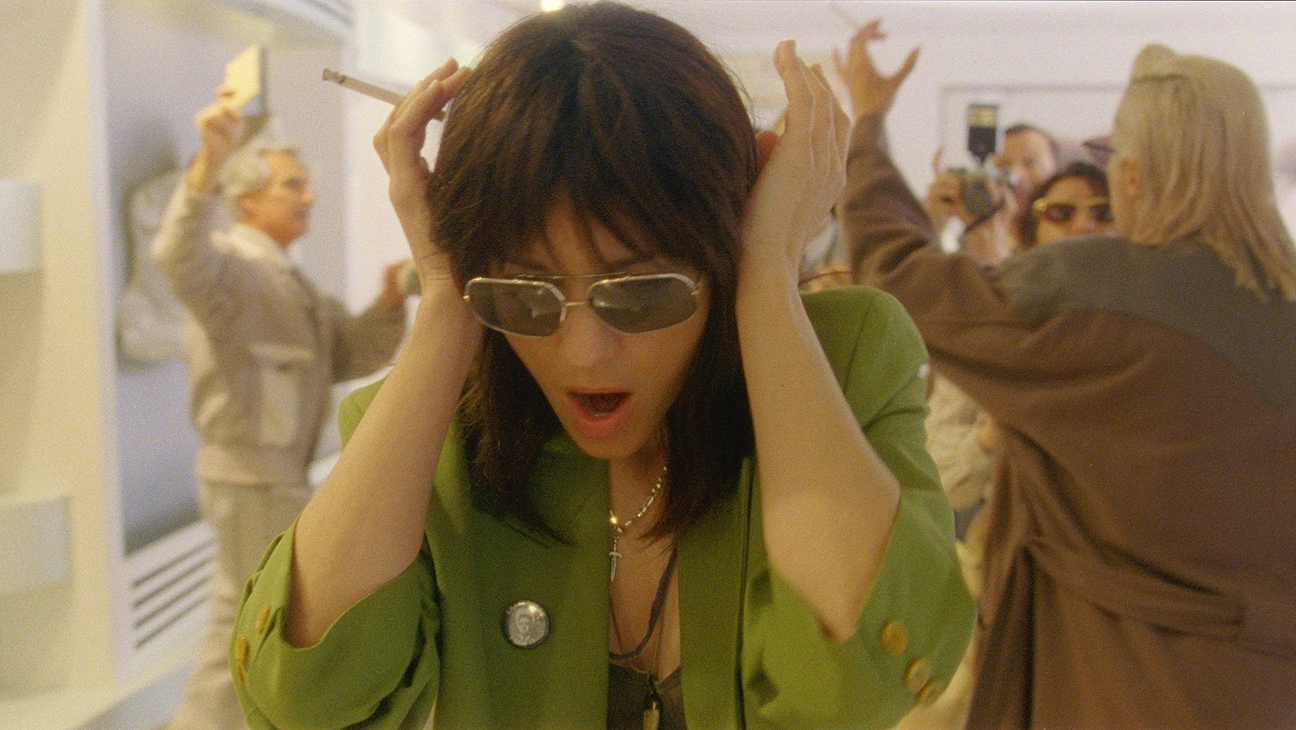

The year is 1982, a cultural hinge where the polished artificiality of a new decade collides with the ruined grandeur of an older one. Bertrand Mandico introduces Eddie Mars, an aging scream queen and cinematic diva diagnosed with a terminal brain tumor.
She declines the comfort of quiet disappearance and chooses defiance. She travels to Rome to shoot a final, aggressively pretentious science-fiction feature, converting her biological countdown into theater. Naturally, cinema demands a curtain call with paperwork.
Mandico stages this hallucinogenic psychodrama with his familiar hunger for surreal imagery. Marion Cotillard dominates the frame, giving Eddie a desperate magnetism that feels both theatrical and raw. Noémie Merlant appears as her loyal confidante, while Italian cinema veterans Franco Nero and Ornella Muti lend cameos that root the project in historical irony.
The atmosphere works as a fever-dream tribute to B-movie memory, mixing high camp with a grave meditation on mortality. The film asks if an artist can outrun bodily decay by surrendering herself to celluloid. It becomes a vivid study of a mind splintering beneath the pressure of its own expiration date.
The Kaleidoscope of Cinematic Ghost Hunting
The narrative structure depends on a nested film-within-a-film design, a classic psychological thriller mechanism that unsettles the viewer’s footing. Eddie plays Rowina, an art-rock star moving through a monochrome dystopian future set in 2026. This inner world presents a bizarre terrain where neo-fascists fight ecologists, and citizens pass through single-use transit funnels.
Also Read




Mandico shifts from the lurid colors of 1982 to high-contrast black-and-white, loosening the grip of linear plot development. The film behaves as a dense pastiche of genre ancestry. It summons the sharp, paranoid angles of classic neo-noir, the sensational violence of Italian giallo horror, and the psychological fragmentation associated with David Lynch and Andrzej Żuławski.
As Eddie’s health deteriorates, the line between movie set and private life vanishes. Reality begins to imitate an expressionistic psychological thriller with alarming enthusiasm. A drug-fueled encounter with her neighbors, who work as special effects artists, gives physical shape to her mental collapse.
A spectral double of her younger self appears, joined by a grotesque creature that recalls international cult cinema. The sequence sharpens the film’s concern with lost agency, linking Eddie’s cognitive breakdown to the visible fracture of the cinematic medium. The viewer becomes trapped inside her subjectivity, uncertain which horrors come from the script and which emerge from her failing mind.
Divas, Shadows, and the Retinue of Madness
Marion Cotillard gives a performance of remarkable transparency, tracing the point where vanity curdles into terror. She plays Eddie Mars with fierce commitment to physical decline, shaping her as a noir antiheroine whose final criminal gesture is an attempt to cheat death. Cotillard uses her expressive range to hold the film together through passages of extreme alienation.
In a standout sequence, Eddie confronts a mirror while wearing a prosthetic second head, a literal image of fractured identity that lands with tragic force. Absurdity is present, naturally. The sadness wins. “Filmmaking is the antidote to old age,” gasps an ancient director on set, capturing the desperate philosophy driving the production.
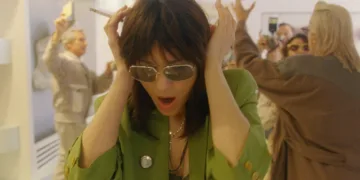
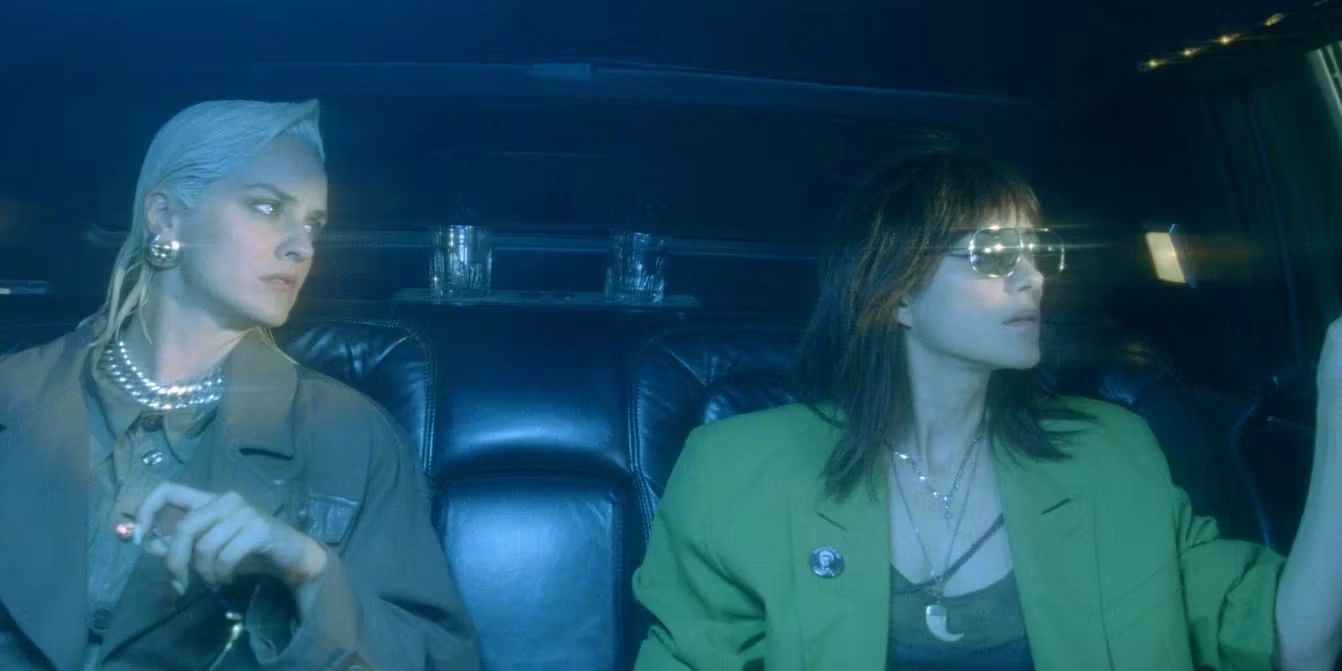
Noémie Merlant supplies the needed emotional ballast as Valentina, Eddie’s makeup artist and protector, rendered nearly unrecognizable through a slicked-back, peroxide-blonde look. Valentina operates as a steady lens, a pragmatic noir sidekick guarding a doomed partner. Her grounded presence steadies Eddie and creates charged friction against the film’s surrounding theatricality.
That stability faces constant assault from the larger ensemble. Franco Nero appears as a philosophical director offering wry reflections on the vanity of the medium, while Ornella Muti presides over a chaotic, grotesque Italian talk show filled with masked figures. These performances bring self-reflexive humor to the film, teasing the solemnity it also works so hard to cultivate. A little vanity goes a long way. Cinema keeps ordering seconds.
Chiaroscuro Aesthetics and Auditory Irony
Visually, the film is a masterclass in deliberate artifice, rejecting naturalism through expressionistic framing. Production designer Toma Baqueni merges genuine Roman architecture with the cavernous soundstages of Cinecittà studios, filling the frame with crumbling marble busts and unfinished apartments. Pauline Jacquard’s wardrobe contributions deepen the atmosphere through sharp, angular 1980s costuming that creates a harsh geometric counterpoint to Eddie’s organic decay.
Cinematographer Nicolas Eveilleau captures the madness through aggressive technical language. His camera depends on high-contrast black-and-white film stock, surreal superimpositions, and rear-projection techniques that sustain the film’s fevered pressure. The lighting draws on deep chiaroscuro, sinking characters into pools of shadow to stress the theme of existential erasure. Faces become masks. Bodies become evidence.
Fragmentation dominates the image system. Broken classical sculptures with missing limbs fill the backgrounds, serving as repeated visual reminders of Eddie’s internal physical apocalypse. Eddie wears an Eraserhead lapel pin through her travels, a direct signal of the film’s lineage of psychological breakdown.
Pierre Desprats’ sound design manipulates audience perception by moving between high art and pop cynicism. The auditory field shifts from the grand, ordered structures of Bach and Tchaikovsky to the dissolution of Peggy Lee singing “Me and My Shadow.” The final needle drop of “Is That All There Is?” becomes a dry, understated punchline about human mortality, pricking the film’s dense visual poetry with a shrug. Death arrives, and apparently it has a decent record collection.
The Eternal Circus of Eros and Thanatos
The film’s main thematic pressure point examines the entertainment industry as an uncompromising, predatory circus. Mandico sets the legendary history of Italian cinema against cheap 1980s special effects and the aggressive flashbulbs of airport paparazzi.
This collision raises sharp existential questions about the value of an image. The script maps a complex web where Eros and Thanatos pull Eddie in tandem. For her, the camera becomes a form of life insurance, a desperate wager on artistic immortality through the preservation of myth before the body collapses.
Mandico intentionally favors immersive spaces and rich textures over traditional narrative cohesion. The choice creates a polarizing experience that values lasting sensory impressions over tidy psychological resolutions. Through high camp and the agony of fading stardom, the work studies how people build myths to shield themselves from loneliness and suffering. Flesh decays. Performance remains fixed, waiting for a future audience to summon the ghost back onto the screen.
The French-Italian co-production Roma Elastica recently made its world premiere in the prestigious Midnight Screenings section at the 79th Cannes Film Festival in May 2026. Following its festival debut, the surreal psychodrama is currently expanding its festival run and will be available on specialized arthouse streaming platforms like MUBI later this year, as well as receiving selective theatrical distribution across Europe through partners like Rai Cinema.
Full Credits
Title: Roma Elastica
Distributor: Rai Cinema, Atelier de Production
Release date: April 26, 2026
Running time: 107 minutes
Director: Bertrand Mandico
Writers: Bertrand Mandico
Producers and Executive Producers: Thomas Verhaeghe, Mathieu Verhaeghe, Marco Alessi, Daniele Segre
Cast: Marion Cotillard, Noémie Merlant, Martina Scrinzi, Agnese Claisse, Milutin Dapcevic, Isabella Ferrari, Maurizio Lombardi, Ornella Muti, Franco Nero, Zlatko Burić
Director of Photography (Cinematographer): Nicolas Eveilleau
Editors: Laure Saint-Marc
Composer: Pierre Desprats
The Review
Roma Elastica
Bertrand Mandico’s Roma Elastica is a polarizing, hallucinogenic dive into the anxieties of aging and the vanity of the screen. While its non-linear narrative and aggressive aesthetic excess will alienate viewers seeking traditional psychological depth, the film survives on pure sensory audacity and Marion Cotillard’s mesmerizing, fearless performance. It stands as a dark, stylized memento mori for cult cinema enthusiasts.
PROS
- A fiercely committed, towering lead performance by Marion Cotillard.
- Stunning, high-contrast chiaroscuro cinematography and inventive production design.
- A rich, atmospheric soundtrack that effectively uses auditory irony.
CONS
- Fragmented, non-linear narrative structure that occasionally sacrifices substance for style.
- Overly indulgent, high-camp sequences that risk exhausting the audience.