





























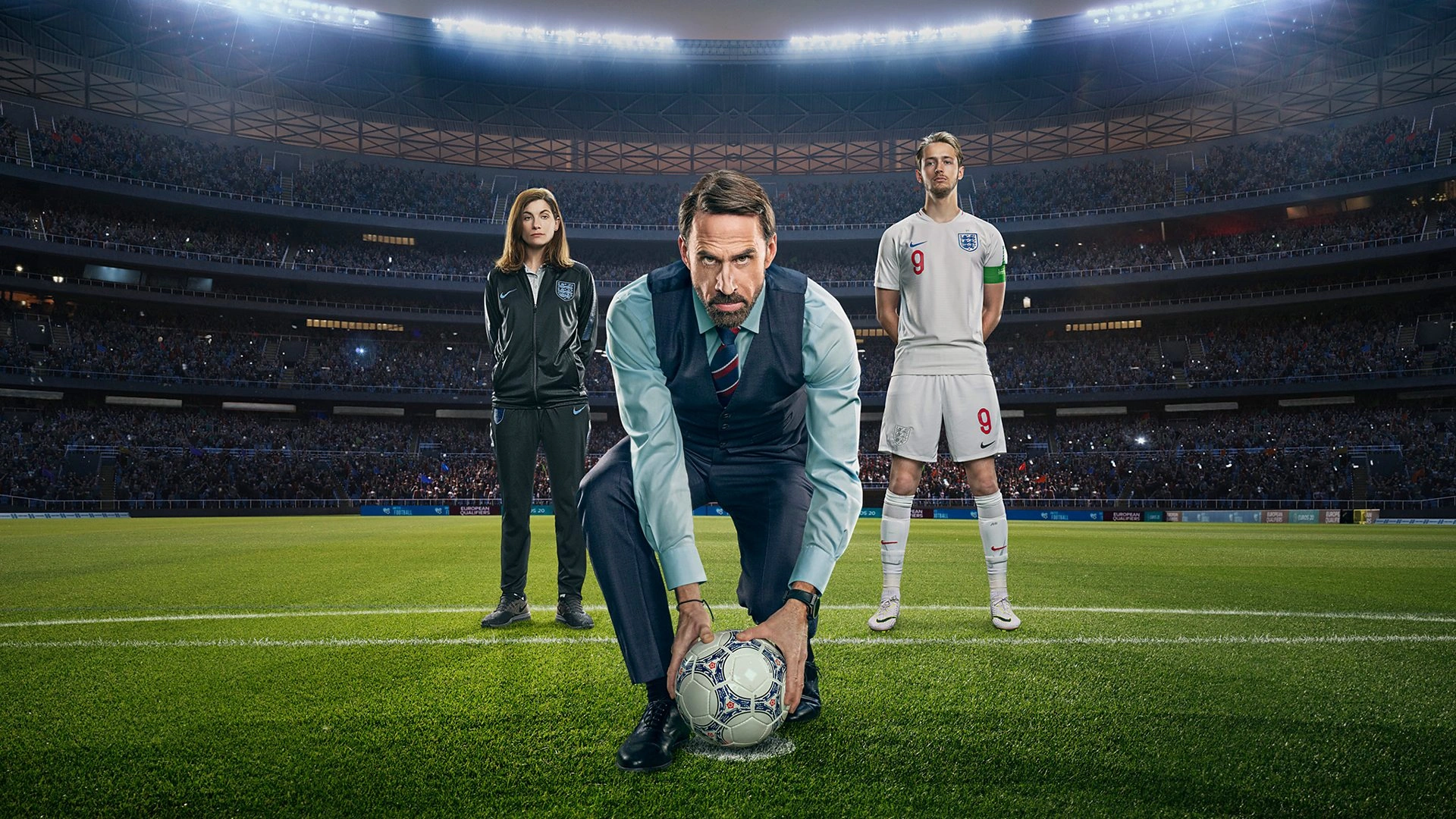

The BBC television adaptation of Dear England, scripted by James Graham and directed by Rupert Goold, stretches the acclaimed National Theatre stage production into a four-part drama. The narrative follows Gareth Southgate’s tenure as manager of the England men’s national football team, running from the humiliation of the 2016 European Championship defeat against Iceland to the end of his leadership in 2024.
The series treats this era as a psychological renovation of a historically troubled institution, a sports story with therapy notes stuffed into the kit bag. It opens with the old bruise of Southgate’s missed penalty at Euro 1996, turning his appointment into a confrontation with inherited athletic trauma.
By bringing in sports psychologist Pippa Grange, Southgate attacks the aggressive habits of masculine sports culture and replaces tactical fixation with emotional literacy, vulnerability, and collective resilience. Across multiple international tournaments, the squad’s internal cultural shift reflects the social anxiety, political division, and cultural movement running through the country.
Anatomy of a Psychological Revolution
James Graham treats the football pitch as a national psychiatric couch, and yes, the couch has studs on. In this version, the adversary haunting the England squad is an internalized fear of history repeating itself. The script makes clear that these multimillionaire athletes possess physical skill in abundance.
Their paralysis comes from the threat of public humiliation, with the penalty shootout serving as the sport’s cruel little trapdoor. By framing the team’s historical deficit as a mental blockage, the narrative follows the shape of classical psychological drama, where the protagonist must conquer an inner demon before meeting the external antagonist.
That setup drives an argument about leadership. Southgate and Grange introduce an empathetic, progressive model into a football culture long shaped by macho management tropes. In the historically hostile atmosphere of English football, diaries, open talk about anxiety, and visible vulnerability become radical moves. The show turns the sports-biopic format into a quieter study of emotional repair, where aggressive grit loses its automatic hero music. A team meeting becomes an exorcism with better tracksuits.
Also Read






The series uses the national team to examine wider cultural pathologies, turning the squad into a mirror held up to the country. It charts how impossible public expectations and buried collective shame can curdle athletic disappointment into public hostility.
This creates a sharp narrative problem because history stays put. The team does not win a major trophy. Graham handles that fixed outcome by moving the dramatic target, finding meaning in loss and concentrating on the painful education of losing with dignity.
Real-world events keep breaking into the athletic bubble. The narrative folds in the turbulent backdrop of contemporary British politics, including revolving-door prime ministers, a pandemic, and massive cultural shifts. The pacing slows to study the public reaction to the squad’s stance on diversity, with targeted racial hostility aimed at young players after tournament exits. These sequences show the limits of the football revolution. Some societal fractures sit too deep for a squad talk and a neat tactical reset.
The Caricature in the Waistcoat
Joseph Fiennes plays Southgate with tortured intensity that sometimes seems better suited to a gritty war veteran than a polite football manager. The move from the scale of theatre to the merciless intimacy of television close-ups exposes the limits of the performance. Fiennes copies the physical mannerisms with eerie precision. The rapid blinking, the chin stroking, the knuckle dabbing the philtrum, and the twitching lips all arrive on cue.
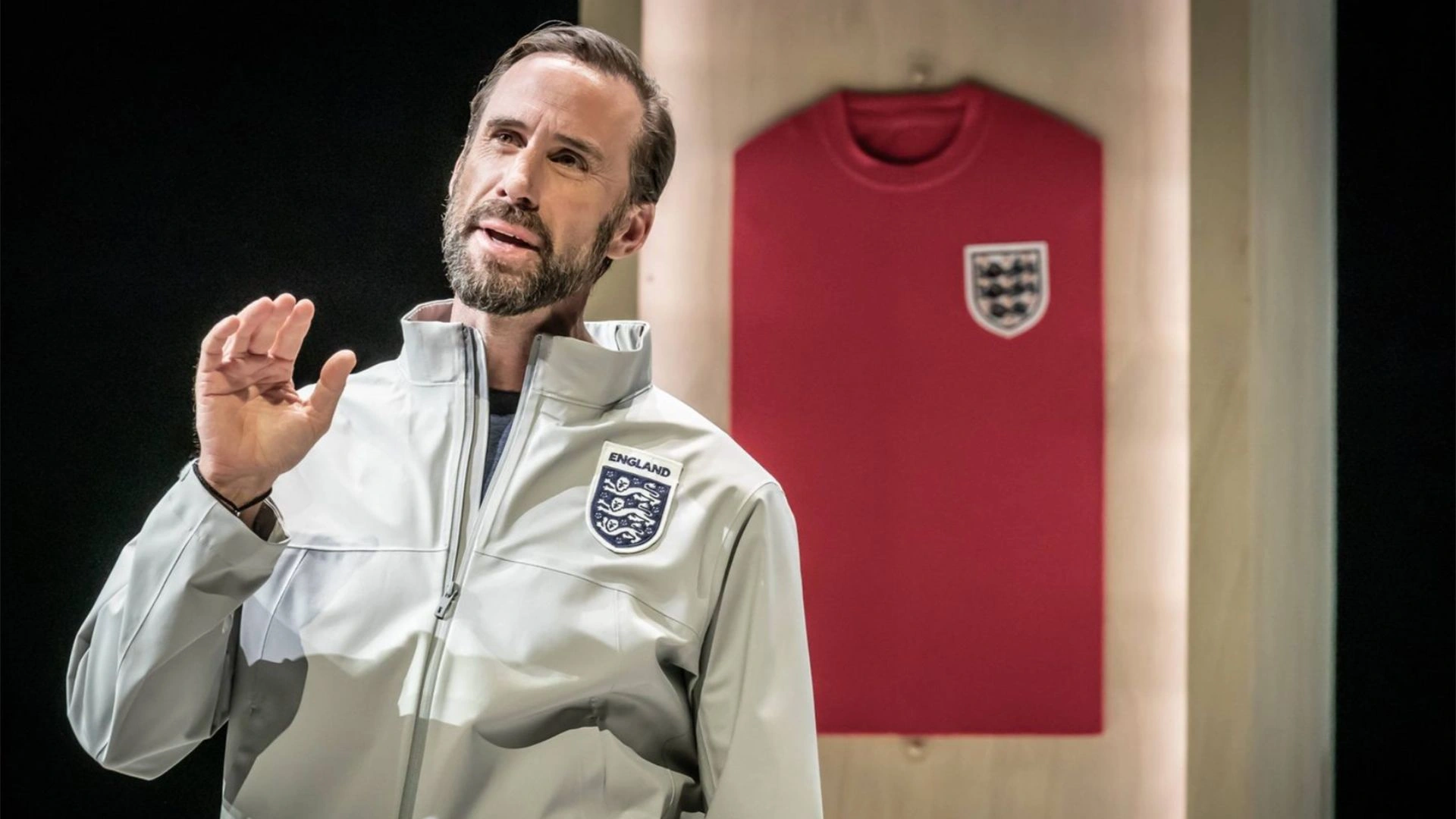
The camera enlarges those tics into caricature. Add the cringing head bob and sideways drawl, and Southgate begins to resemble a haunted savant. The real manager holds attention through reflective, polite everyman decency. Recasting him as a broken genius risks sanding away the quality that made him such an unusual public figure.
The supporting cast supplies a needed human grounding force. Jodie Whittaker plays sports psychologist Pippa Grange with calm, rational focus, giving the management team’s anxiety a steady counterweight. The young ensemble faces the awkward job of portraying globally famous athletes, a task loaded with wig-room peril. Will Antenbring gives the standout performance as Harry Kane.
His face and build barely recall the actual striker. His voice lands with uncanny accuracy. The script also reshapes the public idea of Kane: here, he functions as an emotionally intelligent lieutenant, with the robotic professional image left outside the dressing room. Vocal and psychological fidelity carry greater force here than a simple physical likeness, which is fortunate for everyone who has ever looked nothing like Harry Kane.
The Theatrical Ghost in the Television Machine
Director Rupert Goold faces a tricky technical problem in translating a stylized stage play into episodic television. The production keeps several minimalist theatrical devices, creating an uneasy truce with small-screen realism. That stylistic friction becomes clearest during the critical match moments.
To capture the internal isolation of a player during a penalty shootout, Goold places the actors against plain, spotlit black backdrops. The expressionistic choice communicates the psychological pressure inside an athlete’s head, and it can be striking. It can also make the show feel like filmed theatre wearing a prestige-drama scarf.
This structural experimentation crashes into the use of real archive footage. Blending scripted drama with broadcast clips of famous matches creates an immediate continuity problem. The editing uses clever techniques to obscure the faces of real players during archive footage, trying to keep visual consistency with the actors. The method can capture the organic tension of the sport.
It can also break the spell completely when crisp digital drama gives way to grainy real-world broadcast footage, leaving the viewer to wonder if the original match highlights on YouTube might deliver stronger dramatic satisfaction. Does a football match, already an unscripted reality show with built-in stakes, gain anything after passing through the dramatic machinery of a prestige miniseries?
The four-part television drama premiered on BBC One and became available for streaming on BBC iPlayer on Sunday, 24 May 2026. The miniseries expands James Graham’s Olivier Award-winning stage play into an episodic exploration of British sporting culture, tracing Gareth Southgate’s managerial journey from 2016 through the conclusion of his tenure in 2024. Viewers can watch the complete series streaming on BBC iPlayer in the United Kingdom, or via Binge in Australia starting 28 May 2026.
Full Credits
Title: Dear England
Distributor: BBC One, BBC iPlayer
Release date: 24 May 2026
Rating: TV-MA
Running time: 57 minutes per episode
Director: Rupert Goold, Paul Whittington
Writers: James Graham
Producers and Executive Producers: Tina Pawlik, James Graham, Rupert Goold, Andy Harries, Rebecca Hodgson, Jo McClellan, Sami El-Hadi
Cast: Joseph Fiennes, Jodie Whittaker, Daniel Ryan, Sam Spruell, John Hodgkinson, Jason Watkins, Andrew Dunn, Bobby Schofield, Adam Hugill, David Shields, Francis Lovehall, Lewis Shepherd, Hamish Frew, Edem-Ita Duke, Josh Barrow, Will Antenbring
Director of Photography (Cinematographer): Tony Slater Ling
Editors: Yan Miles, Pia Di Cula
Composer: Dan Gillespie Sells
The Review
Dear England
Dear England functions better as an ambitious cultural autopsy than a smooth television drama. James Graham’s sharp state-of-the-nation commentary provides intellectual depth, but the production trips over its own theatrical roots. Joseph Fiennes delivers an uncanny physical performance that unfortunately curdles into distracting caricature under the lens of a television close-up. While the emotional highs of the 2018 summer resonate, the series struggles to maintain momentum when confronting the tactical realities and ultimate disappointments of the later Southgate era. It remains a fascinating, if uneven, experiment in sports storytelling.
PROS
- Boldly reframes a sports biography into a thoughtful study of national identity, masculinity, and collective psychology.
- Strong performances from the young ensemble, particularly a vocally precise and emotionally intelligent portrayal of Harry Kane.
- Jodie Whittaker provides a compelling, rational anchor as sports psychologist Pippa Grange.
CONS
- Joseph Fiennes relies heavily on physical tics, turning a gentle everyman into an eccentric caricature.
- The jarring transition between real archive footage and expressionistic, black-backdrop stage recreations shatters the immersion.
- The script frequently suffers from heavy-handed, leaden dialogue that overstates its political metaphors.