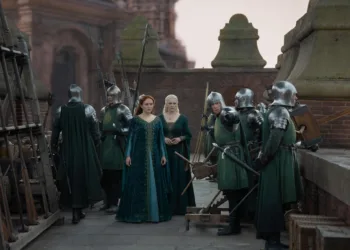
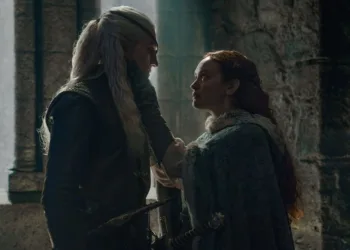
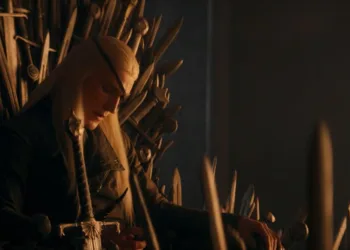
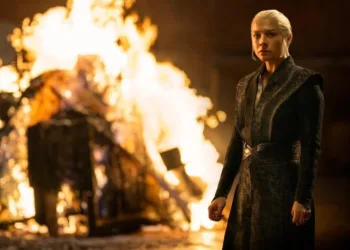
House of the Dragon has always been a study in inherited catastrophe, which sounds grand until one remembers that inheritance here means children receiving crowns, grudges, dragons, and a family tree designed by someone who saw a straight line and took it personally. Season 3 begins where Season 2 left its most terrible hope: Rhaenyra and Alicent’s secret bargain, a desperate exchange built on surrender, mercy, and one severed head. Alicent offers King’s Landing. Rhaenyra offers survival to Helaena and Jaehaera. Aegon, burned and broken, becomes the price of peace.
Peace, naturally, has missed its appointment.
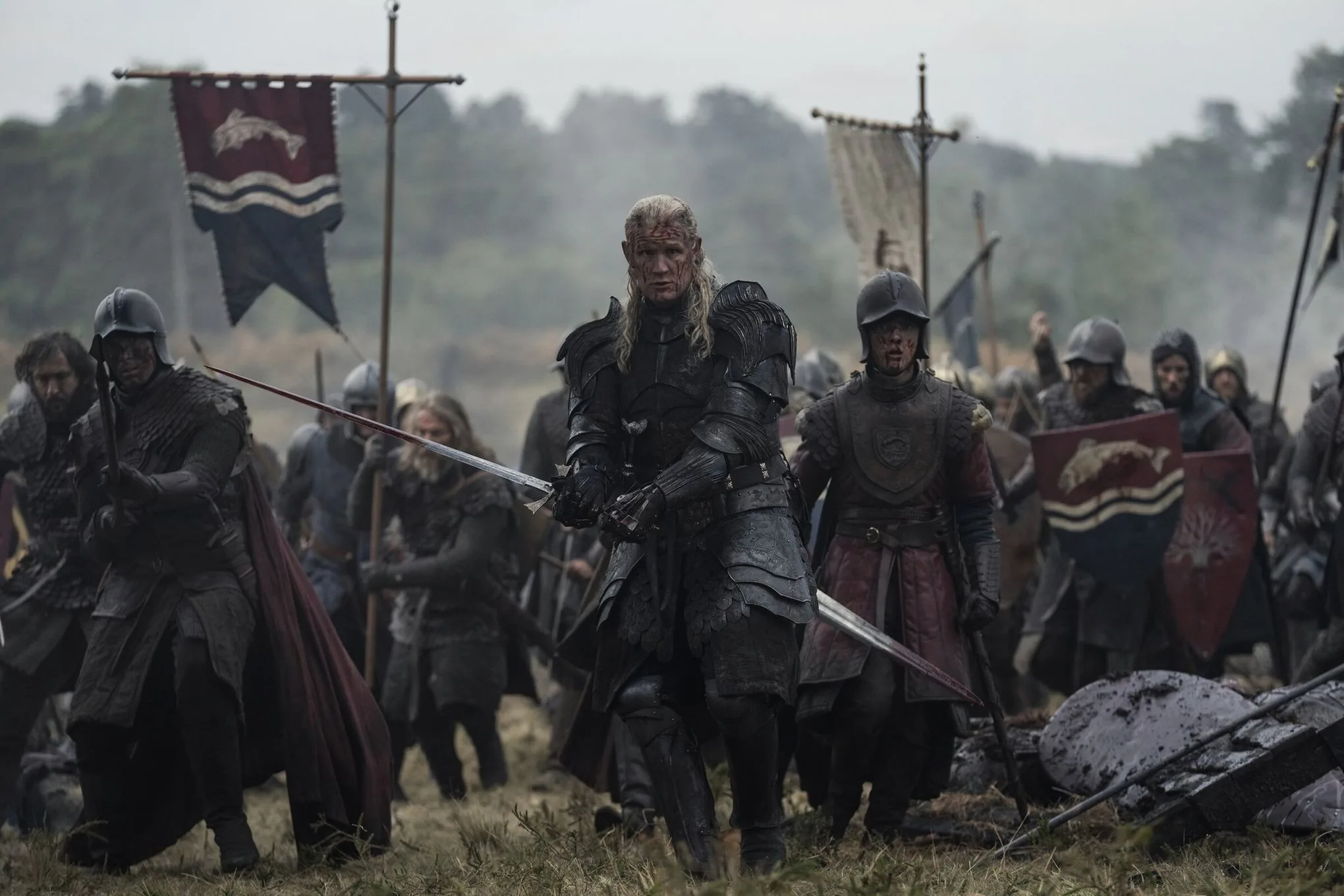
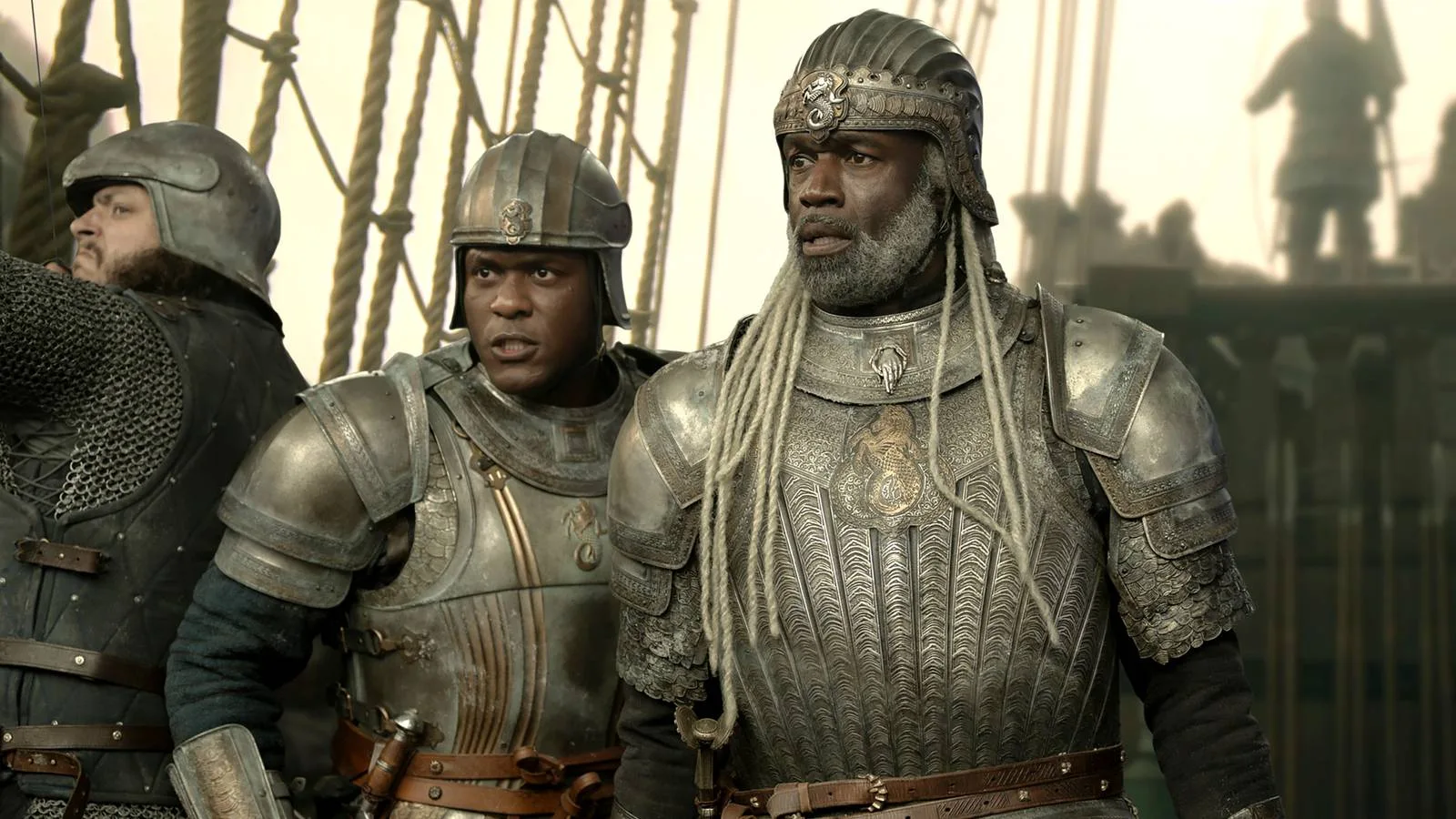
The early episodes throw the realm into the Battle of the Gullet, with Corlys Velaryon’s fleet facing the Triarchy as Rhaenyra’s claim leaves private grief behind and becomes public ruin. The difference from Season 2 is immediate. The previous season often treated war as a storm visible from a window. Season 3 opens the door, lets the rain in, and then sets the house on fire for good measure.
“If this be victory, I hope I never see another,” a survivor says after the battle. The line is almost too neat, yet the image around it earns the sentiment: bodies on the shore, ships reduced to splinters, smoke still rising from an argument no one can win. Call it dynastic entropy, the process by which noble claims turn into common graves.
The Gullet and the Art of Awful Spectacle
The Battle of the Gullet is the season’s first major answer to anyone who thought House of the Dragon had become too enamored with hesitation. It is large, ugly, expensive, and, at its strongest, spiritually miserable. That last part matters. A cleanly exhilarating battle would betray the show’s best instinct, which is that dragon warfare should look less like glory and closer to a state crime committed from the sky.
Director Loni Peristere stages the naval conflict as organized panic. Ships collide. Soldiers slip across decks slick with blood and seawater. Arrows and fire move faster than comprehension. Then the dragons arrive, and whatever remains of strategy starts to look adorable, in the way a paper umbrella is adorable during a meteor shower. Rook’s Rest in Season 2 had the shock of intimate dragon-on-dragon violence, especially through Aegon’s maiming and Rhaenys’s death. The Gullet widens the wound. It turns family vengeance into mass event.
The setpiece works because it never allows scale to become comfort. There are heroic frames, yes, because television with dragons cannot resist a beautiful nightmare. Yet the aftermath keeps poisoning the image. The battle’s true subject is not who wins. It is what victory asks the winner to carry afterward.
That said, Season 3 sometimes pays for its new momentum. The early stretch moves through power shifts at a speed that can feel less like narrative confidence and closer to clerical efficiency. Aegon flees King’s Landing. Aemond takes command. Harrenhal returns to the board. Alicent schemes around sons she can no longer control. Some moments arrive with force, then vanish before their bruises darken. The season has exchanged drift for compression. A good trade, mostly. Still, compression has teeth.
Rhaenyra, Alicent, and the Theology of Wanting Power
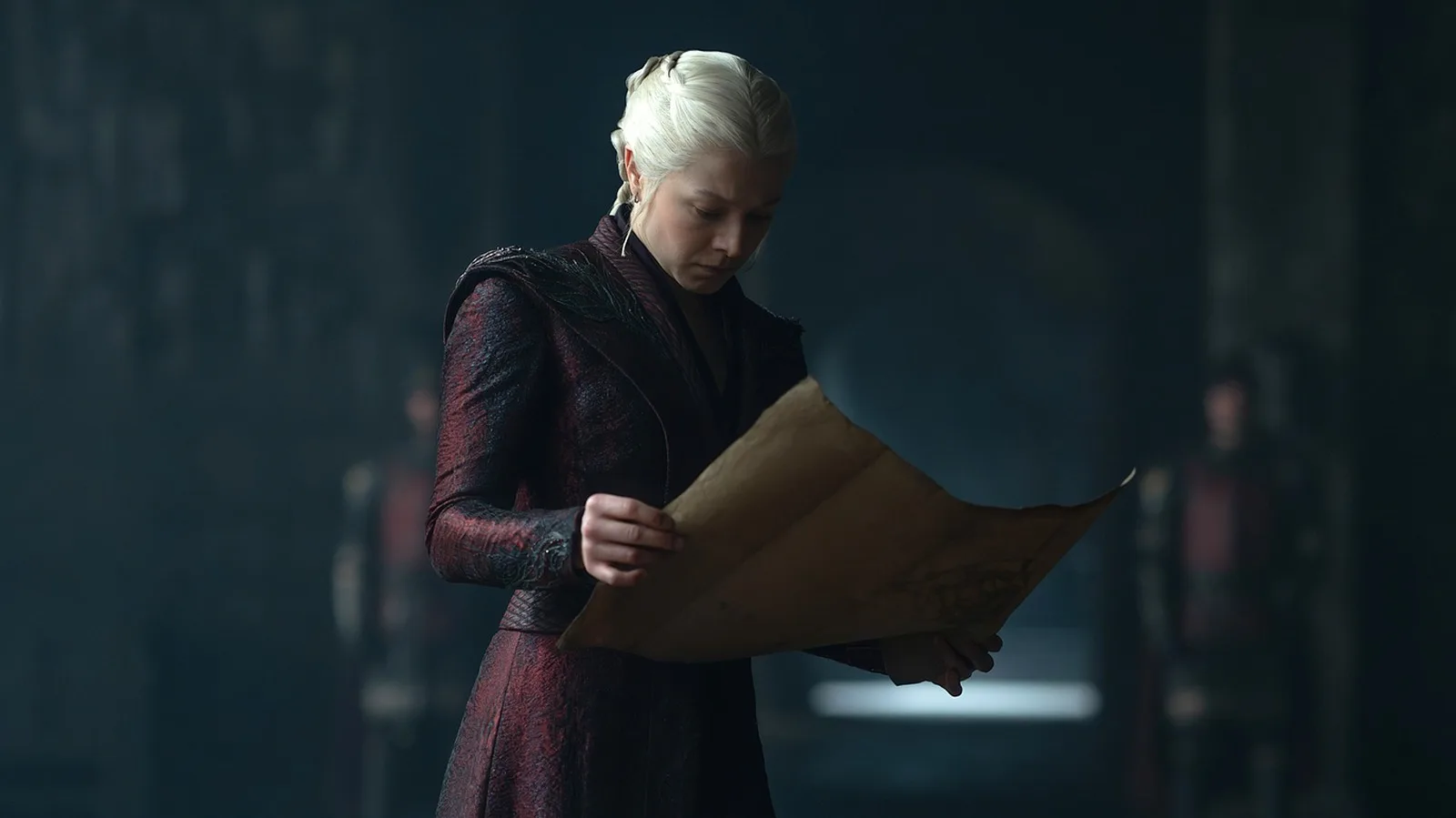
Emma D’Arcy’s Rhaenyra is no longer waiting for history to recognize her. That waiting had its own tragedy in Season 2, yet it also kept the character trapped in reaction. Here, D’Arcy gives her a harder surface. Rhaenyra listens differently now. She commands with a voice that has discovered the pleasure of being obeyed, and that pleasure is dangerous.
Her demand for Aegon’s head is the season’s cleanest moral fracture. The arithmetic is old: a son for a son. What makes it chilling is not cruelty alone, but the feeling that Rhaenyra can still explain it to herself as justice. That is where the show becomes sharper. Evil rarely enters Westeros wearing a little name tag. It arrives dressed as balance, duty, law, prophecy, family memory. A very respectable outfit, frankly. One sees why people keep falling for it.
Season 3 leans further into the Targaryen habit of confusing political authority with sacred exception. Rhaenyra’s claim has always rested on legitimacy, but the early episodes suggest something feverish growing around her. The dragon is no longer simply a weapon or symbol. It becomes proof. The bloodline becomes doctrine. The throne becomes altar furniture.
This is where Alicent remains essential, even when the season gives Olivia Cooke less space than she deserves. Alicent begins these episodes as a woman who tried to end a war by sacrificing one damaged son to save the rest of her family. Cooke plays that bargain without cleansing it. Alicent’s love has become selective under pressure, which may be the most honest kind this family knows.
Scenes between Alicent and Rhaenyra still carry the show’s deepest charge. Their old intimacy has curdled into something stranger than hatred: recognition without rescue. They know the girl inside the queen, and that knowledge has become another weapon neither can put down.
Broken Kings, New Zealots, and Men Who Mistake Honor for Perfume
Tom Glynn-Carney’s Aegon has become one of the series’ most damaged assets, which is quite a feat in a franchise where emotional damage is practically a house sigil. Burned, frightened, bitter, and still absurdly entitled, Aegon moves through the early season like a man haunted by his own body. His return near Rook’s Rest, especially the sight of Meleys’s corpse, gives the character a rare moment of silent comprehension. The war did not happen around him. It went through him.
Pairing him with Larys Strong gives Season 3 one of its better tonal pivots. Matthew Needham keeps Larys unreadable without turning him into a puzzle box with shoes. He watches, recalculates, softens his voice, and leaves every sentence smelling faintly of trap. Together, Aegon and Larys become a grotesque fugitive duo, less comic relief than survival farce.
James Norton’s Ormund Hightower enters as the season’s most useful new disruption. Ormund could have been another stern lord with a banner and a grievance. Norton instead gives him texture: fussy, imposing, deceptive, sensitive to scent, and unpleasantly alert. He feels like a man who would declare divine order while rearranging the room so only he can breathe properly. His zealotry gives Rhaenyra a fresh antagonist, though his arrival does steal some oxygen from Aemond, whose one-eyed menace remains too potent to sideline for long.
Matt Smith’s Daemon remains Matt Smith’s Daemon: charming, theatrical, lethal, and forever one smirk away from making a room worse. Fabien Frankel’s Criston Cole, meanwhile, gets the season’s most useful hypocritical thesis when he says, “We must cling to honor, lest we become beasts ourselves.” Coming from Criston, this is either tragedy or stand-up. Maybe both. His belief in honor has always required aggressive editing.
The supporting field still has thin patches. Jace and Baela need sharper interior lives, especially with the war cutting so close to their inheritance and grief. Rhaena fares better through her contact with Sheepstealer, a wild dragon that opens the season like a warning: power can be mounted, perhaps, but never fully possessed. Ulf White’s rise from drunken commoner to dragonrider carries its own class sting, especially when Rhaenyra tells him he can no longer drink with old friends. Power does not merely lift him. It amputates him socially.
Thrones, Budgets, and the Little People Under the Fire
The dragons look magnificent this season, which is good news for those who watch this series for scale and bad news for every fictional peasant living beneath the flight path. The visual effects give the beasts weight, texture, and terrible grace. Close-ups linger on hide and eye. Aerial shots turn them into weather systems with teeth. In battle, they feel less like creatures than decisions that cannot be recalled.
That is the season’s strongest political idea. Dragons are not symbols of control. They are proof that control was always a fantasy rich people told themselves while commissioning bigger monsters. The Targaryens speak of destiny, blood, and order. The common people receive shortages, corpses, and the thrilling civic experience of being burned by someone else’s birthright.
Episode 3 sharpens this perspective by showing rule as administration rather than myth. Budgets strain. Institutions falter. Public anger gathers shape. Rhaenyra has spent years proving that she deserves the throne, but the throne asks a less flattering question: what can she do once seated near it? Alicent ruled through proximity. Daemon flirts with authority as if it were another dangerous lover. Rhaenyra discovers that legitimacy is easier to recite than governance is to perform.
This is House of the Dragon at its most interesting: less a family saga about rightful succession than a study of aristocratic hallucination. Everyone keeps calling the crown a burden, then clawing toward it with both hands. The show sees the contradiction clearly. Sometimes it even has the decency to laugh at it.
Season 3 is stronger than Season 2 because damage finally replaces anticipation. It is also messier than it needs to be, rushing past certain emotional turns while asking us to mourn them on schedule. Yet when it slows down around Rhaenyra’s hardening face, Alicent’s compromised motherhood, Aegon’s ruined body, Ormund’s sanctified menace, or a beach where victory looks indistinguishable from moral failure, the series finds the dark engine it spent two seasons assembling.
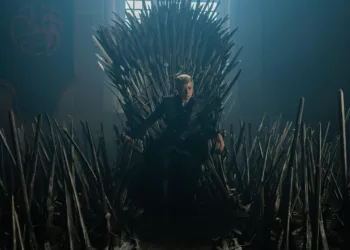
The throne is still ugly. The fire is still beautiful.
That may be the problem.
House of the Dragon Season 3 is set to premier on June 21, 2026, bringing the destructive Targaryen civil war to its most explosive and brutal phase yet. Viewers can watch the eight-episode season on HBO or stream it directly on HBO Max, with new episodes releasing on a weekly schedule. The plot intensifies the deadly “Dance of the Dragons” conflict as Queen Rhaenyra Targaryen utilizes her newly expanded army of dragons to challenge the Green faction for ultimate control of the Iron Throne.
Where to Watch House of the Dragon Season 3 Online
Writers: Ryan Condal, Sara Hess, David Hancock, Philippa Goslett, Shyam Popat, Zenzele Price, Ti Mikkel
Producers and Executive Producers: Ryan Condal, George R.R. Martin, Sara Hess, Melissa Bernstein, Kevin de la Noy, Vince Gerardis, David Hancock, Philippa Goslett, Ron Schmidt, Loni Peristere, Toby Ford, Pam Fitzgerald, Danny Gulliver
Cast: Matt Smith, Emma D’Arcy, Olivia Cooke, Steve Toussaint, Rhys Ifans, Fabien Frankel, Ewan Mitchell, Tom Glynn-Carney, Sonoya Mizuno, Harry Collett, Bethany Antonia, Phoebe Campbell, Phia Saban, Jefferson Hall, Matthew Needham, James Norton, Dan Fogler, Tommy Flanagan, Tom Bennett, Kieran Bew, Kurt Egyiawan, Freddie Fox, Clinton Liberty
Director of Photography (Cinematographer): Vanja Černjul, Alejandro Martínez
Editors: Tim Porter, Selina MacArthur, Crispin Green, Chris Hunter
Composer: Ramin Djawadi
The Review
House of the Dragon Season 3
8Score
House of the Dragon Season 3 finally lets war stop being a threat and become a substance: wet wood, burned skin, divine delusion, bad bookkeeping. Its pace can bruise the character work, and Alicent deserves richer placement, but the season’s best passages turn spectacle into moral nausea. Emma D’Arcy anchors the collapse with frightening clarity, while Aegon, Ormund, Larys, and Daemon keep the dynasty’s rot entertainingly specific. The throne is still ugly. The fire still seduces. Bad family, excellent television.
When you login first time using a Social Login button, we collect your account public profile information shared by Social Login provider, based on your privacy settings. We also get your email address to automatically create an account for you in our website. Once your account is created, you'll be logged-in to this account.
DisagreeAgree
Connect with
I allow to create an account
When you login first time using a Social Login button, we collect your account public profile information shared by Social Login provider, based on your privacy settings. We also get your email address to automatically create an account for you in our website. Once your account is created, you'll be logged-in to this account.