




















Science documentaries often explain invisible forces with diagrams or polished digital animation. Phenomena takes the opposite route. Josef Gatti puts matter under pressure, points a camera at the reaction, and waits for physics to reveal its own imagery.
Expanded from a series of musical shorts later shown by ABC, Gatti’s first feature divides the universe into ten chapters, including light, matter, energy, gravity, sound, electromagnetism, entropy, and life. The structure sounds like a school syllabus, yet the film rarely behaves like a lesson.
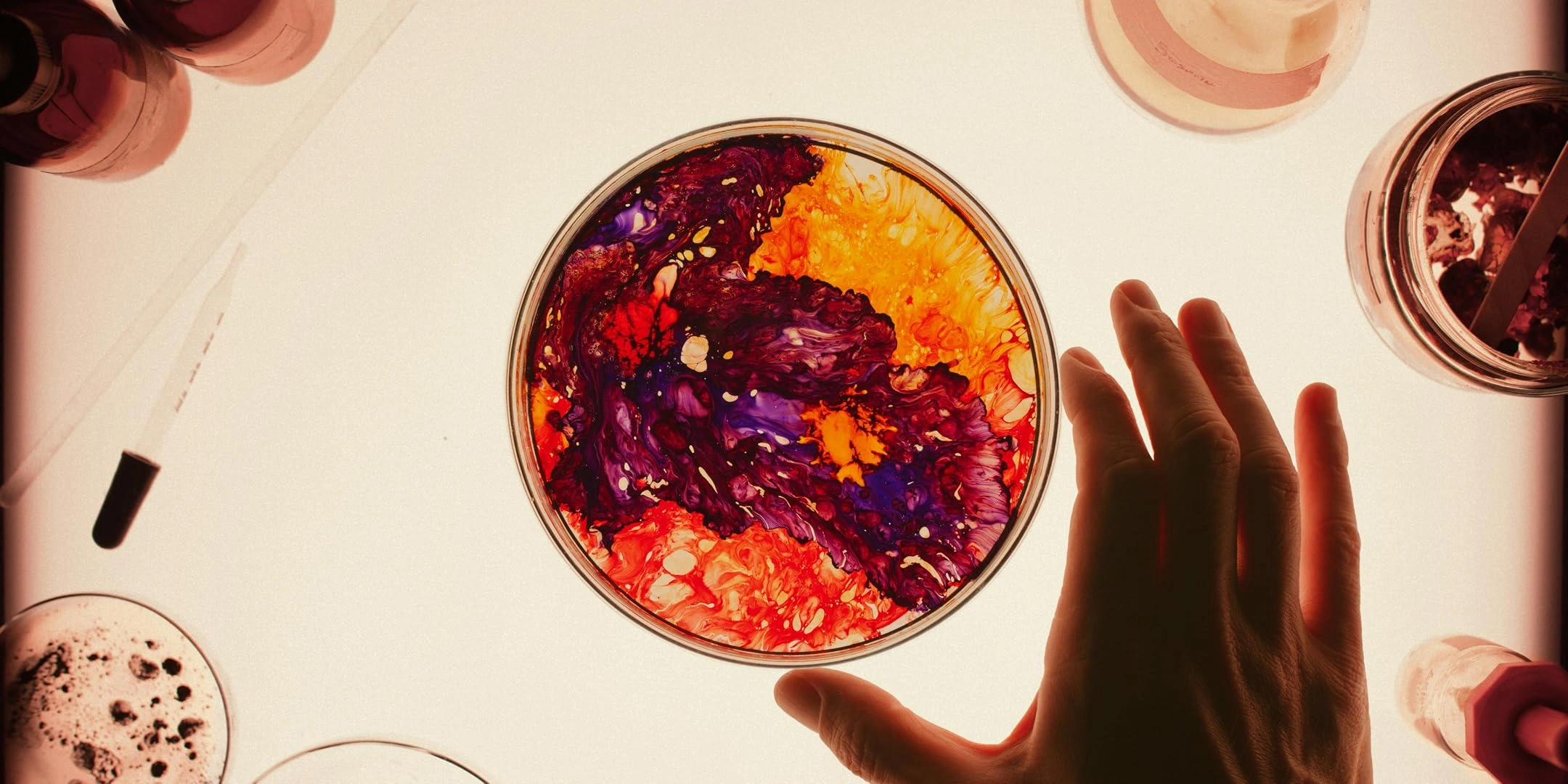
Gatti works inside a backyard shed filled with microscopes, petri dishes, synthesizers, magnets, and whatever material he can collect nearby. His father, a high school physics teacher, occasionally assists, which gives the experiments the relaxed feeling of a family project that escaped into a cinema. Gatti admits that art drew him away from science, but the film shows how closely the two can operate. Each experiment begins with a simple question, then lets color, texture, and movement answer it.
Experiments as Spectacle
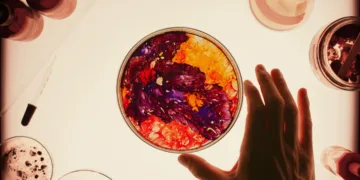
The images are astonishing because they remain physical. Pollen granules exposed to sound frequencies settle into tight formations. Liquid magnetite rises into black spikes under a magnetic field, twitching like a creature trying to assemble itself. Amber-colored resin shifts under heat, while chemical reactions spread across glass in branching streams of orange, violet, and electric blue.
One of the quietest shots may be the most effective. A grain of sand, enlarged roughly one thousand times, takes on the ridges and craters of a distant planet. Gatti does not need to invent a landscape. He needs to change the scale.
That principle guides the cinematography. Intricate close-ups remove familiar references, so a droplet can resemble a storm front and a mineral can resemble something pulled from deep space. The film warns viewers that no artificial intelligence or computer-generated effects were used, a disclaimer that initially feels defensive. After several minutes, it becomes necessary. The camera records transformations so strange that digital fabrication would seem like the easier explanation.
Also Read





The shed setting keeps the spectacle grounded. Cables trail across tables, samples come from the garden, and Gatti warns audiences not to repeat the dangerous experiments at home, “like I did.” The joke matters. It keeps the film from treating curiosity as a sacred ritual. Sometimes discovery begins with poor safety planning.
Science Set to a Beat
Gatti’s narration has the tone of someone excited to share a result before he has found the perfect wording. When he explains that everything in the universe consists of energy and matter vibrating under invisible forces, he quickly admits that it sounds like he is “tripping.” The line breaks the stiffness that can settle over educational filmmaking.
His explanations stay elementary, but the images supply the missing complexity. Lower sound frequencies create simpler formations. Higher ones produce denser patterns. Connecting a synthesizer to an experiment turns vibration into visible geometry, allowing the viewer to watch sound behave rather than merely hear about it.
The music by Rival Consoles, joined by pieces from Nils Frahm, shapes those reactions into distinct sequences. Pulsing electronics make particle movement feel like a miniature rave. Softer ambient passages slow the eye, giving liquid and resin time to stretch, divide, and settle. Editing by Gatti and Johanna Scott follows the same musical logic, cutting through changes in rhythm, scale, and direction instead of building a conventional narrative.
The ten chapters do expose the film’s short-form origin. Most repeat a pattern of explanation, preparation, reaction, and reflection. There is little dramatic development, and the transitions can feel like a gallery program moving to the next installation. The changing materials prevent the repetition from becoming dull, especially when the soundtrack finds a new pulse for each experiment.
Wonder Under Pressure
The real subject is sustained attention. Gatti asks viewers to stare at pollen, sand, liquid metal, and vibrating particles long enough for ordinary matter to lose its ordinary appearance. In a media culture trained by rapid clips and constant scrolling, that patience feels quietly radical.
Phenomena belongs to the tradition of experimental cinema that treats image and sound as primary carriers of meaning. Its chapters could survive as separate museum pieces, yet Gatti’s warm narration gives them continuity. He is less a distant expert than an enthusiastic guide, one who still seems surprised when an experiment works.
An ecological idea grows from that curiosity. The film never pauses for a speech about climate change, soil loss, deforestation, or damaged ecosystems. Instead, it shows natural processes as intricate, unstable, and alive. A petri dish becomes evidence. A grain of sand becomes a world. Beauty does the arguing.
This is also a film that gains force in a theater. The close-ups need scale, and the electronic score needs enough volume to turn vibration into a physical sensation. Watching magnetite rise across a large screen, surrounded by Rival Consoles’ low frequencies, makes a backyard experiment feel briefly cosmic.
Phenomena premiered in March 2026 at international film festivals like True/False and CPH:DOX, with distribution handled by Sandbox Films. The experimental documentary offers a psychedelic odyssey into the fabric of the universe through practical in-camera physics experiments.
Full Credits
Title: Phenomena
Distributor: Sandbox Films
Release date: March 17, 2026
Running time: 80 minutes
Director: Josef Gatti
Writers: Josef Gatti, Joseph Nizeti
Producers and Executive Producers: Rob Innes, Jessica Harrop, Caitlin Mae Burke, Jad Abumrad, Joseph Nizeti, Josef Gatti
Cast: Josef Gatti, Mark Gatti, Emme Orbach, John-Paul James, James McAsey
Director of Photography (Cinematographer): Josef Gatti, Martine
Editors: Johanna Scott, Josef Gatti
Composer: Rival Consoles, Nils Frahm
The Review
Phenomena
Phenomena turns familiar physics into a tactile cinematic playground, finding strange planets inside grains of sand and choreography within magnetic liquid. Josef Gatti’s clear narration keeps the science approachable, while Rival Consoles and Nils Frahm give each reaction its own pulse. The ten-chapter structure occasionally exposes the project’s short-form roots, yet the imagery remains absorbing because every experiment produces a fresh movement, texture, or scale. It left me looking at ordinary matter with renewed curiosity, which may be the film’s finest experiment.
PROS
- Remarkable practical imagery
- Inviting scientific explanations
- Hypnotic electronic score
- Playful, handmade personality
- Strong theatrical sound design
CONS
- Repetitive chapter pattern
- Limited narrative development
- Short-form origins remain visible