


















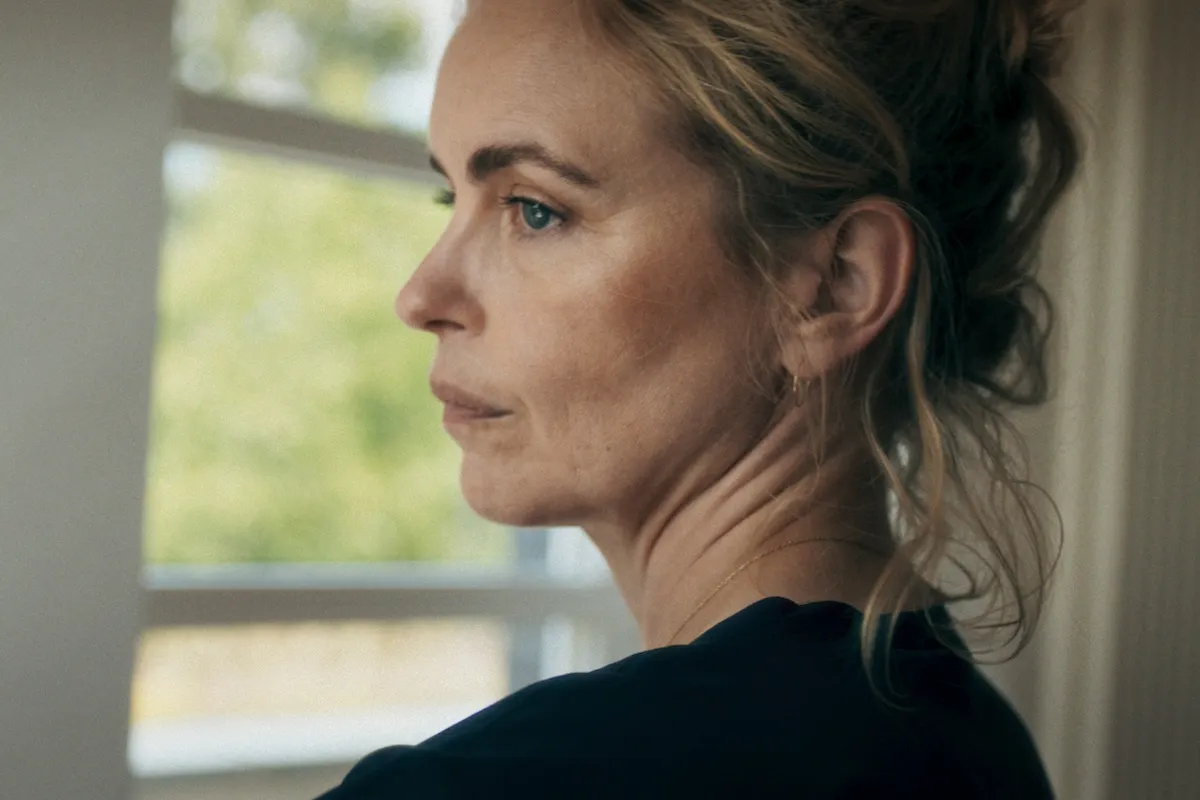

“Cicadas,” written and directed by Ina Weisse and anchored by Nina Hoss (who also serves as executive producer), unfolds over roughly 100 minutes in German and French. Co-stars Saskia Rosendahl, Vincent Macaigne, and Thorsten Merten orbit Hoss’s Isabell, a late-forties Berlin real-estate agent caught between two worlds.
Isabell’s life is measured in caregiving: tending to her stroke-stricken architect father and aging art-teacher mother in their sleek Brandenburg weekend home, all while Philippe, her French engineer husband, drifts ever farther from their marital vows. Into this precarious balance steps Anja, a single mother eking out a living in the countryside and haunted by her restless daughter. Their chance encounter sets in motion a silent reckoning of duty, longing, and the ache of solitude.
Cityscapes of steel and glass clash with the forest’s green hush, and the film’s rhythm slips between the contemplative and the uncanny. Moments of quiet scrutiny—Isabell’s gaze on a leaking window pane, Anja’s deserted playground—linger like questions without answers. The tone is hushed, almost tremulous, with flickers of dark humor and undercurrents of something approaching dread.
Unraveling Paths and Shifting Grounds
In its opening act, Cicadas meticulously sketches two parallel worlds. In Berlin, Isabell moves through glass-walled apartments and boardroom corridors, her mornings defined by property showings and frantic phone calls arranging carers for her ailing parents. Each appointment carries the weight of unspoken obligation—she is both steward and jailer of her family’s legacy.
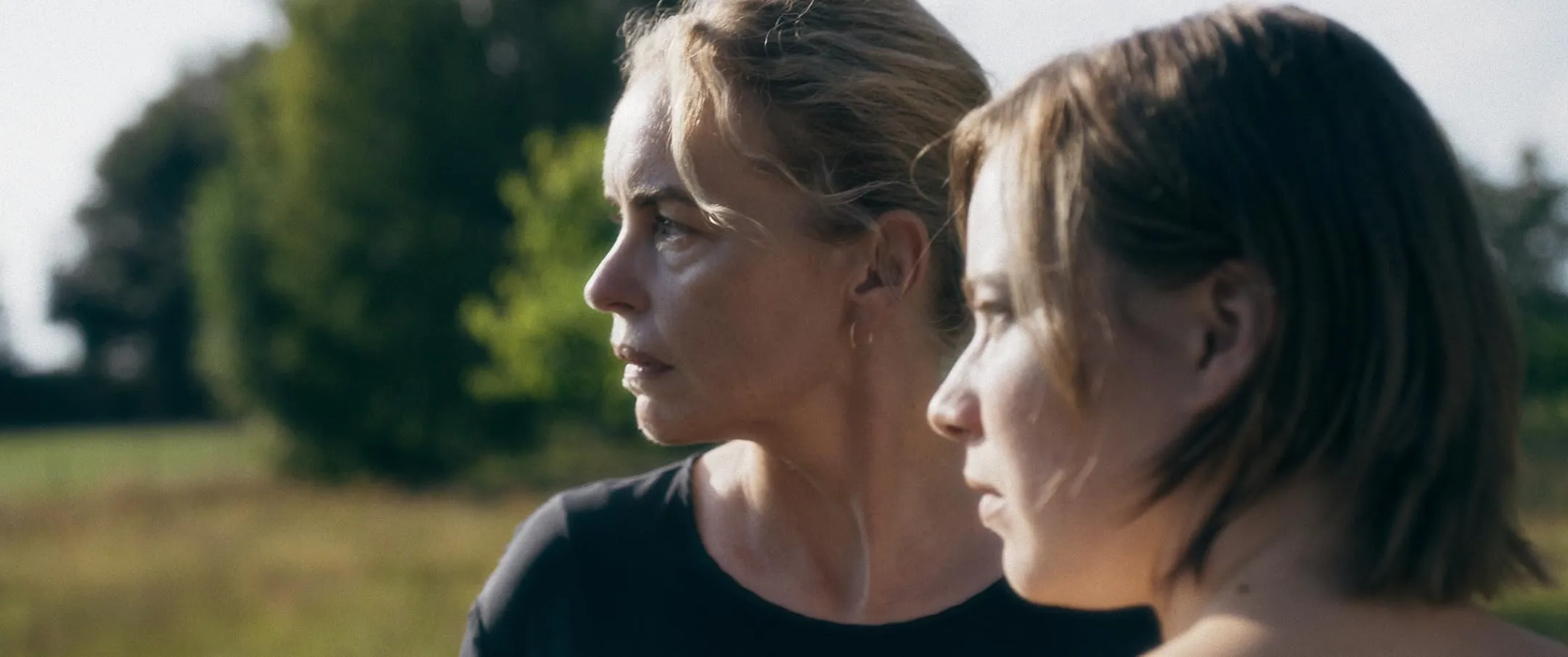
Meanwhile, in the overgrown quiet of Brandenburg, Anja scrambles from her bowling-alley shift to chase her daughter, Greta, through a forest’s dappled shadows. The child’s laughter and the clatter of pins create an uneasy counterpoint to Isabell’s steel-toned routine.
By mid-film, their paths converge on that modernist estate—an edifice of sharp angles and leaky windows. Isabell greets Anja with thinly veiled disdain, yet beneath her polished composure flickers a hesitant curiosity. Caregiver interviews in Isabell’s father’s living room run parallel to Anja hauling greasy dishes and emptying bowling pins. Class distinctions echo in every frame: the polished hardwood of Isabell’s world versus the scuffed linoleum of Anja’s.
Intermittent scenes with Philippe shift the mood—from domestic tension to absurdist comedy. His airport abandonment and later, post-surgery return with a colostomy bag, break the film’s quiet rhythm, revealing marriage as both comic tragedy and grotesque farce.
As tension mounts, shared dinners glow under low light, and off-hand remarks—“Are you attracted to her?”—hover between earnest question and veiled accusation. The house itself breathes decay: insects threading through cracked mortar, water pooling beneath bowed gutters. Architecture becomes memory’s vessel, fracturing under the pressure of familial guilt.
In the final act, Greta’s unsupervised romp through the empty halls becomes a dark echo of generational neglect. And when Isabell and Anja stand face to face in that silent, sunlit room, no answer materializes—only a residual tremor of possibility and doubt, as the film’s unresolved chord hangs in midair.
Echoes of Obligation and Longing
In Cicadas, the burden of family duty becomes a quiet existential trial. Isabell bends her life around her father’s domineering needs—an architect once at the center of every conversation now reduced to a chair and whispered commands. Her mother’s devotion deepens Isabell’s guilt; Anja’s fear of social workers looms like a specter over her own maternal identity, each woman haunted by the possibility of failing the very people she loves.
A stark gulf of privilege carves through their worlds. Berlin’s polished façades and geometric homes stand against Anja’s cramped flat and the shifting earth of Brandenburg’s forest paths. Shared glances across this divide carry both solidarity and suspicion, reminding us that empathy often fractures upon the jagged edges of class.
Within these converging lives, autonomy becomes elusive. Isabell’s professional success feels hollow when measured against her own stagnation; Anja’s fight for economic independence threatens to swallow her, child and all. Each woman circles the other, seeking reflection yet finding only projections of unfulfilled desires.
Underpinning their entanglement is a silent question of longing. Are their burgeoning feelings born of genuine connection, or are they mirrors for concealed voids? The film never answers, instead letting off-hand lines hover between confession and manipulation.
All the while, the modernist house looms as a living cipher—its leaking gutters and scuttling insects echoing a family’s slow decay. Outside, the cicadas’ chorus pulses beneath the surface, a reminder that life’s cycles persist even in the most rigid of structures.
Portraits of Care and Yearning
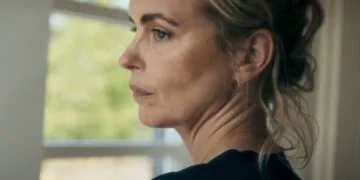
Isabell, as embodied by Nina Hoss, is a study in taut tension—her body a vessel of unspoken debts. Every tilt of her head, each measured step through her parents’ modernist halls, feels calibrated to preserve a fragile equilibrium. Hoss’s controlled expressions betray an internal tremor: the dutiful daughter who, beneath her practiced composure, wonders if duty has become her identity. In one quiet shot, she pauses before a leaking windowpane, her reflection fractured by a stray droplet—an image of a woman teetering on the edge of choice and obligation.
Across the divide stands Anja, brought to life by Saskia Rosendahl with fierce, weary intensity. She moves with the gait of someone perpetually balancing exhaustion and resolve, her eyes scanning every shadow for threats to Greta’s well-being. Yet there’s an inscrutable flicker: is this protectiveness born of pure love, or a deeper hunger for connection with the unburdened daughter-figure she sees in Isabell? Rosendahl whispers questions of trust and manipulation into the film’s margins, leaving us unsure which impulses are authentic, which are projections of abandoned dreams.
Philippe, in Vincent Macaigne’s hands, drifts into the story like an absurdist specter. His airport desertion—abandoning Isabell to her duties—and later, his post-surgery return with a colostomy bag, shatter any lingering domestic gravity. He reminds us that marriage can collapse into farce, or worse, serve as a testing ground for existential absurdity. His presence underscores Isabell’s isolation: she is tethered to family and home even as her husband wanders free.
Then there are Rolf and Inge, played by Ina Weisse’s real parents, whose meta-casting feels both intimate and uncanny. Rolf’s lingering authority persists through paralyzed limbs; Inge’s ceaseless care borders on self-effacement. Together, they become living monuments to generational legacy, even as their decline exposes the rituals that bind and imprison.
And in their orbit, little Greta—her footsteps echoing in empty corridors—embodies chaos and vulnerability. She is the catalyst that forces both women to confront their deepest fears: of failure, of freedom, of love’s elusive boundaries.
The Architecture of Silence
Judith Kaufmann’s cinematography bathes Cicadas in an almost tactile light, tracing the fault lines between open landscapes and claustrophobic interiors. In Brandenburg’s sun-dappled fields, the lens lingers on swaying grasses and distant treetops, inviting a sense of horizon that momentarily frees the viewer from the film’s emotional gravity.
By contrast, Berlin’s sleek apartments are captured in tight, over-the-shoulder shots of Isabell, each frame weighted by the reflections in glass walls and the faint hum of distant traffic. These compositional choices tether us to her perspective, as if we, too, are perpetually calculating the next step—where to go, whom to please, how to hold everything together.
Petra Ringleb and Susanne Hopf transform architecture into a living character. The weekend house—once a monument to modernist ideals—is rendered with clinical precision: sharp corners, polished concrete floors, and floor-to-ceiling windows. Yet subtle details—a creeping vine, water pooling in a corner, insects skittering beneath the threshold—whisper of entropy and unspoken neglect. Anja’s flat, by contrast, feels compressed: low ceilings, flickering bulbs, a single chair pressed against peeling wallpaper. Here, every object seems chosen to underscore worry, the daily fight for survival.
Hansjörg Weissbrich’s editing deepens the film’s uneasy rhythm. Scenes dissolve abruptly—a caregiver interview cuts to a child’s scream in the forest; a husband’s comedic intrusion snaps back to a silent dining table. These elliptical transitions fracture time and place, mirroring the characters’ fractured loyalties. We never settle fully into one reality before we’re jolted into another.
The sound design weaves cicada calls into the fabric of every scene—an insect chorus that crescendos beneath hushed dialogue. Composer-supplied music is sparing, allowing silences to stretch until they almost become palpable. In those quiet moments, the film’s true resonance emerges: an elegy for roles we inherit and lives we can’t quite escape.
The Rhythm of Unspoken Intentions
Ina Weisse directs Cicadas with a measured deliberation, as if each shot were a brushstroke on memory’s canvas. Her semi-autobiographical instincts surface in candid moments—a daughter hesitating at a doorway, a mother’s gentle reprimand—revealing a filmmaker attuned to the weight of inherited legacies. Yet these scenes coexist with daring narrative experiments: time collapses when vestiges of Berlin blur into Brandenburg’s wild expanse, and the story unfolds less as a straight line than as a series of echoing chambers.
Tone shifts ripple through the film like tremors. The opening acts carry a hushed intimacy—a family coping with infirmity, whispered negotiations over caregivers. Then, almost without warning, Philippe bursts in like a surreal joke: abandoned at the airport, reappearing in a colostomy bag, he distorts the drama into something absurd, almost grotesque. Each laugh feels uneasy, as though it masks a deeper fracture.
Pacing here is a slow burn. Moments of quiet contemplation stretch long enough to let anxiety settle under your skin. Yet some revelations—about desire, betrayal, duty—linger too briefly, surfacing only in the final stretch before credits loom. The climax arrives as a flurry: a confrontation and then nothingness. This compressed finale rewards those who lingered, though it may leave others questioning whether the film’s true climax lies in what remains unspoken.
Eclipsed Reflections
Here, the film’s gravest strength lies in its performances: Nina Hoss channels Isabell’s taut composure and hidden fracture with a magnetism that draws the viewer into every withheld breath. Saskia Rosendahl’s Anja crackles with raw authenticity, her exhaustion and protective fierceness shaping a character who feels dangerously alive.
Visually, the contrast between the house’s gleaming geometry and the sprawling Brandenburg woods underscores the tension between wealth and precarity, while the ever-present cicada chorus weaves an almost subterranean rhythm through the images. These elements converge in a thematic meditation on care and class, inviting reflection on how duty can both sustain and imprison.
Yet certain threads remain tantalizingly frayed. Secondary figures drift through the narrative without the scaffolding of clear motivation, and the tonal shifts—between intimate drama and unsettling farce—occasionally pull the audience off balance. The film’s final unanswered chords may frustrate those longing for narrative closure, as questions of desire and dependency echo without resolution.
Still, Cicadas reverberates long after its final frame. It asks us to inhabit the spaces between obligation and longing, and to reckon with the porous boundaries of self. For anyone drawn to cinema that probes our darkest solitudes with poetic patience, this film offers an experience both unsettling and unforgettable.
Full Credits
Director: Ina Weisse
Writer: Ina Weisse
Producers: Felix von Boehm, Katrin Jochimsen
Executive Producer: Nina Hoss
Co-Producer: Sébastien Haguenauer
Cast: Nina Hoss (Isabell), Saskia Rosendahl (Anja), Vincent Macaigne (Philippe), Thorsten Merten (Uwe), Christina Große, Alexander Hörbe, Bettina Lamprecht, Inge Maux
Director of Photography (Cinematographer): Judith Kaufmann
Editor: Hansjörg Weißbrich
Composer: Annette Focks
Production Designers: Petra Ringleb, Susanne Hopf
Costume Designers: Waris Klampfer, Lisy Christl
Casting Director: Nina Haun
Sound Design: Noemi Hampel
Production Companies: Lupa Film GmbH (Germany), 10:15! Productions (France)
World Sales: Beta Cinema
The Review
Cicadas
Cicadas lingers like a half-remembered dream, propelled by Nina Hoss’s fierce stillness and Saskia Rosendahl’s raw longing. Its striking visual contrasts and probing of duty and desire linger in the mind, even as tonal jolts and loose threads unsettle narrative flow. The film refuses tidy answers, leaving viewers caught between empathy and disquiet, revealing its haunting beauty.
PROS
- Powerful lead performances by Nina Hoss and Saskia Rosendahl
- Haunting visual contrast between sleek architecture and wild nature
- Rich thematic exploration of duty, class, and desire
- Poetic use of sound (cicada chorus) to underscore emotional tension
CONS
- Secondary characters lack clear motivation
- Abrupt tonal shifts can feel disjointed
- Open, unresolved ending may frustrate viewers seeking closure