









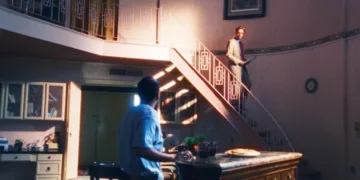
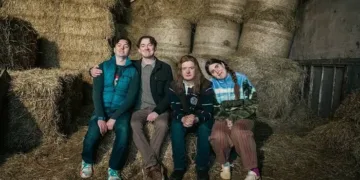

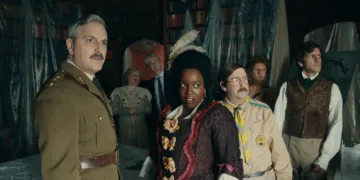











The world of Ben Rivers’ Mare’s Nest begins with a quiet disruption. A tortoise placidly crosses a road, a car crash occurs just out of frame, and the creature withdraws into its shell. From the wreckage emerges Moon (Moon Guo Barker), a young girl who becomes our guide through the film’s desolate, sun-bleached landscape. This is a post-apocalypse populated exclusively by children.
Adults exist only as a monochrome memory, frozen figures in a tunnel like relics from a forgotten catastrophe. The film immediately discards conventional plot, presenting itself as a philosophical inquiry into what remains when civilization is gone.
Rivers, a filmmaker known for his work in experimental cinema, constructs a cinematic poem that prioritizes atmosphere and abstract ideas. The narrative is not a story to be followed but a mystery to be inhabited, a series of questions posed in a world where all the adults have vanished, taking the answers with them.
A Journey in Pieces
The film rejects a standard three-act structure for something more akin to a string of dreamlike vignettes, a narrative approach that mirrors the shattered world it depicts. Moon’s progression is not a quest toward a goal but an aimless wandering through a series of surreal encounters that feel disconnected in time and space. Her journey is a fragmented odyssey.
Early on, she finds the tortoise from the opening and delivers a pocket lecture on evolution. The scene’s power comes from the contrast between her childish form and the formal, scientific language she uses; she is a child playing pretend at being a scholar, or perhaps she is the only scholar left.
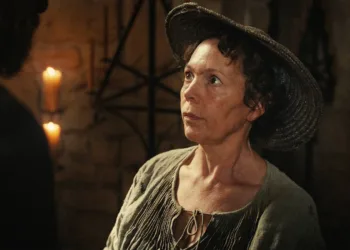
Later, she meets other children who speak with the stilted, unnatural wisdom of adult prophets. A trio of sisters she encounters could have been lifted from a forgotten myth, their pronouncements echoing the cryptic authority of the Fates. This is followed by a visit to a child scholar whose dense language requires another child to act as a translator.
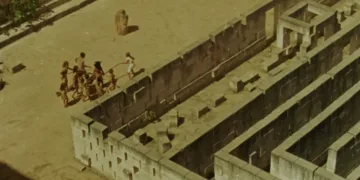
The narrative detours into pure mythology with a sequence featuring a Minotaur stalking the genuine Lithica labyrinth in Menorca, a colossal stone maze. Here, an ancient myth is repurposed for a post-human world.
The episodic construction forces the viewer to assemble meaning from these disparate parts. The only glimpse of the past tragedy is a brief, jarring sequence in harsh black-and-white, showing adult figures frozen in attitudes of dismay. It is the film’s only piece of exposition, offered without words.
Words at World’s End
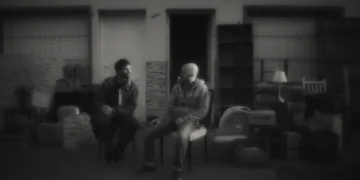
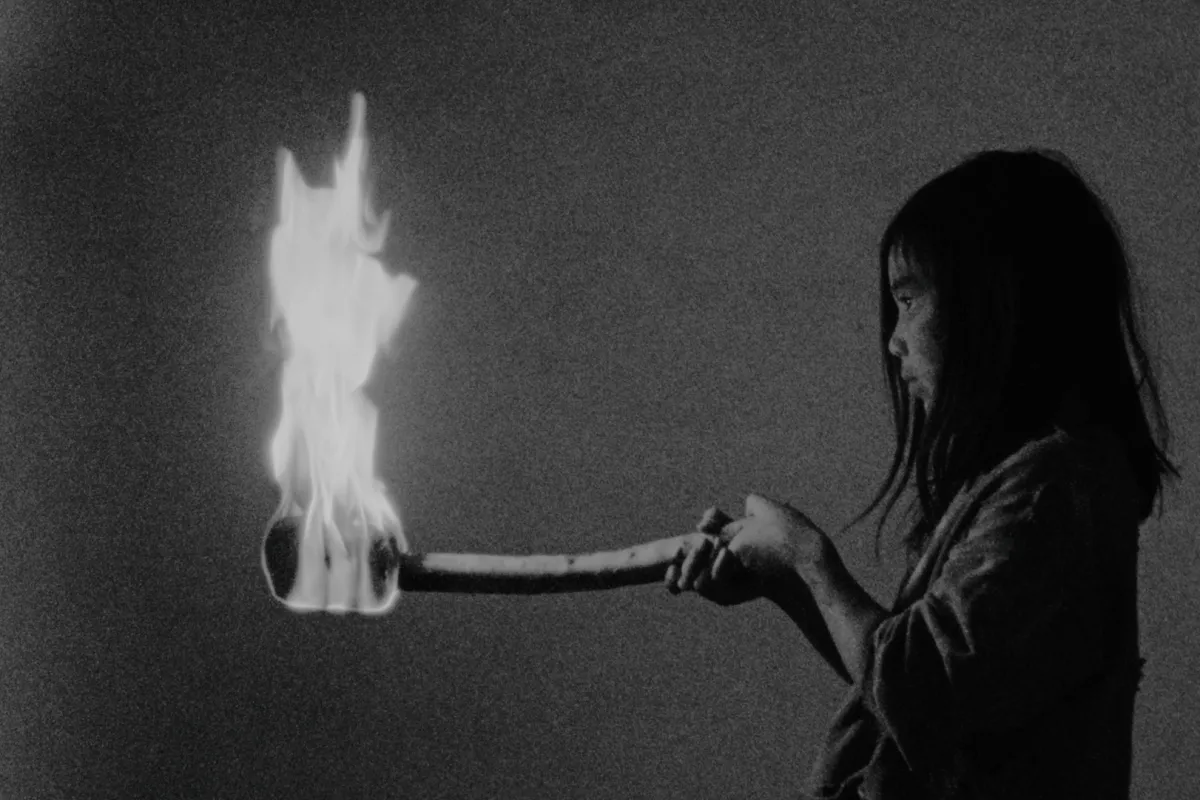
The intellectual center of Mare’s Nest is its direct engagement with Don DeLillo’s play, “The Word for Snow.” This sequence, presented as a stark, black-and-white chamber drama, is the film’s most focused and potent scene.

Staged around a fire in an enclosed space, the atmosphere becomes ritualistic. Here, Moon encounters a child sage and her interpreter, and their conversation moves beyond simple plot and into a deep examination of language’s function in a time of collapse. The line, “The word for snow will be the snow,” suggests a future where direct experience has supplanted abstract representation.
When the world is reduced to its essential elements, language itself may become a casualty. The interpreter admonishes that people are “making words without meaning,” a sharp critique that feels aimed at our own time.
The film expands on this idea, using another piece of dialogue as a key to its own method: “We have myth to protect us when history goes mad.” Rivers positions his film as such a myth, a new story built from the rubble of the old world.
In the face of the overwhelming climate crisis that the original play addressed, the film asks what value art and words truly hold. Moon’s simple, grounding question during the debate, “what is happening?”, cuts through the obtuse rhetoric. It is the plea of a child wanting a straight answer in a world where adults have only left behind riddles.
The Texture of Collapse
The film’s style is as challenging as its ideas, demanding a patience that many viewers may not possess. Rivers deliberately creates an abrasive and inconsistent visual texture, shifting between rich color cinematography for the arid landscapes and grainy, high-contrast monochrome for its most intense and theatrical moments.

This constant change in film stock prevents the viewer from ever settling into a comfortable visual language. It feels less like a movie and more like a curated museum installation, with each scene a separate exhibit to be observed from an intellectual distance.
The pacing is exceptionally slow, built from long, static takes that linger on faces or landscapes long after any narrative information has been conveyed. The intent is clearly to force contemplation, though it often borders on the punishing.
The auditory landscape is just as uneven. Long stretches of quiet are broken by dense, philosophical dialogue delivered in a strange, stilted manner. The children’s performances are intentionally unnatural; they sound as if they are speaking words placed in their mouths by another entity. This ventriloquized quality is perhaps the film’s most unsettling element.
After nearly ninety minutes of this difficult journey, Mare’s Nest ends with a simple, jarring image: Moon driving away in a car, a hopeful smile on her face. This sudden injection of optimism is the film’s final puzzle. It is a moment of release that feels strangely disconnected from the arduous experience that preceded it, leaving one to wonder if her hope is a sign of true resilience or simply the bliss of ignorance.
Mare’s Nest is a 2025 drama film that premiered at the 78th Locarno Film Festival on August 9, 2025, where it was nominated for the Golden Leopard. It is also scheduled to be shown at the 2025 Toronto International Film Festival in September for its North American debut and the 2025 New York Film Festival in October for its U.S. premiere.
Full Credits
Director: Ben Rivers
Writers: Ben Rivers
Producers: Andrea Queralt, Ben Rivers, François Bonenfant, Andreas Mendritzki, Fabrizio Polpettini, Pep Salvador, Aonan Yang
Executive Producers: Andrea Queralt
Cast: Moon Guo Barker
Director of Photography (Cinematographer): Ben Rivers, Carmen Pellon
Editors: Armiliah Aripin, Ben Rivers
The Review
Mare’s Nest
Mare's Nest is a work of uncompromising artistic vision, a film that privileges intellectual inquiry over narrative satisfaction. Its philosophical depth and striking visual compositions are undeniable, yet they are packaged within an experience that is deliberately slow and emotionally distant. It is a demanding piece of cinema that will reward viewers with immense patience for its abstract ideas but will likely prove impenetrable and frustrating for many others. It is a film to be admired more than enjoyed.
PROS
- Intellectually ambitious, engaging with deep philosophical questions.
- Features moments of stunning visual beauty and composition.
- A unique and challenging take on the post-apocalyptic genre.
CONS
- The pacing is exceptionally slow and can feel punishing.
- Its fragmented structure and emotionally distant tone make it difficult to engage with.
- The stilted, unnatural dialogue can be alienating.