

















![Kingdom Hearts Collection [I-III] Review](https://gazettely.com/wp-content/uploads/2026/10/Kingdom-Hearts-Collection-I-III-1-360x180.webp "Kingdom Hearts Collection [I-III] Review: KHII Holds Steady as Newer Entries Fluctuate 40")


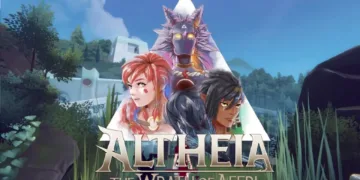
Independent studios often deliver ambitious action-adventure games, and Altheia: The Wrath of Aferi is a clear example of this trend. The game places you in Atarassia, a beautiful fantasy land scarred by a strange corruption called the Void.
You control two characters: Lili, a skilled Guardian with a sword and bow, and Sadi, a young monk with magical abilities, including the power to become a shadow wolf. Their partnership begins with a straightforward task to escort Sadi to a monastery.
This simple objective soon unravels into a deep conflict rooted in the world’s mythology. The pair finds themselves facing a divine power with the potential to destroy their reality, transforming their small quest into a significant struggle.
A World of Fading Gods and Hidden Paths
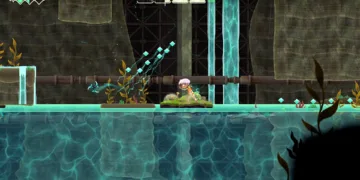
The world of Atarassia immediately stands out with its painterly, Ghibli-inspired aesthetic. This is not simply a game aiming for realism; it chooses a look that feels timeless, like a storybook brought to life. The environments feel like living watercolor paintings, rendered with soft lighting that casts a persistent dreamlike quality over forests and fields.
Sunlight filters through ancient trees, and gentle mists rise from rivers, creating a serene atmosphere that encourages quiet exploration. This beauty is frequently disrupted by the creeping corruption from the Void. This force is represented by a stark, unnatural purple that stains the landscape, twisting flora into grotesque shapes and darkening the skies.
The visual contrast is effective, communicating the world’s sickness without needing a single line of dialogue. The serene greens and blues of the natural world clash violently with the aggressive violet of the infection, constantly reminding the player of the stakes.
The game’s narrative is built on a foundation of mythology, exploring a complex clash between gods and humanity. It moves past simple good-versus-evil plots to examine themes of moral uncertainty, loyalty, and sacrifice. The story of fractured divinity means that the player is often caught between powerful forces with competing, equally valid agendas.
Side quests rarely present a clear “right” choice. Instead, they force you to make difficult decisions that have tangible, often unpredictable, consequences for the world and its inhabitants. This approach is reminiscent of the narrative complexity found in games like The Witcher 3, where moral ambiguity is the rule, not the exception. Player choices carry weight, shaping Lili’s development and her relationships. This design makes the story feel personal and involving.
This thoughtful approach to storytelling is supported by the game’s focus on exploration. Atarassia encourages genuine discovery, rewarding players who venture off the beaten path with hidden ruins and sacred artifacts. The design philosophy is similar to The Legend of Zelda: Breath of the Wild, where curiosity is the main driver.
Unlike many modern open-world games, it does not fill the map with icons and checklists of tasks to complete. It lets you find your own way, allowing the natural landscape to guide you toward points of interest. Seeing a strange rock formation or the top of a forgotten temple on the horizon is all the incentive needed. Reaching that destination and uncovering its secrets feels earned and satisfying.
The world is also built with verticality, using platforming sections to access its many secrets. Leaping across chasms and scaling crumbling walls can be challenging, particularly because Lili lacks a double jump, which demands more precise and committed movement from the player.
The Synergy of Sword and Spirit
The core gameplay of Altheia is defined by the interplay between its two protagonists. The ability to switch between Lili and Sadi at any time is central to navigating the world and its challenges, creating a dynamic that feels different from single-character action games.

Lili is the physical presence of the pair. Her agility allows her to handle all platforming, and she is the sole combatant, wielding her sword and bow against the corrupted creatures of the land. Sadi is the magical and intellectual counterpart. He can place explosive bombs to clear rubble or damage armored foes. He can also create shimmering illusions to distract enemies, opening windows for Lili to attack or slip by unnoticed.
His primary role, however, is interacting with the ancient mechanisms scattered throughout Atarassia’s ruins. The flow of switching between them becomes a satisfying rhythm, where Lili clears a path for Sadi to solve a puzzle, whose solution in turn opens a new route for Lili to traverse.
This dual-character system is most apparent in the game’s environmental puzzles, which are a clear strength. These challenges are thoughtfully designed to require constant cooperation. They move beyond simple “stand on a switch” mechanics and often involve multiple steps with precise timing. One puzzle might require Sadi to use his magic to raise platforms from the water just as Lili leaps across them.
Another could see Lili firing arrows to activate distant targets in a specific sequence while Sadi manipulates rotating walls to clear her line of sight. These moments are when the game feels most polished and inventive. The puzzles are also cleverly integrated into the world’s lore, with their designs often telling a silent story about the people who built them. They feel like a natural part of the world, not like arbitrary obstacles placed in the player’s path.
This design philosophy extends to character progression. Experience points are earned from both combat and exploration and can be invested in skill trees for combat or divine powers. The system is deep enough to allow for different playstyles. A key point is that the progression system is tied directly to the story. Major narrative choices, such as aligning with a particular divine faction, can permanently lock or unlock specific abilities.
For example, helping one deity might grant Sadi powerful light-based magic but make it impossible to learn shadow abilities associated with a rival. This mechanic makes decisions feel more meaningful and encourages repeat playthroughs to see how different choices affect gameplay. It ensures that character growth never feels disconnected from the narrative journey.
The Weight of Combat
Combat in Altheia is a functional part of the experience, though it does not reach the same heights as its exploration or puzzle design. As Lili, the player engages in third-person action using a combination of sword swings and bow attacks.

The controls feel light and responsive. Lili’s dodge roll allows her to move quickly out of harm’s way, and a special attack meter fills during fights, which can be unleashed for a powerful finishing move. The pacing is intentionally slower and more deliberate than in many contemporary action RPGs. This design encourages a strategic approach, asking players to learn enemy attack patterns to succeed.
Button mashing will quickly lead to defeat. The focus is on observation and timing, a quality that is especially important during the game’s large-scale boss encounters. These battles often feel like puzzles themselves, requiring you to identify weak points and use Sadi’s abilities to create openings.
Sadi can also contribute to fights directly, attacking enemies in his wolf form, adding another layer to the combat system. This strategic depth, however, is often undermined by some of the system’s core weaknesses. The combat, while responsive, lacks a critical sense of impact. Sword strikes connect with enemies with a flat, unsatisfying sound, an effect one might describe as “hitting a cabbage.”
There is little physical or audio feedback to make attacks feel powerful, which detracts from the excitement of battle. The bow is another point of weakness. It feels sluggish to aim and fire, making it difficult to use effectively against fast-moving targets. Its primary utility is often relegated to puzzle-solving, where speed is not a factor.
The most significant problem with the combat is the enemy artificial intelligence. The corrupted creatures of Atarassia look menacing, but their behavior is often simplistic and predictable. Many enemies repeat the same one or two attack patterns, making them easy to defeat once you have seen their limited moveset. In larger groups, they sometimes fail to coordinate their attacks, allowing the player to pick them off one by one.
This repetitive AI reduces the overall challenge and can make combat feel more like a chore than a thrilling confrontation. The strategic depth the game aims for is present in its boss fights, but the standard enemy encounters that fill the time between them feel underdeveloped.
Artistic Vision and Technical Faults
The game’s artistic strengths are undeniable, from its strong visual identity to its thoughtful sound design. The orchestral score is evocative, blending traditional symphonic pieces with cultural instruments that ground the music in the world’s mythological roots.

The ambient soundscapes are equally detailed. In ancient ruins, you can hear the faint echo of dripping water and the whisper of wind through stone corridors. In forests, the rustle of leaves and distant animal calls create a rich and immersive atmosphere. The voice acting, while limited, is delivered with passion and emotional weight during key narrative moments.
One small audio issue is how the music shifts during combat. The transition from a serene exploration theme to an intense battle track can be abrupt and jarring. This sudden change can momentarily break the carefully crafted mood, pulling you out of the experience.
A more significant problem is the game’s lack of technical polish. For all its artistic success, the game is hampered by a host of technical issues that suggest a rushed release. Players will likely encounter a range of bugs, from minor visual glitches to game-breaking soft locks that halt all progress and force a complete restart.
The controls can also be a source of frustration. A sluggish camera makes it difficult to keep track of enemies in crowded fights, while input cancellation can lead to missed attacks or dodges at critical moments. These control problems are especially punishing during platforming sections, where a single mistake can lead to a long fall.
The most egregious technical issue is the inconsistent save system. Checkpoints can be spaced far apart, and the game sometimes fails to save progress correctly. It is entirely possible to spend twenty minutes solving a complex environmental puzzle, only to die shortly after and find yourself respawned at a point before the puzzle was even started.
Losing that much progress to a poor save system is deeply frustrating and shows a lack of respect for the player’s time. These technical faults are a constant source of friction. They frequently interrupt the game’s flow and mar what is otherwise an impressive and imaginative artistic effort.
The Review
Altheia: The Wrath of Aferi
Altheia: The Wrath of Aferi is a game of profound beauty and deep frustration. Its painterly world, engaging dual-character puzzles, and mature narrative showcase remarkable artistic ambition. This vision is sadly compromised by lackluster combat and a suite of technical problems, including frustrating bugs and an unforgiving save system. It is a memorable experience for its high points, but one that demands considerable patience to appreciate fully.
PROS
- Stunning painterly art style and world design.
- Clever and engaging dual-character puzzles.
- Mature, morally complex narrative.
- Rewarding sense of organic exploration.
CONS
- Underdeveloped and unsatisfying combat.
- Numerous technical bugs and soft locks.
- Frustrating and inconsistent save system.
- Abrupt audio transitions during combat.