





























Fresh Tracks presents a concept that sounds improbable on paper: a rhythm game on skis. Developer Buffalo Buffalo combines the endless progression of a roguelite with the beat-matching precision of a music game. The result is a surprisingly cohesive and energetic experience.
Players are dropped into the fictional, snow-covered land of Norwyn and given a quest by Koda, the Goddess of Pop. The mission is to reunite her fellow gods, the Mythics, by skiing through a series of epic story-songs and defeating the enemies that stand in the way. It is a strange fusion of ideas that works far better in practice than one might expect, creating a game with a truly distinct identity.
A Symphony of Reflexes
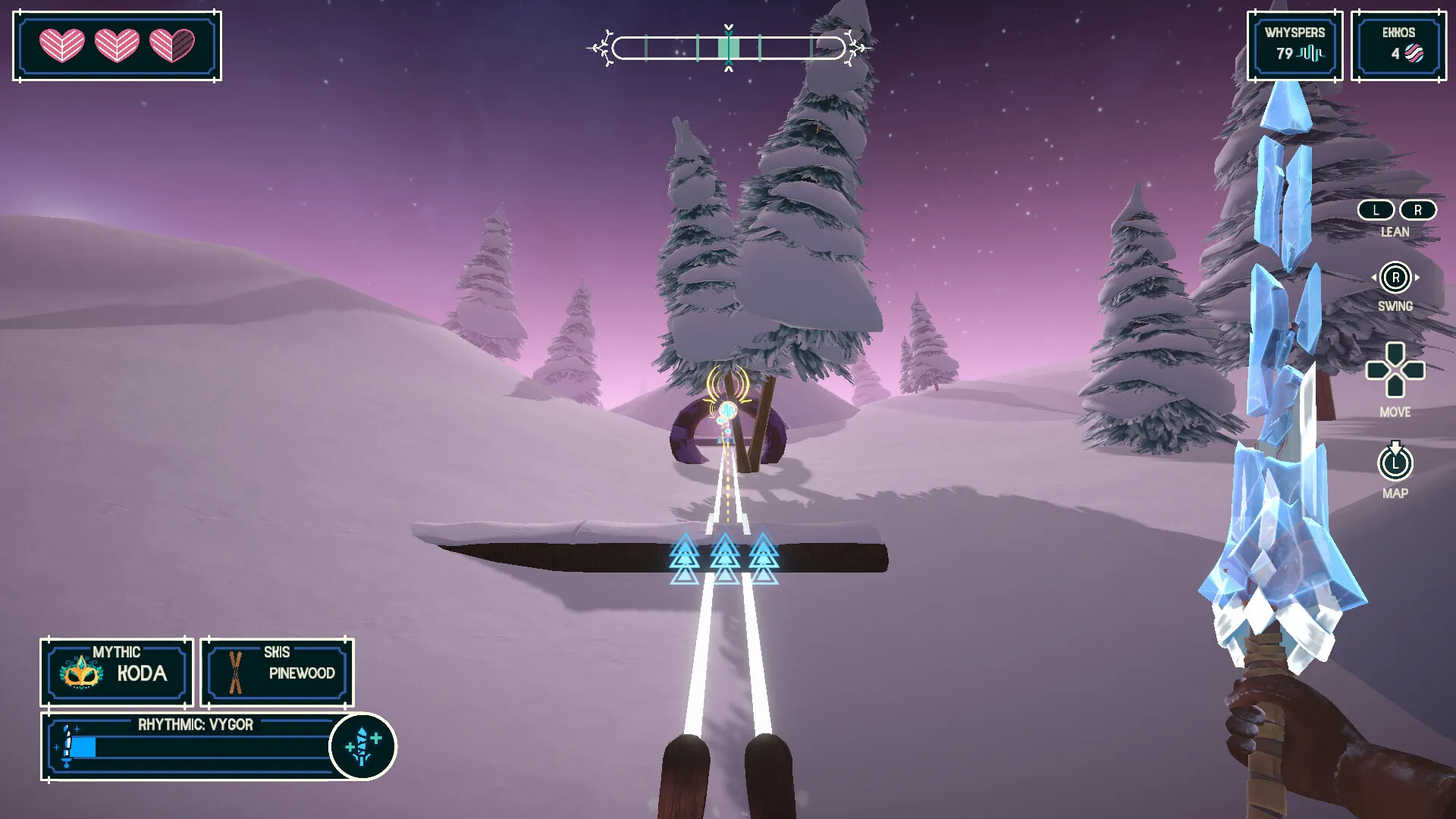
The moment-to-moment experience in Fresh Tracks is a carefully orchestrated chaos, a test of reflexes that demands complete focus. From the first-person perspective, the snowy tracks of Norwyn rush forward with considerable speed, creating an immediate sense of momentum. Success is found in achieving a flow state where action becomes instinct. The game’s foundation is built on evasion.
You are constantly managing your position across three distinct lanes, shifting left and right to avoid static obstacles and collect strings of “whispers,” the game’s physical manifestation of musical notes. This lane-based movement is punctuated by vertical challenges.
You will need to execute short hops to clear floor traps, or use a double jump to soar across wide chasms. Other hazards require you to crouch low or lean your body to squeeze through tight gaps. Each of these maneuvers is simple on its own, but the track design layers them in rapid, complex sequences that require precision timing. A single mistake can break your combo and jeopardize your run.
Layered on top of this intricate dance of avoidance is a surprisingly physical combat system. Your character holds a sword, which is not merely for show. Using the right analog stick, you swing the blade to shatter ice barriers, destroy incoming projectiles, and cut down enemies that appear on the tracks. The combat is not a mindless hack-and-slash affair; many foes are protected by directional shields, forcing you to match your swing—up, down, left, or right—to their specific vulnerability.
This system asks the player to process another stream of information simultaneously with the navigation and rhythm collection. The reward for precision is tangible. Every perfectly timed block and on-beat sword strike contributes to a special meter. Once full, this meter allows you to activate your weapon’s unique power. The starting sword, Vygor, provides a burst of healing, an invaluable lifeline in a difficult section. This design choice turns combat from a simple obstacle into a resource management tool; skillful fighting directly translates into greater survivability.
What makes the gameplay loop so effective is the synthesis of these mechanics. A typical ten-second stretch might involve switching lanes twice to follow a sequence of whispers, performing a double jump over a gap, landing into a crouch to slide under a barrier, and then executing two precise directional sword swings to defeat a pair of enemies. The game demands that you think about your vertical position, your horizontal position, and your offensive actions all at once.
The control scheme is intuitive enough that these actions eventually become second nature, which is a credit to the game’s effective tutorial. It introduces each mechanic one by one before slowly combining them, giving you a chance to build muscle memory. The result is a game that feels like a cross between the high-speed obstacle navigation of an endless runner and the complex input patterns of a fighting game, all set to a driving beat.
The Structure of the Story-Song
The roguelite framework of Fresh Tracks gives its rhythmic challenges a meaningful context and a compelling loop. A single run is an all-or-nothing attempt to push as far as you can through a procedurally arranged series of songs. Health is a finite resource, and when it depletes, your run ends and you are returned to the world map to begin again.
This structure heightens the tension of every performance. A single mistake feels significant because its consequences can be permanent for that attempt. The primary expression of player agency during a run comes at the end of each song. The track splits, presenting a choice of up to three different paths forward. Each path corresponds to a new song and displays its difficulty and the potential reward for its completion. This is the game’s core strategic layer.
Do you choose the easy path to conserve health before an upcoming boss? Or do you risk a difficult track to acquire a powerful “charm” that could define the rest of your run? This decision-making process is reminiscent of the map choices in games like Slay the Spire, where short-term safety is constantly weighed against long-term gain.
This structure is supported by two distinct forms of progression. Inside a run, you collect whispers that act as a temporary currency. These can be spent at merchant stops for charms, which provide run-specific benefits like extra health, more charges for your weapon’s power, or discounts at future shops. These charms are lost when a run ends, forcing you to adapt your strategy on the fly based on the options available. This system creates the potential for unique builds and synergies with each new attempt. Separate from this is the permanent progression system.
Successes and failures alike grant you a different, persistent currency that can be spent back at your home base. Here, you can unlock new pairs of skis that come with passive perks, such as a brief window of invulnerability after taking a hit or a higher starting health pool. This meta-layer ensures that no run is ever a complete waste. You are always making incremental progress, slowly building your power and resilience, which makes the prospect of starting over less frustrating and more hopeful.
The game’s most clever design choice is how it integrates its narrative directly into this roguelite loop through the Mythics. When you begin, your journey is narrated by Koda. By defeating the other Mythics in challenging boss battles, you unlock them as selectable narrators for subsequent runs. This choice is far from cosmetic. Each Mythic has their own distinct personality, provides unique gameplay boons, and has a preference for a certain genre of music.
Selecting Sogvar, the god of heroic rock, will heavily weight the song selection toward guitar-driven anthems, while Koda favors upbeat pop tracks. This allows the player to influence the tone and soundtrack of their own experience. The story itself is also delivered dynamically through this system. Each Mythic holds different pieces of the lore, sharing them through their narration as you play. To understand the full story of Norwyn, you must complete runs with each of them. This transforms the narrative from a passive script into an active discovery, rewarding repeated play and mechanical mastery with new story revelations.
An Imperfect Performance
The audio presentation in Fresh Tracks is its strongest asset. The soundtrack features 28 original songs that span an impressive array of genres. You will hear everything from catchy synth-pop and heavy rock anthems to theatrical show tunes and energetic rap battles. The quality of the music is consistently high, with many tracks being memorable enough to stand on their own. The game deepens its connection to the music by having the lyrics reflect the world’s lore, effectively turning the entire soundtrack into a concept album that tells the story of the Mythics.
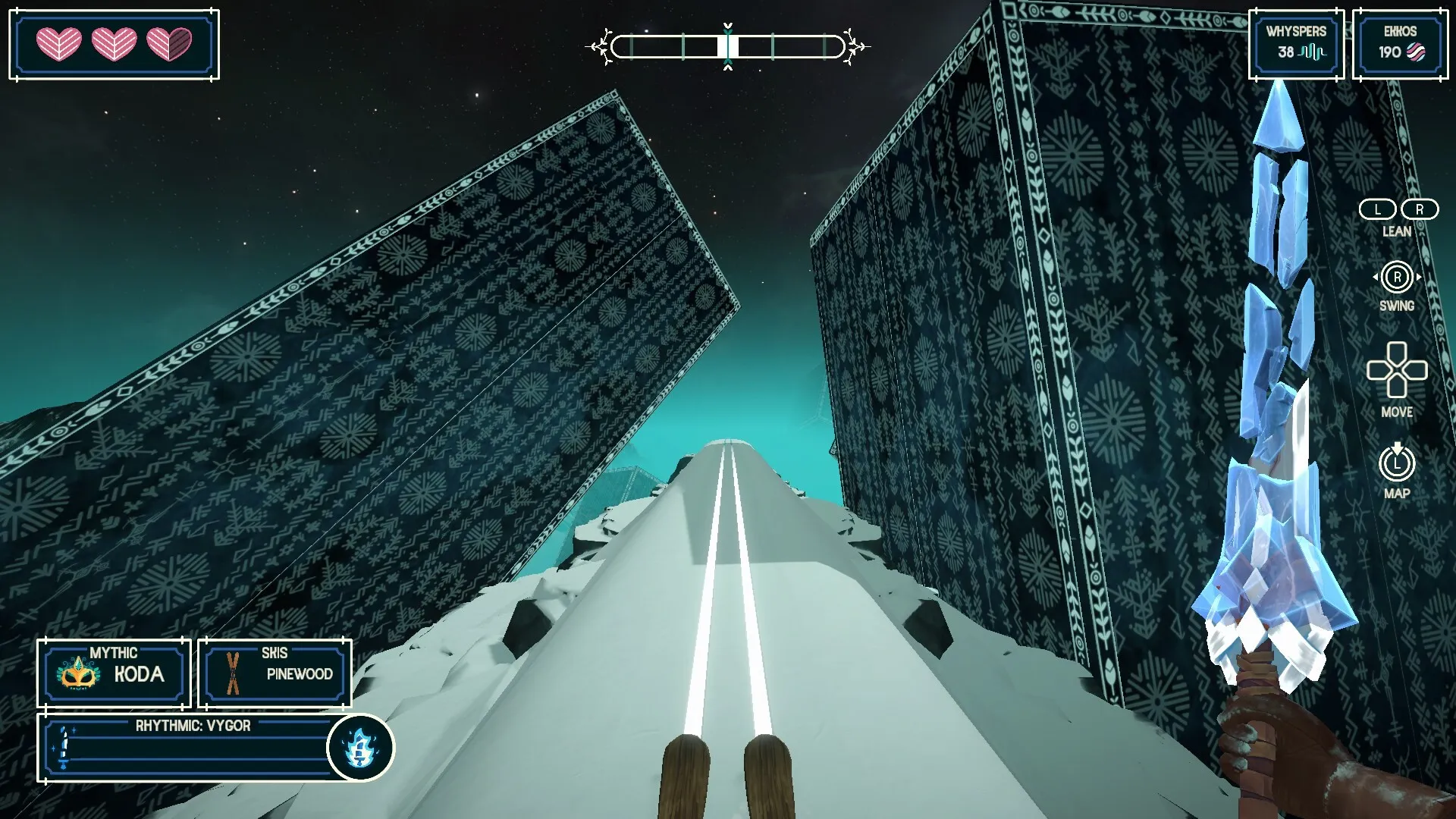
The voice acting is another high point. The performers give each Mythic a strong, clear personality that shines through in the narration during runs. This character work helps to make the world feel alive and provides a welcome companion during long play sessions. Visually, the game is proficient. The art style is clean and readable, which is important for a game that moves so quickly. Certain environments, like the crystalline slopes of Stille Mountain, are genuinely beautiful and provide a great backdrop for the action.
The game’s design does have some notable points of friction. The roguelite structure, when combined with a library of 28 songs, can lead to a feeling of repetition sooner than one might like. While the songs themselves are excellent, hearing the same track multiple times within a short period can diminish its impact. The procedural generation seems to favor certain songs, making this issue more pronounced on some runs than others.
The first-person perspective, while immersive, also presents some gameplay challenges. Enemies and obstacles can sometimes be obscured by objects closer to the player, reducing the time you have to react. This can lead to taking damage from a threat you simply could not see in time, which can feel unfair in a game that otherwise rewards skill.
Perhaps the most discussed aspect of the game’s design is its curious lack of a VR mode. The entire mechanical framework seems perfectly engineered for virtual reality. The act of physically dodging, leaning, and swinging a sword with motion controllers would elevate the immersion to a new level.
The experience is analogous to playing a game like Beat Saber on a standard screen; while it can still be fun, it feels like you are only interacting with a shadow of its true potential. That Fresh Tracks remains a highly enjoyable game without this feature is a credit to its strong core design. Still, the absence of VR support feels like a significant missed opportunity to create a truly groundbreaking title in the rhythm space.
The Review
Fresh Tracks
Fresh Tracks is a daring and largely successful experiment. Its fusion of high-speed rhythm action and deep roguelite progression creates a genuinely exciting loop, supported by a stellar original soundtrack and a clever narrative structure. While repetition can eventually set in and the lack of a VR mode feels like a significant missed opportunity, the game's core mechanics are so well-executed that it remains a thrilling and highly recommended performance.
PROS
- Creative fusion of rhythm and roguelite mechanics.
- Excellent original soundtrack with great variety.
- Deep progression systems that reward repeated play.
CONS
- Song library can feel repetitive over time.
- First-person view sometimes obscures hazards.
- Gameplay feels perfectly suited for a VR mode that is absent.