
























![Kingdom Hearts Collection [I-III] Review](https://gazettely.com/wp-content/uploads/2026/10/Kingdom-Hearts-Collection-I-III-1-360x180.webp "Kingdom Hearts Collection [I-III] Review: KHII Holds Steady as Newer Entries Fluctuate 37")





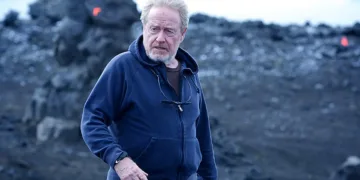
Ridley Scott told a live audience in London that modern Hollywood is “drowning in mediocrity,” adding that he has lately returned to rewatching his own films because “they’re really good” and “don’t age.” The remarks came during an onstage conversation at BFI Southbank on Sunday, Oct. 5, part of a career retrospective timed to a season of screenings and an exhibition devoted to his work.
Asked about his current viewing habits, the 87-year-old director said the sheer volume of releases had not translated into consistent quality and argued that too many productions lean on expensive visual effects to paper over weak scripts. “Get it on paper,” he said, urging stronger screenwriting as the first step toward better films.
His comments arrive after a high-profile run that included last year’s “Gladiator II,” which delivered the largest international opening of his career and a robust global rollout despite competition from other event titles. Scott is now finishing “The Dog Stars,” a post-apocalyptic drama dated for March 27, 2026, positioning another major release as the industry recalibrates after uneven box-office cycles.
Reaction to the director’s critique has split along familiar lines. Supporters see a veteran calling for higher standards in an era of content oversupply and algorithmic commissioning; skeptics counter that Scott’s recent output has also faced mixed notices and that craftsmanship depends on more than nostalgia for practical techniques. The discussion echoes wider debates about whether franchise dependence and streaming economics have crowded out mid-budget originals, even as the year’s strongest performers show audiences will still turn out for fresh stories anchored by clear authorship.
The BFI event, moderated by his son Luke Scott, capped a multi-week program of talks and screenings, including introductions to landmark titles and a public Q&A. The institution billed the afternoon as a chance to take stock of a six-decade career spanning historical epics, science fiction and contemporary thrillers, and the director used the platform to press for fundamentals: fewer shortcuts, better scripts, and a higher bar for the films competing for audience attention.