

























![Kingdom Hearts Collection [I-III] Review](https://gazettely.com/wp-content/uploads/2026/10/Kingdom-Hearts-Collection-I-III-1-360x180.webp "Kingdom Hearts Collection [I-III] Review: KHII Holds Steady as Newer Entries Fluctuate 37")





A lone tortoise begins an unhurried trek across the earth, a symbol of ancient, terrestrial time. From the sky, a spacecraft descends, bringing bioengineer Anandi back to a world she no longer recognizes. This opening contrast in Vimukthi Jayasundara’s Spying Stars establishes the film’s central dialogue between the timeless and the terrifyingly new. Anandi, portrayed with a mesmerizing stillness by Indira Tiwari, has returned to Sri Lanka on a mission of personal grief: to bury her father.
Her plans are immediately nullified. Diagnosed with the “illvibe” virus ravaging the planet, she is spirited away to a quarantine facility on Hanuman Island. This is no sterile hospital but a luxurious resort, a gilded cage where her physical needs are met while her emotional world disintegrates. Her personal sorrow is soon dwarfed by the quiet horror of her surroundings. Earth is now a place of silent, machine-driven order, where a watchful satellite hangs in the sky and citizens disappear without explanation. Anandi’s intimate journey of mourning becomes an unwilling exploration of a society under siege.
A World of Quiet Dissonance
The film’s power is located in its atmosphere, a carefully constructed environment of deep unease. Jayasundara rejects conventional narrative exposition in favor of a purely sensory experience, immersing the viewer in Anandi’s disoriented perspective. The story is told through the poetic cinematography of Eeshit Narain, which lingers on the lush textures of the Sri Lankan landscape, the clinical surfaces of the resort, and the expressive contours of Anandi’s face.
Dialogue is used with extreme economy; silence and ambient sound do the work of building the world. The soundscape itself is a key actor in the drama, a tapestry of organic wind and rustling leaves that is violently torn by the piercing shriek of alarms or the unnatural hum of unseen technology. This creates a constant, low-level thrum of anxiety. The film’s most effective technique is its juxtaposition of deep serenity with shocking brutality. A meditative shot of a beautiful shoreline might be interrupted by the discovery of a severed limb washed up on the sand.
A quiet drive is fractured by a glimpse of a citizen being forcibly taken by faceless authorities. These moments are never dwelled upon, but their fleeting nature makes them more disturbing, suggesting a reality of violence that has been normalized. The sci-fi elements are presented as facts of life: the ever-present surveillance cameras, the UFO-like satellite, and the cryptic news reports all paint a picture of an authoritarian state where humanity is managed, monitored, and, when necessary, quietly erased.
The Protagonist’s Internal Exile
Anandi’s emotional arc is a slow, arduous crawl from paralysis to life. For much of the film’s first half, she is a ghost, haunting the resort’s corridors in a state of near-total silence. Her unprocessed grief over her father’s death, compounded by the guilt of her absence, has rendered her an exile in her own body.

Indira Tiwari’s performance is a masterclass in physical storytelling; she communicates Anandi’s profound sorrow and alienation through her posture, her vacant gaze, and her cautious interactions with the world. Her increasingly strange behavior, such as eating flowers from the resort’s garden, reads as a desperate attempt to ingest something real and organic in a synthetic environment. The narrative’s critical shift occurs with her escape from this controlled space.
Her flight into the jungle is not just a plot point but a symbolic act of rebellion against the machine’s sterile order. She finds sanctuary with Nita, the resort’s trans concierge, a character who embodies a gentle, self-possessed authenticity. In Nita’s isolated home, far from the reach of technology, Anandi begins to reconnect with a more fundamental humanity. This healing is completed through an engagement with local mysticism. A shamanic ritual, presented with ethnographic sincerity, allows her to finally achieve the catharsis that the modern world denied her, providing a spiritual remedy for a technological malady.
Science Fiction as Social Allegory
While Spying Stars functions as a contemplative science fiction film, its true weight comes from its allegorical connection to Sri Lanka’s recent history. For those familiar with the nation’s decades-long civil war, the film’s imagery is painfully resonant. The constant surveillance, unexplained disappearances, and casual discoveries of violence are not futuristic fantasies but are instead drawn from a past of political trauma.
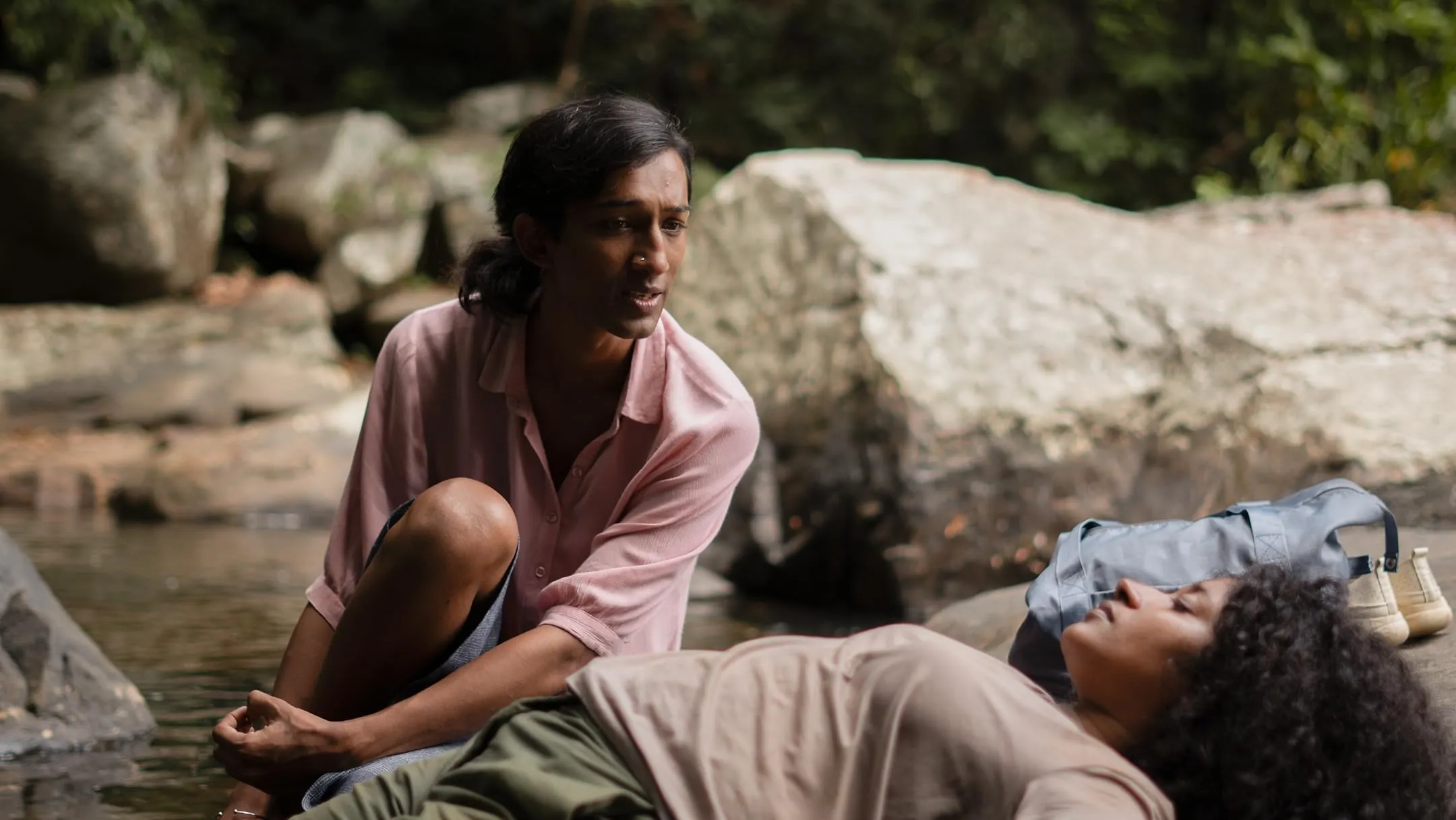
The film externalizes these societal wounds, placing them within a sci-fi context that allows for both direct commentary and philosophical exploration. The “illvibe” virus itself operates as a powerful metaphor, signifying a sickness that is spiritual and social as much as it is physical—a pandemic of disconnection. Ultimately, the film presents a profound argument about the nature of healing.
The machine-ruled world, with its promise of order and safety, is revealed as a force of alienation and control. True recovery, Jayasundara suggests, lies in a return to the natural world, to community, and to the indigenous spiritual knowledge that predates the technological siege. Anandi’s journey argues that the most potent form of resistance is not a fight, but a retreat into a deeper, more organic way of being.
“Spying Stars” is a science fantasy drama film that premiered in Competition at the 30th Busan International Film Festival on September 23, 2025. Directed and written by Vimukthi Jayasundara, this Indo-French-Sri Lankan co-production is set in a future world ruled by machines and ravaged by a fast-spreading virus. The story follows Anandi, a bio-technician, who returns to Earth to perform her late father’s final rites but is forced into quarantine at a secluded mountain resort. As she grapples with her grief, Anandi begins to notice disconcerting signs of hidden surveillance, strange disappearances, and a UFO hovering over the area, leading her to seek refuge and healing in the natural world that persists against the clinical, dystopian backdrop. The film’s general release or streaming platform availability beyond its festival run is not yet specified.
Full Credits
Director: Vimukthi Jayasundara
Writers: Vimukthi Jayasundara
Producers: Nila Madhab Panda, Vincent Wang
Cast: Indira Tiwari, Kaushalya Fernando, Samanalee Fonseka, Saumya Liyanage, Hidaayath Hazeer, Shreerupa Mithra
Director of Photography: Eeshit Narain
Editors: Saman Alvitigala
Composer: Alokananda Dasgupta
The Review
Spying Stars
Spying Stars is a visually stunning and thematically dense film that rewards patient viewing. It masterfully blends science fiction with political allegory, using its quiet, contemplative pace to explore profound ideas about grief, trauma, and humanity's relationship with nature and technology. While its deliberate slowness and minimal dialogue will not be for everyone, it is a haunting and intellectually stimulating piece of cinema, anchored by a powerful lead performance. It’s a demanding, but ultimately unforgettable, experience.
PROS
- The film is visually poetic, creating a beautiful yet unsettling atmosphere.
- Indira Tiwari conveys a deep range of emotions with minimal dialogue.
- It functions as a powerful allegory for political trauma and personal grief.
- Successfully merges slow-burn drama, science fiction, and mysticism.
CONS
- The methodical pacing may feel inaccessible or alienating to some viewers.
- The story relies on atmosphere and subtext, which can be challenging to follow.
- The near-silent protagonist makes it a less conventional viewing experience.