

























![Kingdom Hearts Collection [I-III] Review](https://gazettely.com/wp-content/uploads/2026/10/Kingdom-Hearts-Collection-I-III-1-360x180.webp "Kingdom Hearts Collection [I-III] Review: KHII Holds Steady as Newer Entries Fluctuate 37")



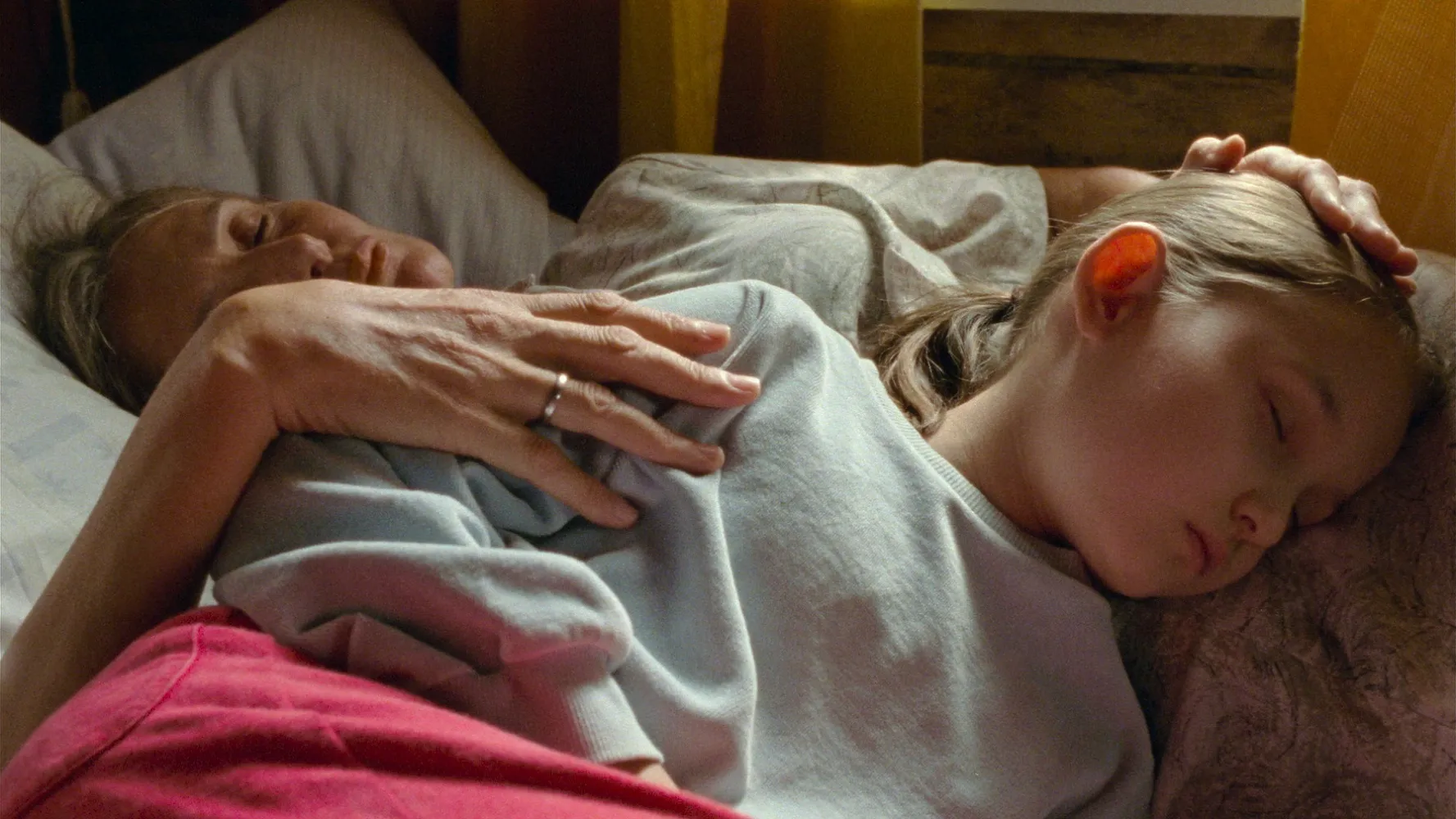

A dancing square of light plays across a darkened wall. It is a simple, child-made magic, born from a shard of glass held in a small hand. This act of capturing and redirecting the sun is the central visual thesis of Short Summer, a film where innocence is not a passive state but an active, fragile attempt to create beauty in a world succumbing to gloom.
The narrative follows eight-year-old Katya to her grandparents’ dacha, a place of supposed summer refuge that is, in reality, a quiet battleground. Here, the slow-motion collapse of a marriage unfolds in tandem with the ambient threat of a distant national conflict. Director Nastia Korkia constructs a somber, atmospheric study of a world seen through the eyes of a child who intuits, but cannot yet name, the twin forces of personal and political decay that are steadily dimming the light.
An Impressionistic Childhood Idyll
The film’s pulse is deliberately slow, matching the unhurried metabolism of a childhood summer where time itself feels viscous. Katya’s world is built from a succession of sensory impressions, rendered with a quiet, tactile precision. The camera lingers on her hands as her grandfather teaches her to clean mushrooms, the texture of the earth and the delicate flesh of the fungi given equal weight.
We follow her bicycle down overgrown paths and watch as she participates in the formless, ritualistic games of local children. Korkia resists narrative urgency, choosing instead to build a world through accumulation. Long, static takes immerse the viewer in the thick, sun-drenched air and the low hum of insects. The sound design is naturalistic, capturing the rustle of leaves and the distant shouts of playing children, creating a verisimilitude that feels less directed than remembered.
This is a Proustian reverie, a reconstruction of a past that feels both vividly real and irrevocably lost. The director’s patient framing forces the audience to inhabit Katya’s perspective, to find the small dramas within the frame: the way she lies on a bed in quiet solidarity with her sad grandmother, the focus she gives to tossing a stone into a pit. It is a world of perceived stability, an idyll whose very tranquility feels precarious, a long, quiet breath before a storm that has already begun.
The Unseen Wars
The film’s genius lies in its depiction of conflict as a pervasive environmental toxin rather than a series of dramatic events. The war in Chechnya exists at the edges of the frame and on the periphery of hearing, a constant, low-grade fever infecting the countryside. Korkia’s composition is key to this effect. In one remarkable shot, a children’s football game occupies the foreground, their movements full of chaotic energy.
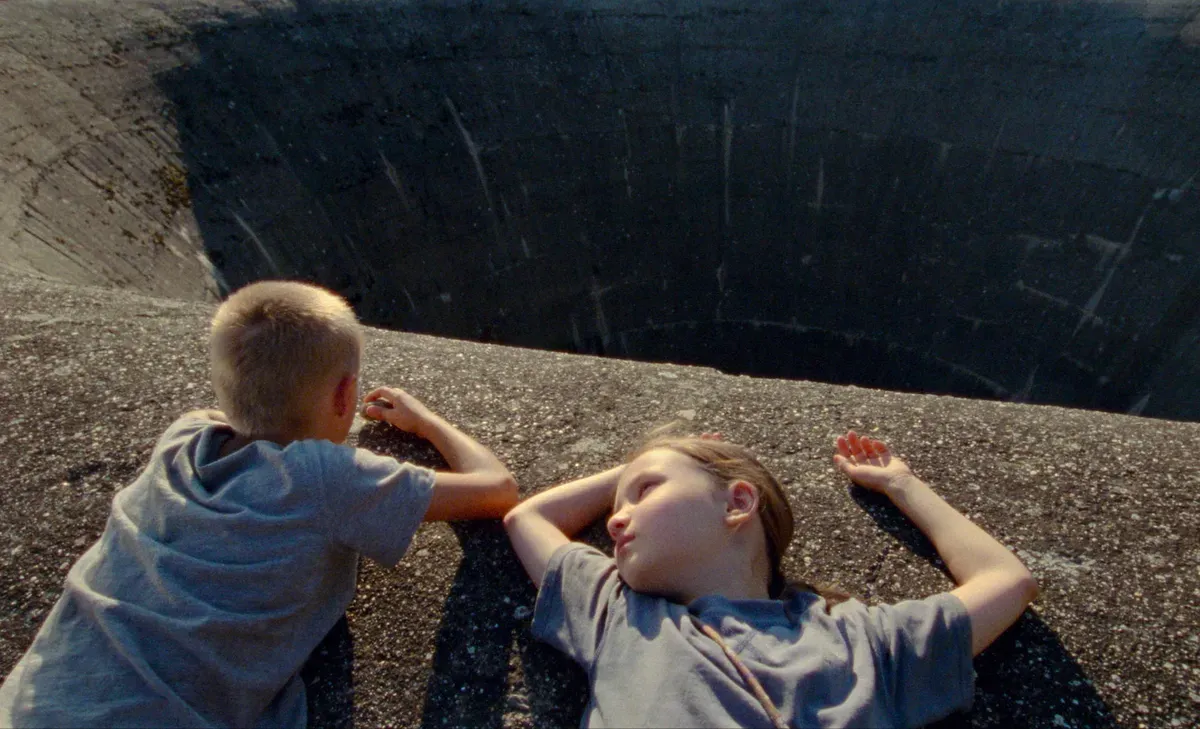
In the deep background, a freight train methodically transports a line of military tanks across the horizon. The children do not notice; for them, the machinery of war is as unremarkable as the passing clouds. The war is also made tangible in other, more intimate ways. It is a piece of shrapnel kept as a morbid souvenir in a boy’s treasure box, a relic of the violence that maimed his father. It is the hollow bureaucracy faced by a woman in a local office, unable to get a death certificate for her son because the state prefers the ambiguity of “missing in action.” These are not plot points; they are symptoms of a society where the language and artifacts of violence have been fully absorbed into the fabric of daily life.
This national malaise is mirrored by the cold war being waged within the dacha. The grandparents’ decaying marriage is a study in silent hostility, their conflict articulated through the empty space between them in the frame and the weary set of the grandmother’s jaw. The simmering resentment is a palpable force in the small house, a tension Katya navigates with the uncomprehending sensitivity of a child.
The grandfather’s infidelity is revealed in a brilliant, voyeuristic long shot that positions Katya as a distant, unwitting observer of his transgression. She sees the act—a man greeting a woman at a doorway—but lacks the context for the betrayal it represents. This small, personal collapse serves as a potent metaphor for the larger one, suggesting a widespread corrosion of faith and connection that afflicts both the family unit and the state.
A Language of Light and Shadow
Korkia’s aesthetic is one of rigorous, formal control, and it is this precision that elevates the film from a simple story to a philosophical inquiry. Shot on grainy 16mm stock, the images possess the textured, artifact-like quality of a home movie unearthed from a lost time. The camera is almost entirely static, its stillness transforming each composition into a densely layered tableau.
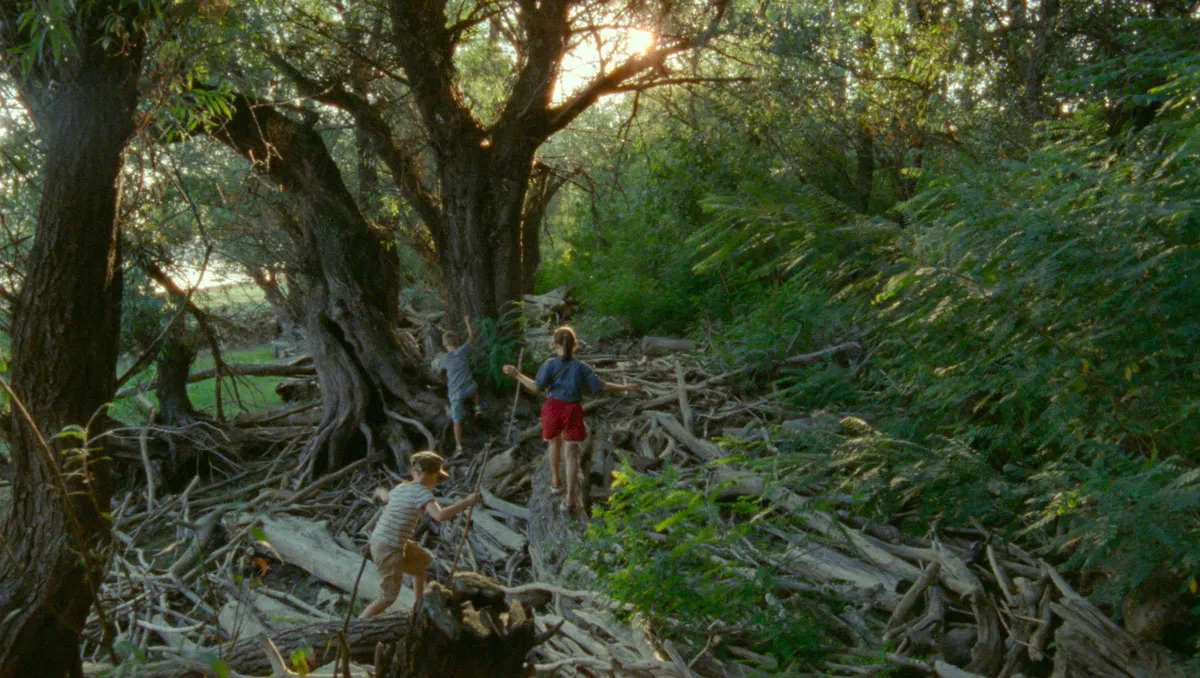
This technique demands an active viewer, one who must scan the frame for the subtle dramas unfolding in the deep background, where the film’s true meaning often lies. The environment itself becomes an agent of a quiet determinism, its bleakness and beauty shaping the small lives within it.
The shard of glass Katya treasures is the film’s most powerful recurring motif. It is her tool for manipulating the world, for seizing a piece of the sun and imposing her own small order on the encroaching shadows. Her projection of light is an act of defiance, a claim of agency in a world that offers her none.
The childhood game of burying a “sekretik”—a small, beautiful object hidden under the glass—becomes a heartbreakingly poignant attempt to preserve a moment of grace against the certainty of decay. The film’s final, cryptic shot of a single beam of light dancing in a dark room is a direct echo of this act. It poses a final, unanswered question. Is this light a symbol of resilient hope, the persistence of Katya’s spirit? Or is it merely the final, fleeting reflection of an innocence about to be extinguished completely? The film offers no easy answer, leaving the viewer to linger in its beautiful, unsettling ambiguity.
Short Summer is the debut fiction feature film from director Nastia Korkia, which had its world premiere at the 2025 Venice International Film Festival as part of the Giornate degli Autori section. The film is a drama, co-produced by Germany, France, and Serbia, that tells the story of eight-year-old Katya spending a summer with her grandparents in the Russian countryside during the Second Chechen War. It offers a poetic and atmospheric portrait of childhood innocence coexisting with the subtle, but pervasive, shadows of conflict. As of now, the film has been screened at various international festivals, including the BFI London Film Festival, and is distributed by sales agent Totem Films; its availability on general release or streaming platforms will depend on future distribution deals in your region.
Full Credits
Director: Nastia Korkia
Writers: Nastia Korkia, Mikhail Bushkov
Producers and Executive Producers: Dirk Decker, Andrea Schütte, Natalia Drozd, Bérénice Vincent, Miroslav Mogorović, Stefan Mladenović
Cast: Maiia Pleshkevich, Yakov Karykhalin, Aleksandr Karpushin, Vesna Jovanović, Alexander Feklistov, Stojša Oljačić
Director of Photography (Cinematographer): Evgeny Rodin
Editors: Benjamin Mirguet
The Review
Short Summer
Short Summer is a visually stunning and philosophically rich film that masterfully captures the erosion of innocence. Through its patient, formalist direction and powerful symbolism, it explores the quiet ways that adult conflicts—both personal and political—seep into a child's world. While its deliberate pacing demands attention, the reward is a deeply moving and unforgettable portrait of a fragile beauty threatened by encroaching darkness. It is a masterful piece of atmospheric cinema.
PROS
- Masterful direction and breathtaking, formalist cinematography.
- Subtle, powerful visual storytelling that conveys meaning without dialogue.
- Deeply resonant exploration of innocence, memory, and societal decay.
- Intelligent use of symbolism to build a rich thematic landscape.
- A quiet, atmospheric tone that is both haunting and beautiful.
CONS
- Extremely slow and deliberate pacing may be challenging for some viewers.
- Minimalist plot requires significant audience engagement and interpretation.
- The emotional tone is observational and detached, which may not appeal to all.







