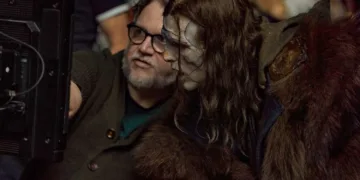






























Jacob Elordi says spending 11 hours in the makeup chair to become the Creature in Guillermo del Toro’s Frankenstein was “the perfect amount of time,” describing the marathon application as a way to shed himself and “become something else” before stepping on set. The actor discussed the transformation during a late-night TV appearance, adding that he developed the character’s movement with guidance from a Butoh teacher to evoke a body that feels newly assembled and not fully under its owner’s control.
The comments arrive as the film expands in theaters and streams after a fall festival run that drew sustained ovations and positioned the project as an awards contender. Netflix materials set the streaming debut for November 7, following a staggered theatrical rollout that began in October and included a new trailer emphasizing the Creature’s perspective.
Behind the performance is an effects build designed to depart from the blocky iconography of earlier screen versions. Creature designer Mike Hill has said the team crafted 40-plus prosthetic pieces for a lean, scar-mapped look rooted in 18th-century medical imagery, a design that changes across the story to reflect the Creature’s inner state. Reporting around the production has varied on the daily call time, with Hill noting applications around ten hours on set and Elordi recounting an 11-hour full transformation during testing.
Elordi’s physical choices also extended to how the Creature walks and carries himself; he has explained he imagined limbs that “aren’t listening to your brain,” using Butoh principles to create halting, off-kilter motion. Del Toro has framed the approach as a conscious steer away from simple monstrosity, emphasizing fragility and a “newborn” presence for the character.
The film pairs Elordi with Oscar Isaac as Victor Frankenstein and Mia Goth among the principal cast. Trailers and studio notes highlight a narration from the Creature and a period setting that pulls from Mary Shelley’s novel while inviting a more intimate focus on identity and remembrance. Early reactions singled out the makeup and movement work as central to the film’s emotional pitch.