
























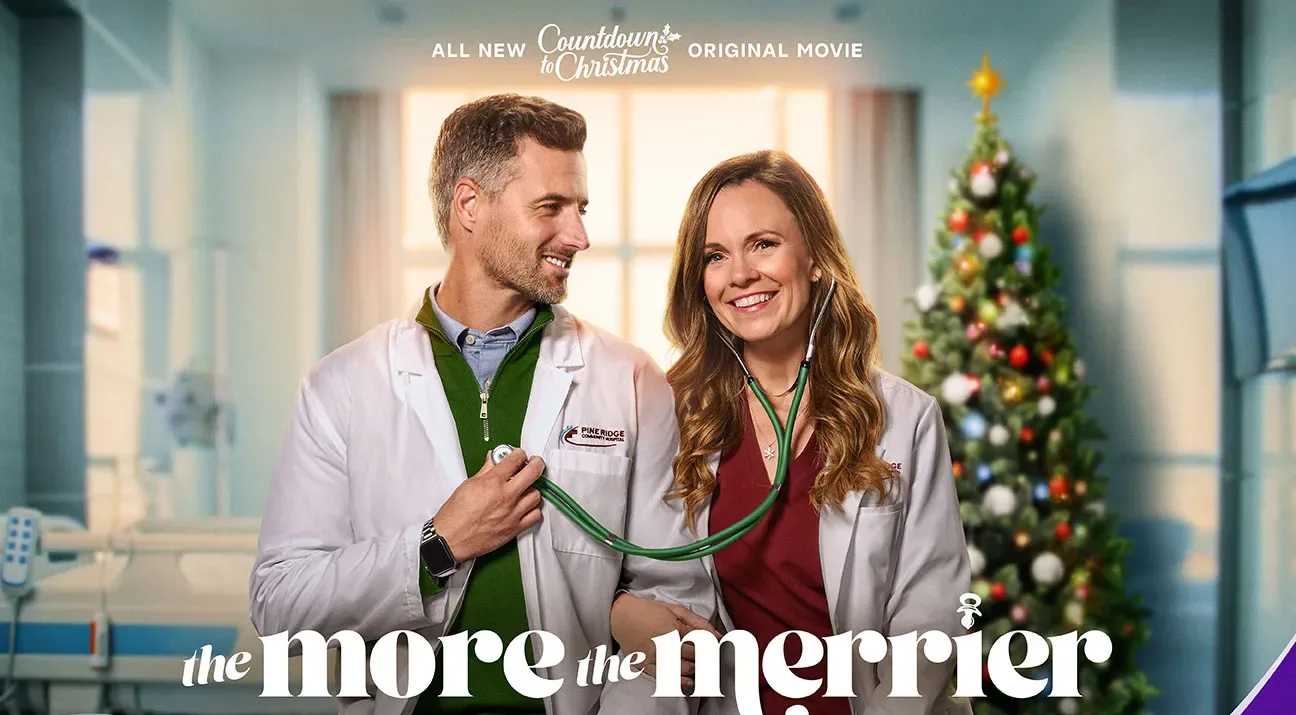

Cinema often treats the Christmas season as a pre-packaged collection of glowing fireplaces and reunion-ready living rooms. The More The Merrier looks in a very different direction and places its story under hospital fluorescents at Pine Ridge Community Hospital, where holiday spirit arrives in the middle of an emergency-room shift. A severe blizzard locks the small town in on Christmas Eve and cuts the hospital off from outside help, turning the night shift into a contained, high-stakes drama.
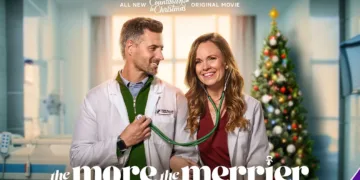
Within that pressure cooker, Dr. Alice Rogers (Rachel Boston), an ER attending defined by unwavering dedication and unapologetic festive cheer, works alongside Dr. Brian Davis (Brendan Penny), a new and skeptical cardiologist shaped by the emotional distance of big-city medicine.
The title describes the situation bluntly: a sudden rush of patients, especially multiple women in labor, leaves the pair and their skeleton crew handling a crisis that far exceeds their staffing. The film leans into this tense, unconventional setting to examine how a single night of adversity can speed up the formation of deep human bonds.
Structural Innovation: The Cinematic Bottle
The element that stands out strongest here is the movie’s commitment to one primary location. This sort of bottle design, familiar from sharp television drama, feels striking in a holiday-film context. By trapping nearly all the action inside the hospital as the snowstorm rages outside, the script builds a pressurized environment where emotional conflict, professional friction and connection move at a rapid pace.
A hospital naturally functions as a place of high tension and minimal comfort, yet Dr. Rogers’ determined holiday decorations and rounds of cookie delivery keep nudging the space toward something softer. That push-and-pull sits in the middle of the film’s atmosphere.
The story operates as an experiment in turning a site associated with trauma into a space of surprising communal warmth. I was drawn to how this visual approach nudges against the usual iconography of Christmas cinema. There is a clear commentary on contemporary life here, suggesting that real community often surfaces once familiar comforts fall away and people have to depend on each other directly.
The secondary narrative involving a woman stuck in a local bakery and on the verge of giving birth gently extends the film’s geography without breaking its structural focus. This B-story underlines the strength of the town’s mutual support system, presenting neighbors who step into first-responder roles. When this thread finally reconnects with the main action at the hospital, the story emphasizes that the same spirit of care stretches beyond the immediate reach of the ER.
The pacing stays brisk, juggling a crowded slate of emergencies, from head injuries to multiple births. That steady sense of movement keeps the confined setting from feeling repetitive. Because the film keeps so many crises in play, the events of this single chaotic night gain real weight and leave lasting impressions on the characters’ lives and relationships. The storytelling clearly prefers intensity and character-focused beats over sweeping spectacle, which gives the drama a sharp, concentrated edge.
Character Study: The Contrast of Service
The central pairing relies on a familiar dynamic, yet the movie’s attention to the larger ensemble raises it above a simple romance. Rachel Boston’s interpretation of Dr. Alice Rogers serves as the emotional anchor. Alice’s identity is tied to her commitment to Pine Ridge, and the film shows her as generous with her time and spirit, decorating the hospital to lift staff morale.

At the same time, she keeps her private life tightly guarded. The looming decision about a potential job in another location brings a steady hum of vulnerability into her scenes. Boston plays that sincerity in a way that makes Alice’s affection for the town feel fully convincing and grounds her belief in the hospital’s mission.
Facing her is Dr. Brian Davis, played by Brendan Penny. Brian arrives as a skeptical, recently divorced cardiologist who carries the detached professional style of a larger city. His discomfort and distance from Alice’s festivities and community rituals serve a clear narrative purpose by embodying the outsider viewpoint. The tension between his rational reserve and her emotional investment shapes both their working relationship and their evolving personal connection.
The chemistry between Boston and Penny reads as relaxed and credible. Their bond forms through shared pressure, on-the-fly decision making and respect for each other’s skills, all built into the relentless rhythm of the ER. This foundation helps the romantic element feel earned, while the film wisely keeps that thread as one part of a wider story, never the single driving force.
One of the film’s richest assets lies in the work of the supporting cast. The patients’ stories, from the expectant mothers to the teenage boys who link up over a heart condition, land with particular clarity. These side characters build out the sense of a living community and create a hospital environment that viewers could easily imagine revisiting. The ensemble approach suggests that the movie’s emotional pulse beats strongest in the moments that focus on collective experience and moves away from the central romance. That shared emotional burden gives the genre framework a welcome extra density.
Defining the Community Ethos
The core ideas in The More The Merrier circle around civic responsibility and sacrifice, ideas that feel closely tied to contemporary culture. The film concentrates on the deliberate act of choosing to belong and contribute. The full name, Pine Ridge Community Hospital, is repeated in a way that turns it into a mantra for Dr. Rogers and a thematic signal. It carries the suggestion that any institution draws its strength from the people who commit to it.
The story operates as a long-form tribute to healthcare workers. It pays respect to the staff members who give up their personal holiday time to care for others. Watching this shift unfold highlights a belief that people often reveal their best qualities under sustained pressure. The movie lingers on small gestures of kindness and steady professional focus that together create a portrait of everyday heroism. For me, this is the film at its most honest, placing service ahead of spectacle.
Dr. Rogers’ struggle over leaving the town deepens the film’s interest in community. Her possible departure grows out of a buried fear, the professional trauma tied to the risk of losing someone she loves while in her care. The night’s events bring that fear to the surface and push her to consider her desire for a new job or an escape from emotional risk. Her eventual choice functions as a symbolic gesture that lines up directly with the film’s message about finding the courage to stay in place and keep working for the people who matter.
The recurring images of new life, concentrated in the cluster of simultaneous births, create a steady reminder of hope. They frame the hospital as a site of injury and illness, joy and resilience. Through that lens, the film recasts the institution as a genuine community hub, a place where new beginnings enter the world and where the shared effort of a long night leaves everyone changed.
The More The Merrier premiered as part of the Hallmark Channel’s annual “Countdown to Christmas” programming event. It debuted on the Hallmark Channel on Friday, November 28, 2025. The movie centers on two doctors—a devoted ER physician and a newly arrived cardiologist—who find themselves snowed in at a rural hospital on Christmas Eve. The film can be watched on the Hallmark Channel and is available for streaming on the subscription service Hallmark+.
Full Credits
Title: The More The Merrier
Distributor: Hallmark Media (Hallmark Channel)
Release date: Friday, November 28, 2025
Rating: TV-G
Running time: 1 hour 30 minutes (90 minutes)
Director: Peter Benson
Writers: Caroline Farah (story), Zac Hug (teleplay)
Producers and Executive Producers: Andrew Gernhard, Peter Benson (Co-Executive Producer), Greg Holstein, Marybeth Sprows, Zac Hug (Co-Executive Producer)
Cast: Rachel Boston, Brendan Penny, Marlie Collins, Cai Holm, Jecca Beauchamp, Peter Benson, AJ Kostynick, Lucia Walters, Aadila Dosani, Carmel Amit, Carey Feehan, Iris Quinn, Donna Benedicto, Cardi Wong
Director of Photography (Cinematographer): Jesse D.E. Young
Editors: Nicole Irene, Lisa V. C. Abugov, Alison Reid
Composer: Toby Sherriff
The Review
The More The Merrier
The film succeeds by shifting the holiday narrative from the domestic space to a high-pressure professional one, effectively using its confined structure to generate genuine communal warmth. Rachel Boston’s sincere central performance grounds the drama, creating a moving portrait of service and personal decision-making. Though the lead romance is competent, the strength of the ensemble subplots truly defines this story. It is a thoughtful exploration of community sacrifice and finding where one belongs.
PROS
- Uses the hospital and blizzard structure to create immediate, intense drama.
- Supporting characters and their individual crises provide unexpected depth and humor.
- Rachel Boston anchors the film with a genuine portrayal of dedication and vulnerability.
- Successfully honors first responders and the ethos of professional sacrifice.
CONS
- The central romantic arc is sometimes overshadowed by the more engaging ensemble stories.
- Despite the unique setting, it utilizes some expected genre tropes (cynical city man meets community enthusiast).
- Visible use of product placement may slightly detract from the immersive nature of the hospital setting.