





















Fox has taken a relic from the early aughts and given it a new exhale with Fear Factor: House of Fear. The revival keeps the primal dare premise, then reframes it for a 2026 audience already living in a steady hum of anxiety. Set inside a lavish mansion in Vancouver, British Columbia, the series traps fourteen contestants in a long stay where high-end decor sits beside engineered discomfort. The place looks expensive, then behaves like a stress test.
The money math has changed. The old episodic $50,000 payouts have been replaced by a season-long $200,000 grand prize. A winner-take-all design turns the experience into endurance by accumulation, the kind that grinds down the mind through repetition. Johnny Knoxville presides over the ordeal. He occupies the formal role of ringmaster, the job title you give a man when you want chaos to wear a name tag.
Knoxville’s presence also signals a shift in what the show wants from its participants. Physical endurance still matters, and the series now demands social maneuvering that used to sit outside the premise. Survival inside the house becomes part of the test, measured in alliances and grudges, then paid out in nominations. It plays like a social experiment wrapped in a gross-out competition, which feels like an honest metaphor for a moment where personal safety and social standing get negotiated daily, often in rooms that look nicer than they feel.
The Long Burn of Serialized Suffering
The biggest change comes from the show’s preference for “Slow-Burn Sadism” (my term for misery that compounds across episodes until it starts to feel like weather). By ditching the self-contained structure, the producers build a serialized narrative where trauma lingers from one installment to the next. The format borrows heavily from social-strategy television: alliances, voting blocs, shared living quarters. The raw simplicity of the original stunt-forward model gets scraped away and replaced with something more procedural, more political, more exhausting.
Episodes tend to open with a main challenge meant to thin the herd. Winners gain the power to nominate peers for the “End Game,” an elimination event with real teeth. That single mechanic turns fear into currency. Contestants can use another person’s phobia as a lever, then call it gameplay. The setup doubles as a grim echo of contemporary labor markets, where dwindling resources get framed as a moral lesson and competition becomes an argument for itself.
The $200,000 prize carries a flavor of “Economic Insult” once you filter it through 2026 inflation. Weeks of mental and physical punishment get exchanged for a sum that used to read as life-altering and now lands closer to a modest down payment. The stakes take on a strange double register: desperation feels genuine, and the reward struggles to keep up with the cost of what’s being asked. The show functions like a pressure cooker where the steam stays trapped. The suffering persists, the narrative keeps rolling, and relief becomes another thing contestants have to compete for.
The Grandfather of Provocation
Johnny Knoxville fits this brand of demented supervision with alarming ease. He brings an impish energy, gray hair, and a wardrobe of colorful sweater vests. His look suggests mischief with seniority, the kind of figure who could offer you a butterscotch candy right after signing off on an ethically questionable challenge. He visibly enjoys the contestants’ discomfort. He supplies cackles where earlier hosts relied on stoicism or manufactured intensity.

His tone plays differently than the show’s past versions. Knoxville sidesteps the aggressive seriousness that marked the Joe Rogan era and opts for lighthearted sadism that can feel, weirdly, comforting. He shows up in moments of peak distress, using humor as a blade that sharpens the tension. The vibe reads as “Nihilistic Charisma,” the sense that everyone understands the joke, even if the joke ends with someone getting vacuum-sealed.
That energy keeps the series from sinking into pure grimness. The stunts escalate, and Knoxville’s affability buffers the atmosphere. He treats the spectacle as performance, and he holds two roles at once: genial host, sadistic supervisor. The balance should collapse under its own cynicism. He makes it work with a wink that feels like a permission slip for the audience to laugh, then flinch, then laugh again.
The Kinematics of Claustrophobia
“Sealed Fates” lands as a small masterclass in psychological horror. Contestants get vacuum-sealed inside massive plastic sheets, with thin tubes supplying oxygen as their only lifeline. The imagery is blunt and effective: total helplessness packaged in transparent material, fear made visible through condensation and panic. The show leans into sensory deprivation and primal dread. Suffocation and darkness become the real antagonists, and the deciding factor turns into mental steadiness under pressure that can be measured in breaths.
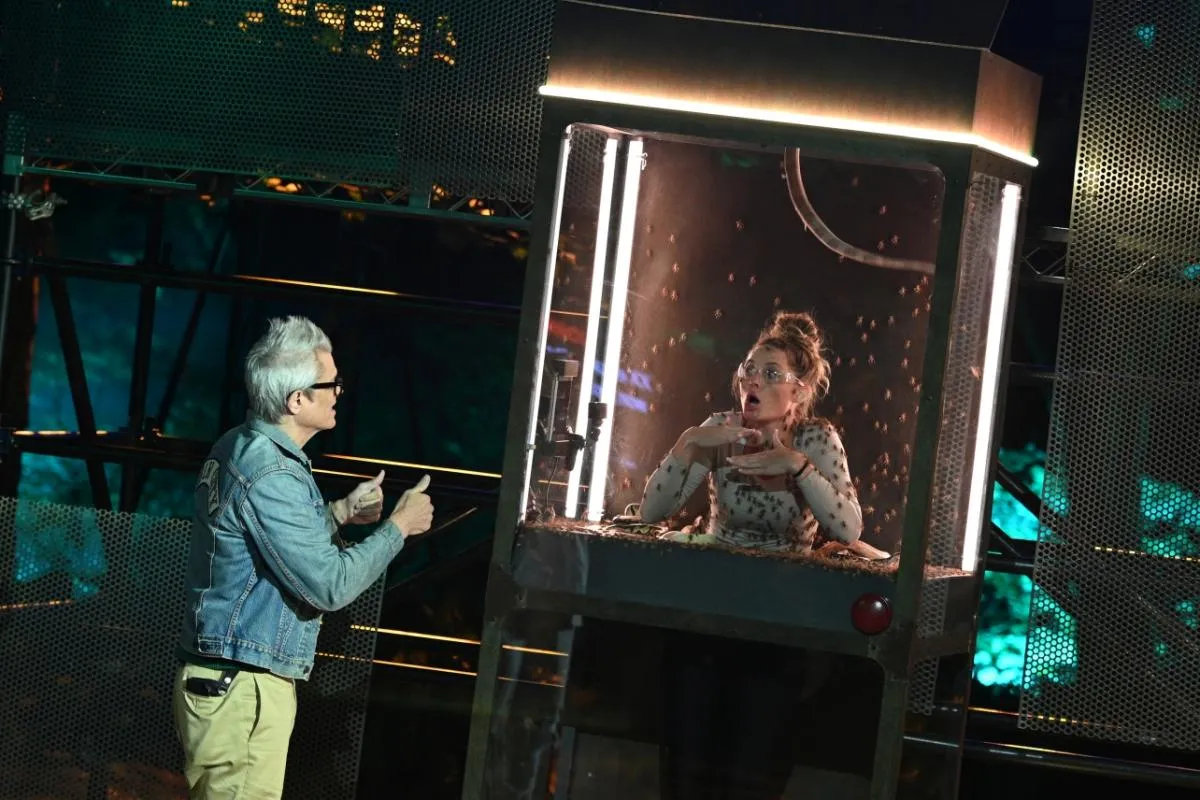
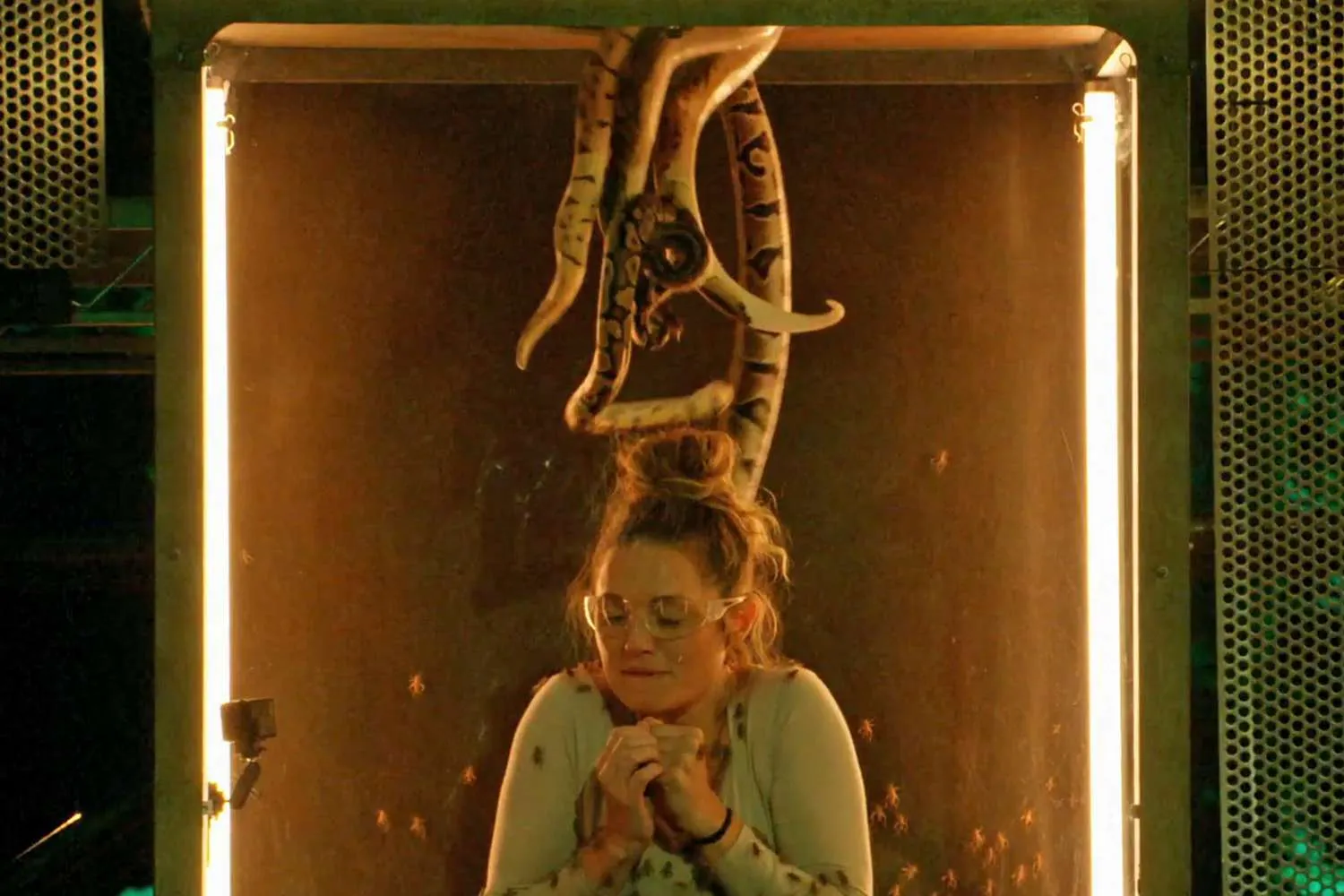
The “Hall of Fame” elimination task continues the movement toward environmental hazards. Players get trapped in booths while crickets, rats, snakes, and pigeons rain down on them. They have to sift through the writhing mass to find hidden codes. Specific lighting and framing push the isolation of each person, creating a “Micro-Dystopia” that belongs to one booth at a time.
Production choices sometimes interrupt the immediacy. The series occasionally uses digital previews to tease upcoming tasks, which can feel slightly detached from the physical reality of what’s happening in the room. The backbone still comes from wildlife and environmental stress, the franchise’s signature cruelty. These challenges aim straight at biology. Alliances can be managed with lies and charm. Nervous systems respond on their own schedule, especially when a snake is on your head.
The Architecture of Betrayal
Fourteen contestants arrive with recognizable archetypes, from the competitive athlete to the professional “Dickbag.” The personalities collide inside the Vancouver mansion because proximity makes conflict feel inevitable. Biases shape the elimination pipeline, and the social game starts to look like a dinner-table referendum. The logic behind who gets sent into the booths rarely feels technical. Dislike does the work.
The dialogue becomes a loop of reality-TV clichés. “At the end of the day” and “trusting my gut” fill the air between moments of horror, as if the cast has been issued a limited phrasebook for what they’re living through. Trust and betrayal get treated with the subtlety of a sledgehammer, and the edit keeps returning to interpersonal conflict to justify the game’s machinery. The series wants the social tension to read as destiny.
The house itself plays a role, dressed in “Creepy Chic” touches like two-headed ducklings. It’s pleasant to look at and poisonous to live in, a showroom for resentment. The residential sections can feel like a diversion from the stunts, yet they feed the social fire that powers the eliminations. The spiders matter, sure. The person sleeping in the bunk above you can matter more.
The reimagined reality competition series premiered on Fox on January 11, 2026, immediately following the NFL Wildcard Game. This season introduces a psychological twist to the classic format by requiring fourteen contestants to live together in a remote mansion in Vancouver, British Columbia, while competing for a $200,000 grand prize. New episodes air on Wednesday nights at 9:00 p.m. ET, and you can stream the series the following day on Hulu or through the Fox Now app.
Full Credits
Title: Fear Factor: House of Fear
Distributor: Fox Network, Hulu, Disney Plus
Release date: January 11, 2026
Rating: TV-14
Running time: 43 minutes
Director: Kevin Lee
Writers: Endemol Shine Netherlands
Producers and Executive Producers: Kevin Lee, Anthony Carbone, Sharon Levy, Michael Heyerman, Sean Loughlin
Cast: Johnny Knoxville, Blake, Chelsea, Damienne, Danielle, Dida, Ethan, Jayleen, Jeni, Kristen, Lance, Rob, Rodney, Tyler, Zach
- Composer: Russ Landau
The Review
Fear Factor: House Of Fear
This revival offers a bleakly fascinating look at human endurance within the framework of modern economic anxiety. While the social maneuvering occasionally slows the momentum, the visceral power of the stunts remains undeniable. Johnny Knoxville provides a necessary layer of charismatic levity to a format that might otherwise feel overly cruel. It captures a specific cultural dread, making it a difficult yet gripping watch for those who can stomach the grime. This season transforms a game show into a serialized psychological experiment.
PROS
- Johnny Knoxville’s affable and mischievous hosting style.
- High-concept stunts that prioritize psychological tension over simple physical tasks.
- Strong production design that establishes a specific, unsettling atmosphere.
- A serialized format that allows for deeper interpersonal stakes.
CONS
- Frequent use of reality television clichés in the contestant dialogue.
- Reduced prize money that feels disconnected from the increased duration of the contest.
- Awkward editing and framing choices in the premiere episode.
- The house segments sometimes distract from the core appeal of the stunts.