
























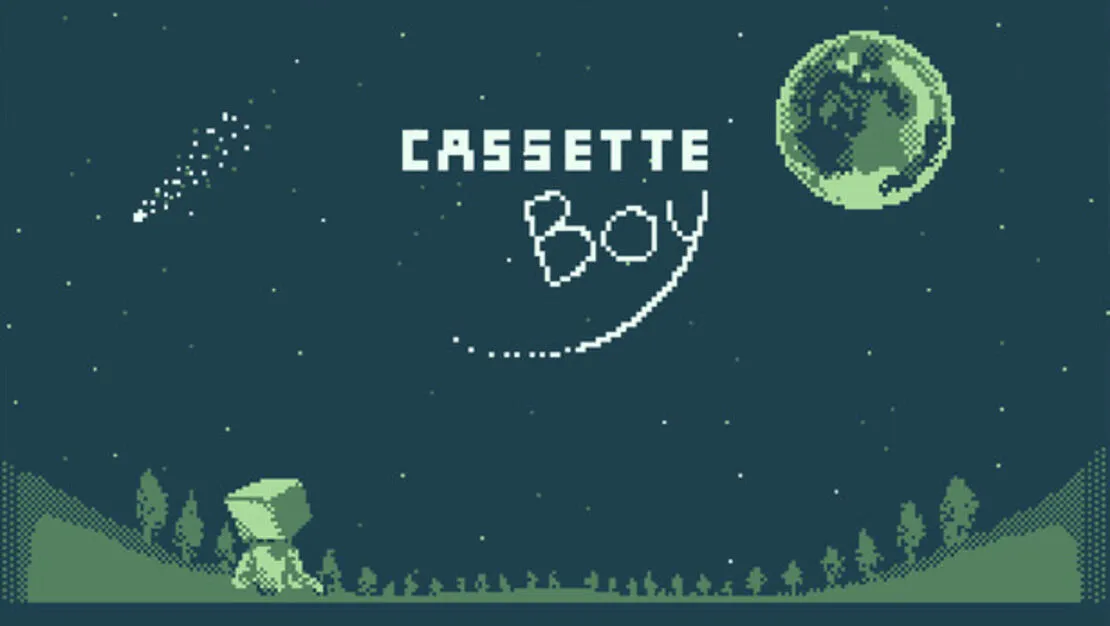

Cassette Boy builds a world that pulls from the early era of handheld gaming. The story follows a young protagonist in a quiet village who learns the moon has vanished. That disappearance kicks off a quest to locate scattered fragments and bring balance back to the sky.
The presentation echoes classics like Link’s Awakening and early Pokémon entries, then pivots into a mechanical idea that changes how space works. After you obtain a pair of headphones, you can rotate the world along a three-dimensional axis to shift your viewpoint. The game treats visibility as reality: anything hidden from view stops existing in the space you can interact with.
With that rule in place, you hunt moon fragments, talk with residents in a hub town, and push through a series of dungeons. Using a sword, bow, and bombs, you lean on spatial reasoning to solve environmental puzzles that block progress. The pacing favors discovery and experimentation, asking you to read rooms in ways that a traditional two-dimensional adventure never asks from the player.
Spatial Logic and the Schrödinger System
The headphones drive the game’s main idea through what it calls the Schrödinger System. Pressing the shoulder buttons rotates the environment, letting you examine rooms from new angles. The mechanic works like a literal version of quantum observation. An object hidden behind a wall or another piece of scenery effectively disappears. That rule opens up playful solutions to obstacles.
You can pass through a wall by rotating the camera until the wall leaves the screen. Floor switches can remain active after you step on them, then rotate the view until the switch becomes obscured. The same logic applies to hazards and enemies. Wide gaps become crossable if you hide the floor between platforms, and a threatening monster can be removed from play by turning your view away from it.
A cassette player adds another tool by letting the character shrink. Shrinking enables entry into tight spaces that stay unreachable at normal size. Shifting between the flat isometric view and the blocky three-dimensional rotation feels smooth, keeping a steady rhythm as you reframe each room. The system demands a change in how you map spaces in your head, since room layout becomes something you actively manipulate through perspective.
Monochrome Aesthetics and Atmospheric Sound
The game’s look leans hard on a monochrome green palette modeled after original Game Boy hardware. That choice gives the experience a strong nostalgic pull and still reads cleanly on modern screens. Character sprites for the boy and the village residents stick to simple pixel art that will feel familiar to fans of retro RPGs.
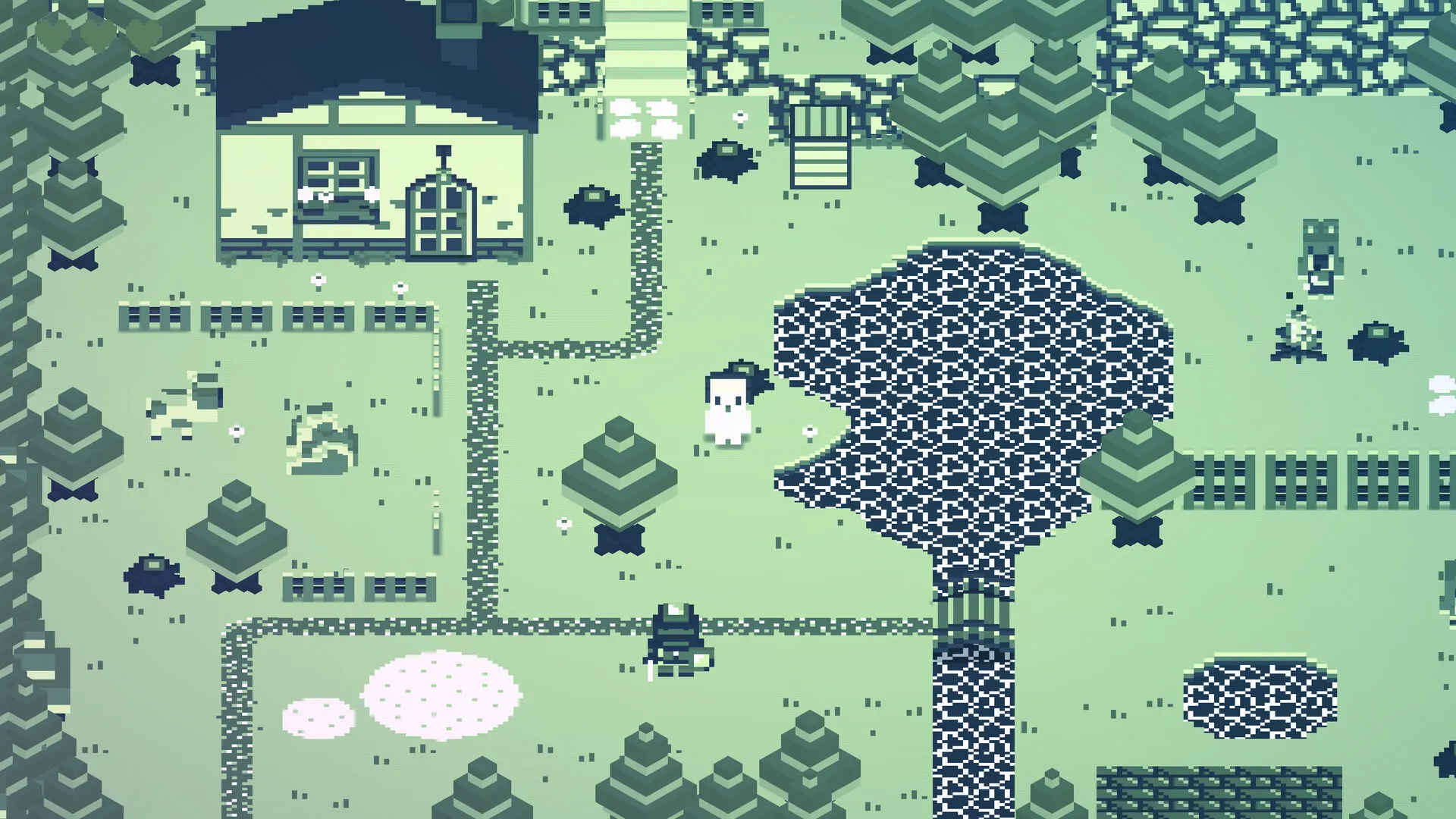
The green-on-green approach also creates clarity issues in practice. Objects like fences, crates, and background structures can blur together, and that blending can make it harder to tell what is solid and what reacts to interaction.
During world rotations, the art becomes blocky, yet the technical performance stays sharp. The game holds 60 FPS, so constant rotation and repositioning remains smooth. The audio supports that visual direction with a lo-fi soundtrack built around a calm, quiet mood.
Music sits back to support exploration, reinforcing an introspective tone without pulling focus. Together, the retro visuals and atmospheric sound shape a cohesive setting that feels like a rediscovered artifact from an earlier period of gaming.
Combat Mechanics and Character Development
Combat follows a familiar isometric action structure with real-time encounters. Your tools include a sword for close-range fights, a bow for distance, and bombs for area damage. The kit is recognizable, and the feel has its own quirks. Movement comes across as loose, with the protagonist seeming to slide across the ground. The sword relies on a three-hit combo that rewards careful timing. The final strike locks the character in place during its animation, which can leave you open if the attack misses and an enemy is already moving in.
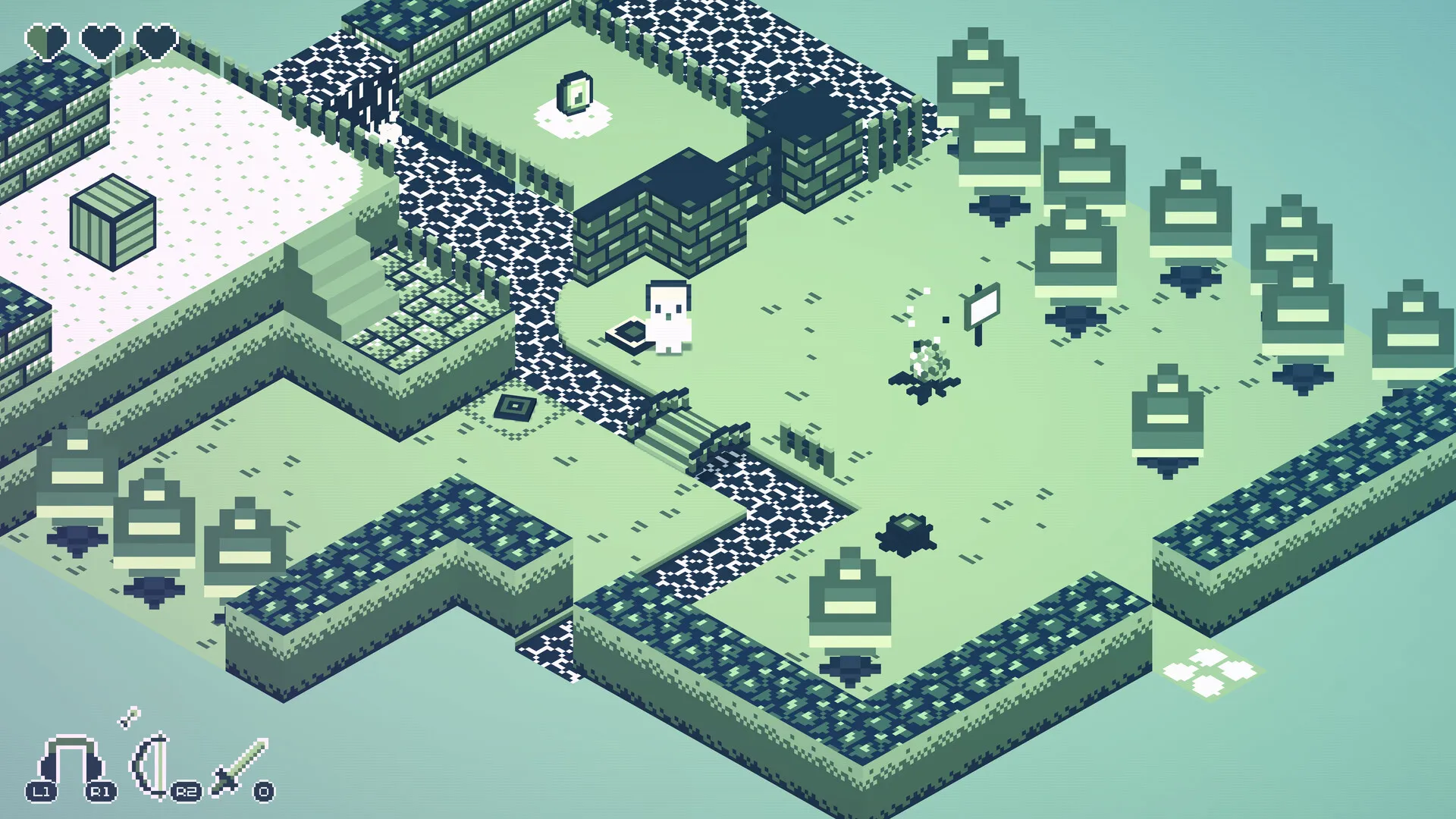
Progression comes from experience orbs dropped by defeated monsters. Gathering them increases stats like health, attack, and defense. The upgrades apply automatically, so you never stop to manage points or menus. Saving ties into exploration through bonfires placed around the world. Resting at a bonfire heals you and records progress.
Dying before reaching one costs recent items and experience, which raises the pressure to secure safe points as you push deeper. Boss fights close out major areas with large enemies that often shift through multiple phases. Some bosses expect you to apply the perspective mechanics to create openings and deal damage, and other fights play out as more direct tests of offensive stats and timing.
Exploration Logic and Dungeon Design
The world structure leans into player agency and curiosity. The game does not hand you mission markers or a quest log to direct the next step. Progress comes from conversations in the hub town, with residents pointing you toward the information you need. Talking to characters like Luna, the owner of the cat, supplies context that keeps the story moving. This approach pushes you to watch your surroundings and listen closely to what people say.
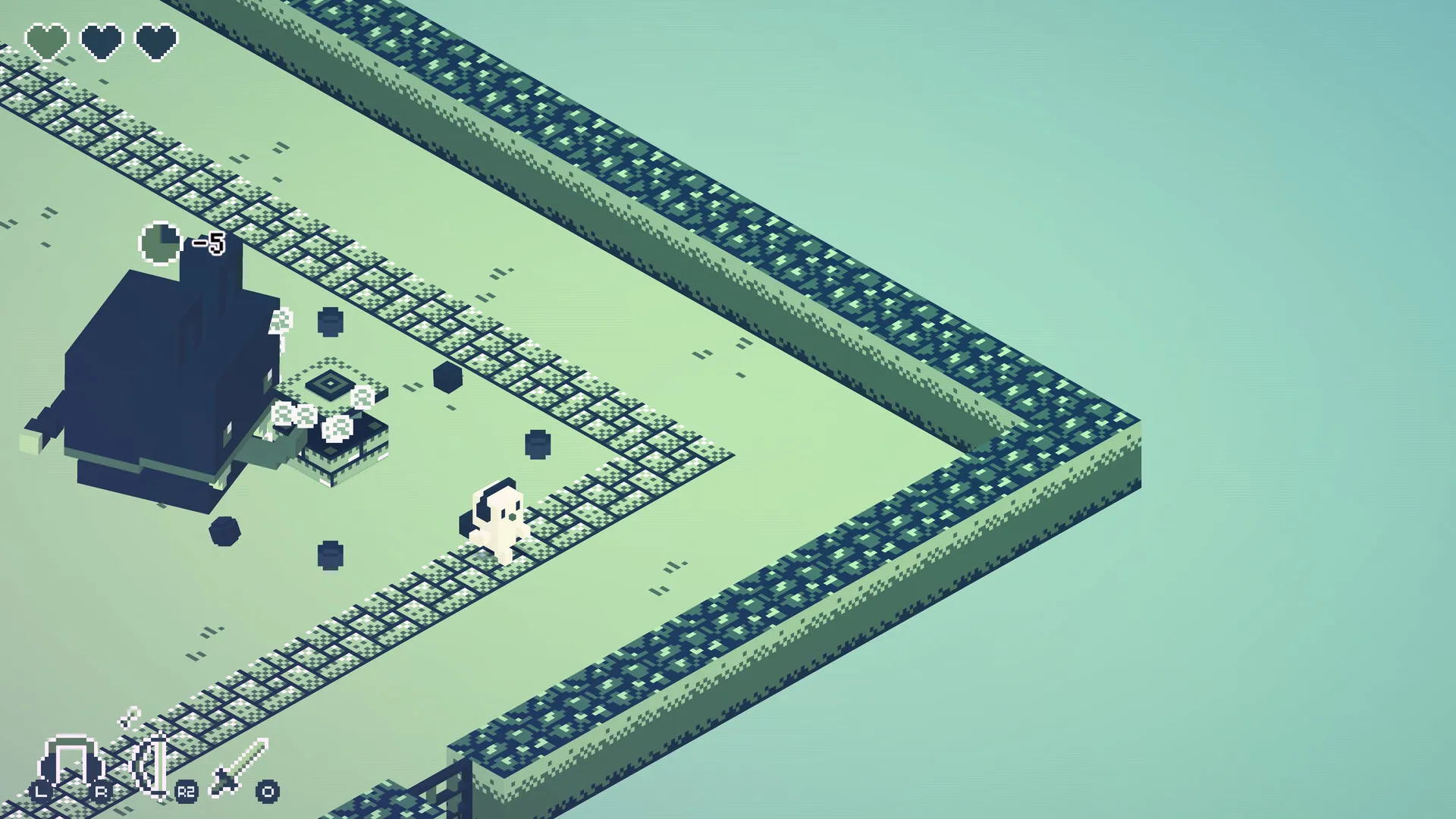
Dungeons stay compact and hide extras like ancient coins and optional challenge rooms. These spaces test your grasp of the game’s rules without always being required for the main path. Items also encourage experimentation through flexible uses. Bombs do more than deal damage: they can reveal hidden routes in walls and function as temporary stepping stools to reach higher ledges.
That flexibility calls to mind puzzle design seen in games like Fez and Tunic. Certain stretches, including the forest maze, demand specific items or a willingness to work through trial and error. The game expects you to notice environmental clues and speak with every resident who might have a hint, and each newly uncovered route or tucked-away treasure lands as something you earned through attention and persistence.
The Review
CASSETTE BOY
Cassette Boy is a clever exploration of perspective that turns a nostalgic aesthetic into a genuine puzzle mechanic. While the combat and movement lack the precision of the classics it mimics, the "Schrödinger System" provides a consistently satisfying mental challenge. It succeeds by trusting the player's curiosity and spatial reasoning rather than relying on handholding. Though the cryptic progression and repetitive leveling may frustrate some, the ingenuity of its world-shifting puzzles makes it a worthwhile journey for fans of atmospheric indie adventures.
PROS
- Inventive perspective-shifting puzzle mechanics.
- Charming, nostalgic Game Boy aesthetic.
- Calm and atmospheric lo-fi soundtrack.
- Rewarding sense of unguided discovery.
CONS
- Sluggish combat and loose character movement.
- Cryptic progression can lead to getting lost.
- Visual palette occasionally obscures important objects.
- Leveling system feels unnecessary to the core experience.