

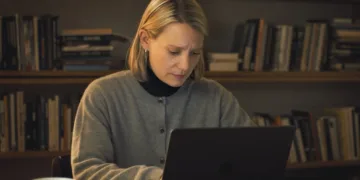
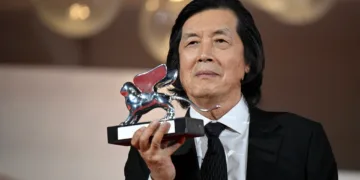










The sterile fluorescent hum of the Countess of Chester Hospital supplies the antiseptic setting for Dominic Sivyer’s latest examination. This 90-minute Netflix film returns to the case of Lucy Letby, a neonatal nurse convicted in 2023 and 2024 for the murder and attempted murder of infants in her care. The documentary plays like a cold autopsy of a public identity. It tries to hold the visceral horror of the crimes beside a rising chorus of experts who question the reliability of the legal result.
Letby herself appears as a visual absence, an unremarkable woman whose name now sits beside some of the most notorious figures in British criminal history. Sivyer uses a clinical arrangement of police footage and interview tapes to reconstruct events from 2015 and 2016.
The film refuses easy answers. It presents a world in which medical charts become the chief evidence for a soul assigned darkness. We move through clinical blue and sterile white, a visual field where every shadow receives scrutiny for a trace of malice. Sivyer frames the material as an inquiry into the limits of forensic certainty.
The Architecture of Conviction
The opening hour works like a rigid architecture of conviction. It builds a cage of circumstantial data around Letby. The patterns identified by hospital investigators arrive with the clarity of a Dutch Master painting. A central emphasis falls on the correlation between Letby’s shifts and a spike in infant collapses.
The camera handles these schedules as a chain of damning coincidences. We study the 250 confidential handover sheets found in her home, filed by date inside a box marked “Keep.” The paper hoard reads as a dark archive from a secret life. Then come the Post-it notes. Phrases such as “I am evil” and “I did this” give the viewer a view of fractured interiority. They resemble a damned monologue written in ballpoint pen.
Retired pediatrician Dewi Evans supplies forensic authority, speaking about air embolisms and insulin poisoning with terrifying precision. The film includes interrogation tapes in which Letby appears as a study in emotional flatness. She stays even-toned.
She often says she cannot remember specific medical crises. Sarah, the mother of a victim named Zoe, fills that vacuum through testimony. Her grief serves as a necessary anchor and keeps the forensic abstractions tied to human cost. This is the prosecution’s world, rendered as a place of absolute silhouettes and sharp lines. Chiaroscuro by spreadsheet. Noir has worn many costumes.
The Calculus of Epistemic Doubt
The final third shifts toward scientific critique and introduces a necessary dose of epistemic doubt. The film moves from the rigid prosecution brief into a territory shaped by systemic malaise. Lawyer Mark McDonald enters as a figure of persistent skepticism, seeking a new trial through challenges to the medical theories that produced the original life sentences.

Canadian neonatologist Shoo Lee joins him and argues that interpretations of the clinical notes were fundamentally mistaken. The documentary foregrounds the claim that the neonatal unit suffered chronic underfunding and operated as a mismanaged environment.
A critical point appears in the discussion of mortality rates. They fell after Letby left, yet that change occurred at the exact moment the unit was downgraded to treat fewer high-risk infants. The suggested link starts to look like a statistical ghost. Even the “confessional” notes receive a new framing from the defense. They are described as the product of a therapeutic exercise, with an NHS therapist said to have suggested them so Letby could process fear about professional inadequacy. This portion of the film plays like a neo-noir inversion, asking if a monster was assembled to conceal the failures of the machine.
The philosophical pressure here lands on questions of knowledge and culpability. Data appears as a route to certainty, then slips into ambiguity under fresh interpretation. Identity becomes unstable inside competing expert narratives. Ethical judgment remains suspended in a fog built from charts, notes, and institutional strain. The truth stays obscured by the density of the evidence itself. We are left with competing narratives that refuse alignment. Dark irony hangs over the frame when a shredded document seems to speak louder than a witness.
The Digital Uncanny and the Algorithm
Sivyer’s directorial choices raise serious ethical problems. The most jarring decision is the use of AI to “digitally anonymize” interviewees such as Letby’s friend Maisie. AI-generated faces speak about baby loss or PTSD. These digital shrouds feel deeply unsettling. Lip movements drift out of sync. Expressions stay blank while voices carry raw agony. The effect creates a visual rift that the film never resolves. It pulls attention toward the machinery of representation at the exact moment the testimony asks for human presence.
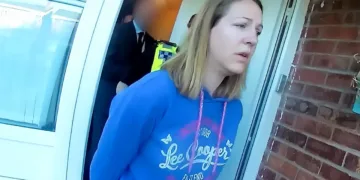
The bodycam footage of Letby’s arrest carries its own disturbance. Her mother’s primal howling is heard as police lead her daughter away. The scene presents domestic ruin in stark terms, then packages it for global consumption. Letby’s parents say they did not know the footage would be shared. The sequence feels like a ghoulish invasion of privacy. The camera records pain with documentary access, then the platform converts that access into circulation. That tension sits heavily over the film.
A harder question follows. Does this documentary produce new knowledge, or does it depend on sensational clips to hold the attention of a true-crime audience? The piece often leans on spectacle while the case remains under review by the Criminal Cases Review Commission. Using a streaming platform to litigate material tied to an active review process feels like a modern overreach. The legal process becomes algorithm-friendly content. Tragedy becomes spectator sport. The film invites viewers to witness wounds reopening before they have had time to close.
Sivyer clearly understands how sound, pacing, and image can manipulate audience perception. The documentary controls tension through procedural sequencing, abrupt tonal pivots, and the friction between sterile visuals and emotionally charged audio. It narrows the viewer’s interpretive space, then widens it late with expert dissent. That design is effective, and ethically messy. We end up watching trial-by-media staged in a digital colosseum. The final irony lands with a chill: the algorithm may be the only presence in the room that never doubts its verdict.
The Investigation of Lucy Letby premiered globally on Netflix on February 4, 2026. This feature-length documentary, produced by ITN Productions, offers a comprehensive re-examination of the criminal case against the former neonatal nurse. The film combines previously unreleased police bodycam footage of Letby’s arrests with exclusive interviews from medical experts, legal professionals, and families affected by the events at the Countess of Chester Hospital. It provides a platform for both the original prosecution’s forensic evidence and the emerging scientific critiques that have sparked international debate over the safety of the convictions.
Where to Watch The Investigation of Lucy Letby (2026) Online


Full Credits
Title: The Investigation of Lucy Letby
Distributor: Netflix
Release Date: February 4, 2026
Rating: TV-MA
Running Time: 1 hour 34 minutes
Director: Dominic Sivyer
Writers: Dominic Sivyer
Producers and Executive Producers: Carla Wright, Caroline Short, Ian Rumsey
Cast: Lucy Letby, Shoo Lee, Mark McDonald, Dewi Evans, John Gibbs, Simon Blackwell, Paul Hughes, Danielle Stonier
Director of Photography (Cinematographer): Jean-Louis Schuller
Editors: Simon Mason
Composer: Paul Saunderson
The Review
The Investigation of Lucy Letby
This documentary is a jarring collision of forensic procedural and digital voyeurism. While it efficiently lays out the prosecution’s case and the rising tide of scientific skepticism, it falters under the weight of its own stylistic choices. The use of uncanny AI faces and invasive bodycam footage of parental grief feels more like an appeal to the algorithm than a search for truth. It serves as a haunting, if ethically murky, document of a system in crisis, leaving the viewer in a state of unresolved, chilling ambiguity.
PROS
- Comprehensive overview of both the forensic evidence and the systemic counter-arguments.
- Inclusion of perspectives from high-level experts like Dr. Shoo Lee and Mark McDonald.
- High production value and effective use of archival police interrogation tapes.
CONS
- Jarring use of AI-generated faces that disconnects the viewer from the emotional weight of the testimony.
- Questionable ethics regarding the privacy of the parents and the use of sensationalist arrest footage.
- Offers very little new information to those already familiar with the extensive media coverage.