










![Kingdom Hearts Collection [I-III] Review](https://gazettely.com/wp-content/uploads/2026/10/Kingdom-Hearts-Collection-I-III-1-360x180.webp "Kingdom Hearts Collection [I-III] Review: KHII Holds Steady as Newer Entries Fluctuate 37")





Taiwanese folklore acquires a contemporary charge in Agent From Above, a series that arranges its supernatural world across the Celestial Realm, the Human Realm, and Hell. That three-tier design recalls the layered heavens of Indian Puranic tradition, so the show’s cosmology lands with a familiar shape even as it remains rooted in Taiwanese belief.
The story begins with an ancient conflict in which the Third Crown Prince cast the Demon King out of the Earthly plane. A decree now bars deities and demons from taking their true forms among mortals, and that rule gives rise to the “Agents From Above,” human mediums assigned to control spiritual violations. Han Chieh works in service of the Third Crown Prince as one of these mediums.
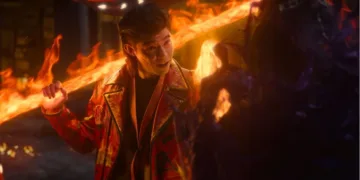
His role functions as enforced atonement after a childhood fire killed his parents. He fights with spiritual weapons called “milkcaps” and uses fire-based powers in hopes of clearing his family debt and securing their reincarnation. His pattern of duty shifts after he meets Yeh Tzu, a young woman searching for help with the haunting surrounding her father. That meeting leads them toward Wu Tien-chi, who is working toward the Demon King’s return.
Character Dynamics and the Human Element
Han Chieh arrives as a bruised, inward figure, and Kai Ko gives him a drained charisma that suits the character’s burdened life. The performance holds on to fatigue, trauma, and duty in equal measure. The series places him in the familiar line of reluctant heroes, and his reserve carries echoes of the emotionally closed men who appear in Indian parallel cinema, where silence and private anguish often shape the drama.
Yeh Tzu, also called Leafy, changes that emotional temperature. She is undergoing chemo treatments for leukemia, yet she carries a stubborn optimism that never turns cloying. Her energy slowly softens Han Chieh’s frozen manner. Their scenes begin in dismissal and friction, then grow into a partnership held together by reluctant trust.
The supporting cast widens that emotional field. Detective Chang Min, a police officer who can see spirits, brings a loose, earthly perspective that cuts through the weight of the supernatural plot. His awkwardness gives the series breathing room. Wang Bo-chieh’s Third Crown Prince stands as a severe authority figure, one who values order above personal suffering and appears with a sharp, modern visual style. Taken together, this ensemble forms an unusual investigative unit.
The group chemistry gives the series room to study endurance in the face of divine coldness. Each character carries a distinct weakness, and that makes their continued survival feel deserved. Han Chieh and Yeh Tzu remain the emotional core, with their gradual change giving the series its strongest human thread. Through them, the show keeps returning to the idea that connection survives inside a world ruled by debt, punishment, and celestial hierarchy.
Episodic Structure and Mythological Scope
The series adopts a case-of-the-week structure to widen its world piece by piece. Each investigation stands on its own and also leaves behind fragments that point toward the Demon King’s return. That design opens space for a broad look at Taiwanese temple culture, presented here as an active presence inside present-day life.

The spirits themselves vary widely. Some pose real danger. Others drift through the story in confusion. A sequence involving a lecherous ghost in an internet cafe shows the series leaning into physical comedy, and that choice gives the material a sudden swing from menace to absurd humor.
Animation appears in a practical storytelling role, offering stylized lessons about the three realms and the rules of spiritual channeling. These passages explain the universe with clarity. The pacing stays even as Han Chieh moves through one supernatural case after another, though the shifts in tone can arrive with a jolt. The show remains grounded through the rituals and practices of local temples, and that grounding preserves its cultural specificity. Its spiritual system also stays coherent.
The script explains why certain spirits demand particular tools or rituals before they can be calmed. That precision makes the stakes of each clash easy to follow. Small hauntings and the looming rise of the Demon King sit side by side without collapsing into each other. In that sense, the series resembles recent Indian urban fantasy, where regional mythology gives familiar supernatural frameworks a local body and a distinct rhythm.
Aesthetic Design and Technical Production
The show’s visual style depends on practical craft joined with digital effects. Fire attacks and glowing amulets shape the action scenes, with light serving as a sign of spiritual power. The malevolent spirits carry a grimy inventiveness in their design, far removed from polished or softened horror imagery.

They have a tactile quality that recalls the handmade ingenuity found across older genre cinema from many film cultures. Action choreography combines physical stunt work with CGI support, which helps the supernatural abilities feel planted in a recognizably physical space.
The music supports that momentum, especially in the theme song, which brings a contemporary rhythmic push to the series’ older mythic material. Costumes for the celestial figures present a fashionable, current version of temple iconography. That choice places divine beings comfortably inside modern Taipei instead of separating them from it.
The production also uses the city’s packed architecture well, turning urban density into a source of tension during spirit hunts. In the final confrontation, the scale widens when the Third Crown Prince directly takes control of Han Chieh’s body. The possession sequence becomes a display piece for the VFX team and throws the distance between human fragility and divine force into sharp relief.
Careful set design helps the passage between ordinary city life and supernatural conflict feel smooth. The scale of that technical effort matches a wider movement seen in recent Indian productions that bring traditional legend into contemporary spectacle through visual ambition.
Agent From Above is a visually striking Taiwanese supernatural thriller that made its global debut on Netflix on June 20, 2025. Based on the acclaimed novel The Oracle Comes by Xing Zi, the series explores a modern urban landscape where the boundaries between the celestial and human realms have blurred. Viewers can currently stream the entire series on Netflix, where it has gained attention for its unique portrayal of Taoist mythology through the lens of a gritty detective narrative. As of 2026, the series remains a prominent example of how traditional folklore can be effectively reimagined for a contemporary international audience.
Full Credits
Title: Agent From Above
Distributor: Netflix
Release date: June 20, 2025
Rating: TV-MA
Running time: 45, 60 minutes
Director: Donnie Lai
Writers: Emma Chen, Xing Zi
Producers and Executive Producers: Rita Chuang, Chang Ya-ting, Lin Shih-ken
Cast: Kai Ko, Buffy Chen, Wang Po-chieh, Hsueh Shih-ling, Johnny Yang, Penny Lin, Gingle Wang, Kuo Tzu-chien
Director of Photography (Cinematographer): Chen Chi-wen
Editors: Liao Ching-sung, Chen Po-wen
Composer: Lu Luming
The Review
Agent From Above
Agent From Above succeeds by grounding high-stakes spiritual warfare in the relatable struggle of human debt and redemption. While the tonal shifts between horror and comedy feel jerky, the series maintains interest through its specific cultural lens. The central performances provide weight to a story that might otherwise feel like a standard procedural. It functions as a solid example of urban fantasy that honors local traditions while aiming for a global reach. It remains a capable, entertaining addition to the genre for those seeking a fresh perspective on mythological combat.
PROS
- Strong lead performance by Kai Ko.
- Authentic integration of Taiwanese temple culture.
- Imaginative creature design and visual effects.
- Effective ensemble chemistry.
CONS
- Inconsistent pacing in certain episodes.
- Jarring transitions between dark themes and physical comedy.
- Repetitive narrative patterns.
- Final battle reduces protagonist agency.