






























If you spot a fallen tree blocking the road, keep your hands on the wheel. Do not hunt for a gas station. Keep going until the ocean shows up. The Township feels like the worst travel review ever written. The hospitality staff would gladly eat your face, and checkout never arrives.
Season 4 begins in the wreckage of a family. Jim Matthews is dead. The Man in Yellow has removed the father figure and torn a hole through the community. This season finds the survivors done with grieving and ready to dig. They stand at a crossroads. Some pursue the logic of the outside world. Others begin developing abilities that laugh at physics. Julie Matthews is slipping between moments in time.
Tabitha and Jade are chasing the origins of the ghostly children. A priest and his daughter, Sophia, arrive and bring a fresh moral burden with them. These episodes focus on the steep price of truth. Learning why they are trapped hurts worse than the trap. The series is shifting gears. It leaves the shelter of the unknown and walks into the brutality of explanation.
Trading Puzzles for Power Tools
Mystery-box television can act like a terrible romance. It sweeps you off your feet early, then ghosts you by season three. This series sidesteps that mess. It grows impatient with its own secrecy. It stops dangling answers out of reach. It lets the characters get their hands dirty.
The writers pull back from stacking new riddles on top of old ones. They choose clarity. That choice changes the whole mood of the show. The town’s origins receive a sharper, more deliberate focus. The children’s phrase “anghkooey” stops functioning as pure nightmare fuel. It becomes a working clue. The characters follow it like a linguistic trail marker.
The characters finally treat conversation like survival equipment. They stop hoarding secrets to keep the plot humming. They share visions. They share fear. That unity changes the Township from a cluster of victims into a real community. A group strategy against the night begins to take shape. Shared knowledge becomes its own weapon. The pace stays lively because the revelations land.
Small details from years earlier return with purpose. A stray object from the first season suddenly carries terrifying meaning. The cyclical shape of the story feels intentional. It matches the sensation of living inside a loop. The episodes move with a sense of aim that had been missing. They refuse to kill time. The storytelling is blunt and forceful. Every discovery lands because it feels earned.
These characters are done stumbling around in the dark. They are searching for the switch. The show knows mystery needs a destination. It gives viewers one. Then it rigs that destination with disaster. You can feel the “Lost” influence, though this version is tighter and calmer in its planning.
No polar bear. Just a visible route toward an endgame. The writers show control here. They are laying out the blueprint of the cage. That choice keeps viewers locked in because the stakes rest on tangible information. The audience has moved past pure guessing. Now we are hearing the clock tick.
The Sheriff, the Scientist, and the Shepherd
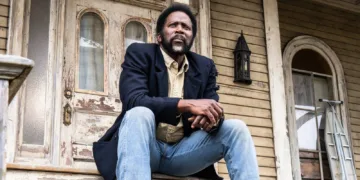
Boyd Stevens looks like a man operating on fumes. Harold Perrineau plays that exhaustion with bruising intensity. You want to hand him a pillow, then maybe a shotgun for good measure. His body is breaking down. His mind is splintering. The tremors in his hands carry the weight of a timer counting down. He is a lawman with no law left to serve. He is the sheriff of a graveyard.

Jade becomes an unexpected source of salvation for him. David Alpay gives Jade a manic charge that plays beautifully against Boyd’s heavy silence. They are the smartest people in the room and the most frightened. Their partnership runs on necessity. They approach the supernatural with cold logic and panicked yelling. It is a welcome turn. They treat the town’s horrors like an equation that still needs solving.
Donna remains the emotional ballast. She keeps the community from floating straight into madness. She handles supplies. She handles morale. She does both with grim efficiency. Her bond with the Matthews kids reveals a vulnerability she usually keeps locked away. She carries the energy of a mother figure in a place that eats children alive. Sophia’s arrival introduces a new source of friction.
She is the daughter of a priest. She brings a religious frame to a world that feels deserted by God. Her presence pushes the survivors to examine their own choices. They must ask if they still qualify as good people. Sophia presses on questions of faith and punishment. Her father tries to guide the group with a moral compass that has lost its North.
Their arrival creates tension rooted in human conflict. That helps the season vary its rhythm and gives the horror room to breathe. The social order begins to crack under the weight of their judgment. The town hardly needs monsters with neighbors like these. Sophia’s father stands for an older world that no longer fits here. He offers prayers to a sky that answers with rain and nightmares.
His dogma collides hard with Boyd’s pragmatism. The clash sharpens the group’s desperation. These people want meaning from a place that offers meat. The performances remain the season’s strongest tool. Perrineau carries decades of trauma in his eyes. Alpay turns his hands into instruments of panic, each movement catching the frantic rhythm of a genius coming apart. The ensemble work is terrific, and the show knows when to let an actor hold the frame for an extra beat.
The Inheritance of Grief and Ghostly Gifts
The Matthews family becomes a high-definition study of trauma. Jim’s death alters everything. Ethan has left behind the role of little boy in need of protection. He becomes a seeker. He believes he can finish what his father began. He walks into the woods with quiet intensity. He is searching for a way to “win the game” his father lost. He should be playing with toys. He is tracking demons.

The season shows him growing up much too quickly. The town has taken his childhood and has its eyes on his life. Julie’s struggle enters stranger territory. She can move between moments. She sees the past. She sees the future. She tries to save her father in the seconds before his throat is torn out. She fails. That failure follows her everywhere.
Her power functions like a curse that cuts her off from the people she loves. She remains present in body, yet her mind drifts years away. The image of her standing in the present while watching the past is haunting. It gives trauma a physical form. You stay trapped inside the worst moment of your life.
Tabitha returns to town carrying quiet desperation. She has brought Victor’s father, Henry, with her. Their reunion is painful and awkward. Henry feels like a man dropped out of time. He sees the town through the eyes of someone who lost his son decades earlier. He looks at Victor and sees a man who should still be a boy.
Tabitha and Jade work side by side, mapping the links between the ghostly children and the town’s present threats. Their investigation moves with the pulse of a sprint. They are searching for an exit before the walls close in. The region’s history feels like a dark well, and they keep leaning farther over the edge.
Each discovery pushes home farther away. Escape demands sanity as payment, and they seem ready to pay. They understand that home has become a fading memory. The younger cast does excellent work here. Simon Webster gives Ethan a frightening wisdom for a child. Hannah Cheramy carries the crushing weight of Julie’s power with real force. They sit near the emotional center of the show, which also makes them the clearest targets.
Nightmares in Muted Grey
The Man in Yellow does not operate like a standard slasher. He is a conductor, guiding the misery of the Township with ugly precision. He wants the residents tearing each other apart. He embodies the town’s cruelty. He mocks Boyd. He taunts the children. His presence changes the stakes.
The monsters now feel connected to a higher intelligence. That raises the threat level in a hurry. Hiding gets much harder once the enemy seems to know your thoughts. The visual style hits a high point this season. The direction leans on silence to build suffocating tension. Cheap jump scares never take over. The fear arrives through long, patient shots, like a smiling face waiting in a window.
The cinematography frames the town as a beautiful cage. The palette stays muted. The shadows sink deep. Every image feels weighted. The Kimono Woman adds fresh unease. She drifts through dreams and waking life alike. She reminds the survivors that safety no longer exists, even in their own heads.
The nocturnal creatures still anchor the dread. They keep smiling. They keep walking slowly. That consistency is exactly what makes them so unnerving. They never need to run. They know no one can leave. The season keeps circling one brutal idea: knowledge carries a cost. Every answer points toward another funeral.
The physical danger never lets up. The psychological damage cuts deeper. The survivors are learning that truth may be the worst monster in town. The sound design does heavy lifting all season. The wind carries the texture of a scream. The crickets click like teeth. The isolation settles into your bones.
The makeup effects are raw and tactile. The blood looks wet. The wounds look deep. The town is finally showing its real face, and it has no interest in mercy or prayer. What remains is a community standing at the edge of a cliff, staring into a spectacular view and an awful drop. Faith may have to answer a very ugly question here: what survives in a place where the gods are hungry?
The first season of From arrived on February 20, 2022. It has since become the most-viewed series in the history of the MGM+ network. The fourth season premieres this Sunday, April 19, 2026. Fans can access the show on the MGM+ app or through streaming partners that host the channel. The story follows a group of survivors in a town that refuses to let them leave. They face psychological terror during the day and physical predators during the night. The community is still recovering from the loss of major residents while the forest grows more aggressive.
Where to Watch From Season 4 Online










Full Credits
Title: From
Distributor: MGM+
Release date: April 19, 2026
Rating: TV-MA
Running time: 45–60 minutes
Director: Jack Bender, Brad Turner, Jennifer Liao, Jeff Renfroe, Alexandra La Roche, Bruce McDonald
Writers: John Griffin, Jeff Pinkner, Vivian Lee, Javier Grillo-Marxuach, Brigitte Hales, Kristen Layden
Producers and Executive Producers: Jack Bender, Jeff Pinkner, Josh Appelbaum, André Nemec, Scott Rosenberg, John Griffin, Anthony Russo, Joe Russo, Mike Larocca, Rola Bauer, Lindsay Dunn, Michael Wright, Nancy Cotton, Harold Perrineau, Michael Mahoney
Cast: Harold Perrineau, Catalina Sandino Moreno, Eion Bailey, David Alpay, Elizabeth Saunders, Scott McCord, Ricky He, Chloe Van Landschoot, Pegah Ghafoori, Corteon Moore, Hannah Cheramy, Simon Webster, Avery Konrad, Angela Moore, Kaelen Ohm, A.J. Simmons, Nathan D. Simmons, Robert Joy, Samantha Brown, Julia Doyle
Director of Photography (Cinematographer): David Greene, Christopher Ball, Michael Wale
Editors: Wendy Hallam Martin, Ana Yavari, Dan Briceno, Stephen Lawrence, Michele Conroy, Maxyme Tremblay, Geoffrey O’Brien, Max Koepke
Composer: Chris Tilton
The Review
From Season 4
This season abandons the stalling tactics typical of high-concept drama. It replaces vague riddles with visceral logic and actual answers. The shift toward clarity makes the Township feel more lethal. Perrineau leads the group with a performance that conveys absolute exhaustion and desperate grit. This is a sharp, effective, and unforgiving chapter of a story that finally knows its destination.
PROS
- Satisfying resolution of early series mysteries.
- Exceptional acting from Harold Perrineau.
- Terrifying villains with clear goals.
- Better dialogue between key survivors.
CONS
- Intentional pacing can feel slow.
- High emotional misery for the audience.
- Some side characters remain underwritten.







