


















![Kingdom Hearts Collection [I-III] Review](https://gazettely.com/wp-content/uploads/2026/10/Kingdom-Hearts-Collection-I-III-1-360x180.webp "Kingdom Hearts Collection [I-III] Review: KHII Holds Steady as Newer Entries Fluctuate 33")







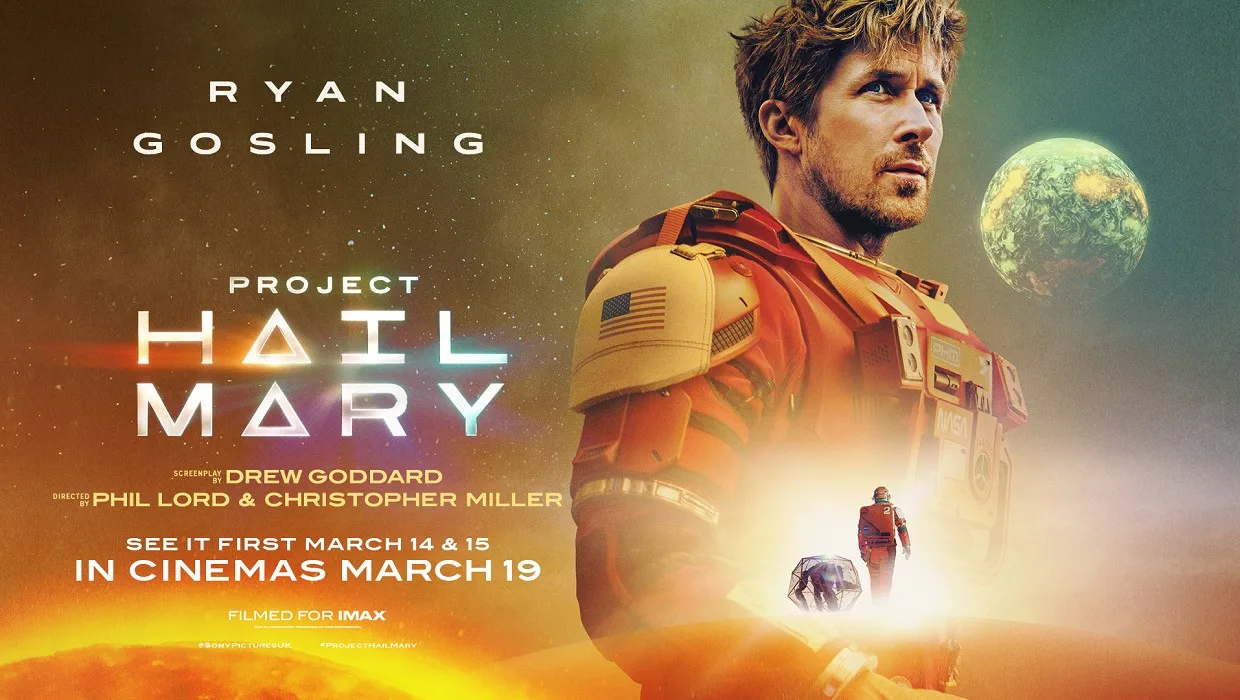

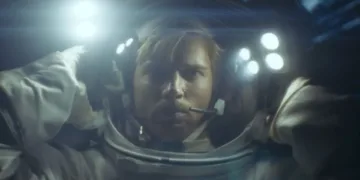
There is something philosophically unsettling about a story that begins with a man who does not know his own name. Ryland Grace wakes aboard a spacecraft, breathing tube in his throat, muscles slack, memory reduced to ash. Two crewmates lie dead nearby. The sun is dying. Somewhere in the void, there may be an answer.
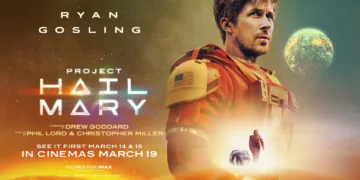
Project Hail Mary, directed by Phil Lord and Christopher Miller and written by Drew Goddard from Andy Weir’s 2021 novel, is a grand-scale science fiction film that places one reluctant man at the edge of human extinction. Ryan Gosling plays Grace, a molecular biologist who had been teaching middle school science before circumstances far beyond his choosing sent him toward a star called Tau Ceti, the only star in the known galaxy resisting the microscopic organisms, Astrophage, that are slowly consuming our sun. He carries the film across considerable stretches of solitude, and largely succeeds. The film swings between awe-inspiring spectacle, screwball comedy, and sincere sentiment, sometimes all within the same sequence, with results that are frequently stirring and occasionally conflicted.
Memory as Architecture
The film’s structural choice to tell its story across two timelines is its most intelligent formal decision. In the present, Grace floats through the ship, recovering fragments of memory the way a man pulls splinters from his skin: slowly, with some pain, and with no guarantee of the full picture. On Earth, in the past, we watch how he was recruited by Eva Stratt (Sandra Hüller), the imperious architect of the Hail Mary project. The amnesia is a narrative engine, letting the audience assemble the mission’s architecture alongside Grace himself.
The interplay between timelines achieves something beyond mere structural cleverness. Because we sometimes understand the stakes of a present-day scene before Grace does, the film creates a specific kind of dread, the dread of watching someone approach a truth they cannot yet bear. We know what he will remember. We wait.
The Earth sequences carry their own weight. Hüller’s Stratt moves through them with precise, clinical authority. She recruits Grace because she needs him, and she removes his consent because she needs that too. Late in the film, when Grace remembers exactly how he came to be on this ship, an induced coma that sealed his fate, the moral question should be seismic. He was sent to his death without agreement, without awareness, without the dignity of a choice. The film raises this, and then lets it settle like dust. Stratt is reframed as a stern mentor who knew better, even rewarded with a sentimental scene that softens what the story’s own logic condemns. There are questions here about authority, individual sovereignty, and the price of collective salvation that the film could have used as its philosophical spine. It does not.
Secondary Earth characters, pulled into the Hail Mary project, add humanity to the pre-launch sequences and give Gosling material to play against. Their scenes provide grounding, revealing who Grace is when no one is watching the clock.
Gosling, Grace, and the Weight of Being Alone
Ryan Gosling is a particular kind of film actor: one whose most expressive instrument is his receptivity. He gives everything to a scene’s other presence, human or otherwise, and the camera catches what that generosity costs him. Here, for long stretches, that other presence is the ship itself, the hum of its systems, the silence of space outside the porthole. Gosling fills that silence with physical specificity and a restless intellectual energy that makes Grace’s scientific thinking feel embodied rather than expository.
He plays Grace as someone who has learned to process fear through humor, a man who makes a joke when the alternative is panic. Lord and Miller’s instincts align with this, and the film is funnier for it, though the comedy occasionally inoculates a scene against its own gravity. There are moments where a harder edge would serve the story, where Grace’s lightness costs the audience the full emotional weight of his predicament.
In scenes with Hüller, Gosling finds his best register. Her deadpan containment draws something genuinely felt from him, an awkwardness that reads as authentic rather than performed. The karaoke scene, where Stratt sings with a vulnerability entirely at odds with her public severity, is the film’s most precisely human moment, and Gosling’s reaction does more for his characterization than several scripted monologues.
The limitation is structural as much as performative. Grace’s inner transformation, his reckoning with having been sent to die without his knowledge, is underwritten. The arc exists. The performance reaches for it. The script does not quite meet him there.
Rocky and the Comedy of Contact
The alien designated Rocky, a five-limbed creature of apparent rock, puppeted on set by James Ortiz, is a small miracle of craft. Without a face, without the conventional grammar of expression, Rocky achieves something that eludes many fully rendered digital characters: presence. The practical construction grounds him in physical space, and Gosling’s commitment to the scenes completes the illusion. When they interact, you believe in the reality of two beings making sense of each other across an absolute species divide.
The relationship between Grace and Rocky forms the emotional architecture of the film’s second and third acts. Two scientists, each the last surviving representative of their planet’s hope, negotiating language, trust, and a problem that will kill everything they love if they fail. The tenderness that develops between them feels earned. Several scenes land with genuine feeling, particularly those built around the slow accretion of mutual understanding rather than the payoff of a punchline.
Lord and Miller’s instinct, however, is to mine this pairing for comedy, and they mine it perhaps one level too deep. Running gags about cleanliness disputes, failed fist-bumps, and improvised dance exchanges provide warmth, but they also bleed tension from scenes that need it. The dramatic architecture beneath these moments has already done the emotional work. The joke that follows displaces rather than deepens it.
The film reaches its most affecting register when it trusts the relationship’s inherent strangeness and gravity, two beings who should have no language for each other, finding one anyway. That is the story worth telling. The buddy comedy wrapped around it, charming as it sometimes is, dilutes the philosophical implications of what first contact between dying civilizations might actually feel like.
Spectacle Under Pressure
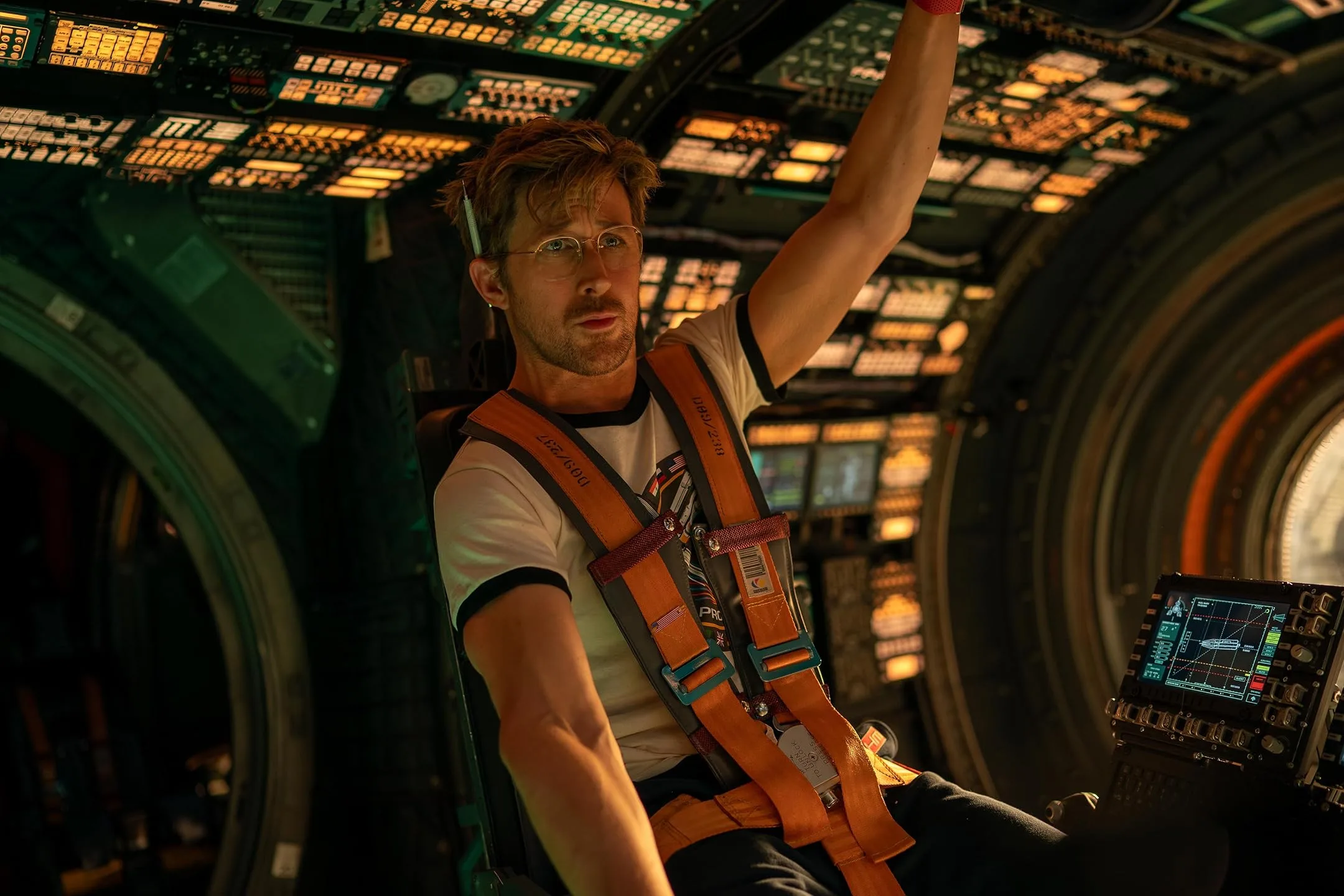
Lord and Miller return to live-action filmmaking after twelve years, and what they have built here is technically formidable. The Hail Mary spacecraft feels functional rather than fantastical, a working environment of corridors, instruments, and improvised repairs, achieved substantially through practical construction rather than digital substitution. The difference registers physically. The ship has weight.
Greig Fraser’s cinematography moves between the claustrophobia of interior spaces and the overwhelming scale of open space with genuine control. Charles Wood’s production design supports this: the vessel reads as a research ship rather than a cinematic prop, its details credible enough to sustain scrutiny. The large-format sequences achieve real grandeur, particularly a passage where Grace and Rocky skim a planetary atmosphere to collect a biological sample. Fraser’s images carry the full strangeness of what the scene depicts.
Some camera choices are less successful. Aggressive Dutch angles appear periodically without clear dramatic motivation, inducing disorientation that serves mood rather than meaning.
Daniel Pemberton’s score is panoramic and emotionally expansive, doing considerable work in the larger set pieces. It is also, at times, too certain of what you should feel. There are scenes where near-silence would allow the image to breathe and the audience to arrive at emotion independently. The score forecloses that possibility. A secondary soundtrack of rock, folk, and Americana needle-drops adds nostalgia and period texture to the Earth sequences, functioning as cultural shorthand for the world Grace is trying to save.
The Science of Saving and the Ethics of Sacrifice
Drew Goddard’s script handles the scientific architecture of Andy Weir’s premise with surprising fidelity given the demands of the form. Astrophage, the single-celled organism consuming solar energy across the galaxy, is introduced and developed with enough specificity to feel real without requiring the audience to follow every calculation. The discovery scenes, where Grace uses what he has available to deduce the nature of the threat, carry a genuine charge. Science here is a mode of survival, curiosity framed as an evolutionary advantage.

The film argues, through its mechanics, for lateral thinking, cooperation, and the scientific method as the only tools available when catastrophe exceeds the scale of any individual response. It is a quietly earnest position, and it gives the story moral weight independent of its plot.
The Grace-Rocky partnership extends this argument into its purest form: two beings who share no biology, no language, no cultural reference point, choosing to work together because the alternative is mutual extinction. The cooperation that develops sidesteps competition entirely, rooted in shared vulnerability. It is, when the film allows it to be, genuinely moving.
What the film cannot quite bring itself to do is examine the cost of Stratt’s choices with the rigor it applies to everything else. Her decision to remove Grace’s agency, to send him to his death without consent, should reframe everything the story has built. The questions it raises, about authority, about sacrifice, about who decides the price of salvation, deserve more than a shrug dressed as sentiment.
Project Hail Mary premiered in theaters on March 20, 2026, quickly becoming a major science fiction blockbuster. Based on the acclaimed 2021 novel by Andy Weir, the film stars Ryan Gosling as Ryland Grace, a middle-school science teacher who wakes up on a spacecraft with no memory of his mission or how he got there. He soon discovers he is humanity’s last hope for survival and must use his scientific ingenuity—alongside an unexpected alien ally named Rocky—to save Earth. As of today, the film is enjoying a successful theatrical run and is expected to be available for streaming exclusively on Prime Video following its cinema window.
Where to Watch Project Hail Mary (2026) Online










Full Credits
Title: Project Hail Mary
Distributor: Amazon MGM Studios
Release date: March 20, 2026
Rating: PG-13
Running time: 166 minutes
Director: Phil Lord, Christopher Miller
Writers: Drew Goddard, Andy Weir
Producers and Executive Producers: Amy Pascal, Ryan Gosling, Phil Lord, Christopher Miller, Aditya Sood, Rachel O’Connor, Andy Weir
Cast: Ryan Gosling, Sandra Hüller, James Ortiz, Lionel Boyce, Ken Leung, Milana Vayntrub, Priya Kansara, Malachi Kirby, Liz Kingsman
Director of Photography (Cinematographer): Greig Fraser
Editors: Joel Negron
Composer: Daniel Pemberton
The Review
Project Hail Mary
Project Hail Mary is a film of genuine ambition pulled in two directions simultaneously. Gosling anchors it with real skill, Fraser's images earn their scale, and the Grace-Rocky relationship achieves moments of unexpected tenderness. Yet the film flinches from its own darkest questions, trading philosophical weight for crowd-pleasing warmth at precisely the moments when discomfort would have made it something lasting.
PROS
- Gosling's performance is committed and frequently magnetic
- Visually stunning, with genuine large-format grandeur
- Rocky is a triumph of practical craft
- The non-linear structure works
- Science is handled with intelligence and care
CONS
- Comedy undercuts dramatic tension repeatedly
- Stratt's moral complexity is abandoned
- Score over-signals emotion throughout
- The third act loses thematic nerve