



























A chilling prophecy tells middle-aged businessman Sakol that his elderly mother, Grandma Saluay, may be nearing death. Panic turns him into a logistical machine. He gathers nine relatives from three generations, loads them into two vehicles, and sends the family across Thailand toward nine Buddhist temples in one day. The plan rests on cultural arithmetic. In Thai tradition, the number nine, kao, sounds like the word for progress. Merit gained through donations and prayer should, in theory, buy time. Money becomes karma with a receipt.
Director Sompot Chidgasornpongse makes his fiction feature debut here, after years spent working as an assistant director to arthouse master Apichatpong Weerasethakul, who remains attached as producer. The inheritance is visible in the film’s patience and its refusal to hurry toward emotional payoffs. The film becomes a slow-burning family drama shaped like a road movie, built around spiritual tradition, modern doubt, and mortality. It treats religious action as a cosmic insurance policy, then watches that policy meet the stubborn fact of an aging body.
Transactifying the Infinite
Sakol is a man possessed by filial terror. His behavior suggests a son desperate to be seen performing goodness: dutiful child, pious patriarch, moral organizer of the clan. His sprint to gather merit turns ancient religious practice into a ritualized checklist. Salvation seems to require routing, scheduling, cash flow, and parking access. This is spiritual capitalism, with incense.
The sacred transaction becomes a psychological barricade against death anxiety. Sakol acts because stillness would expose the fear beneath the performance. He wants faith to function like administration, a system with inputs and measurable returns. People have always tried to negotiate with the infinite; Sakol simply does it with a van, a timetable, and a family under pressure.
Tor’s brooding vulnerability and Koon’s open skepticism sharpen the generational split. The grandchildren register the temple circuit as inherited obligation. For younger Thais, Buddhism here reads as a chosen philosophy, available for reflection and refusal, while the binding existential contract loses its hold. They recognize the commercial machinery of the temples with clear eyes. Their discomfort gives the film its social bite, since the pilgrimage becomes a portrait of a culture arguing with itself inside a moving vehicle.
Grandma Saluay’s exhaustion turns that argument into an ethical test. After several stops, she refuses to leave the rental van. The family faces an ugly question: Should the ritual circuit continue at full force, or should her immediate comfort take priority? The situation echoes a familiar modern cruelty, the elevation of institutional continuity over the fragile human body placed under its care.
The clergy receive a calm, unsentimental treatment. The film presents a religious elite dealing with the practical messiness of its own institution. Some monks offer beautiful pragmatism, assuring the family that merit can reach a relative sleeping in the parking lot. Others slip toward opportunism, promoting youth meditation camps for short attention spans or asking for donations with startling bluntness. Faith survives here through accommodation, hustle, sincerity, and the occasional sales pitch.
The Quiet Power of the Matriarch
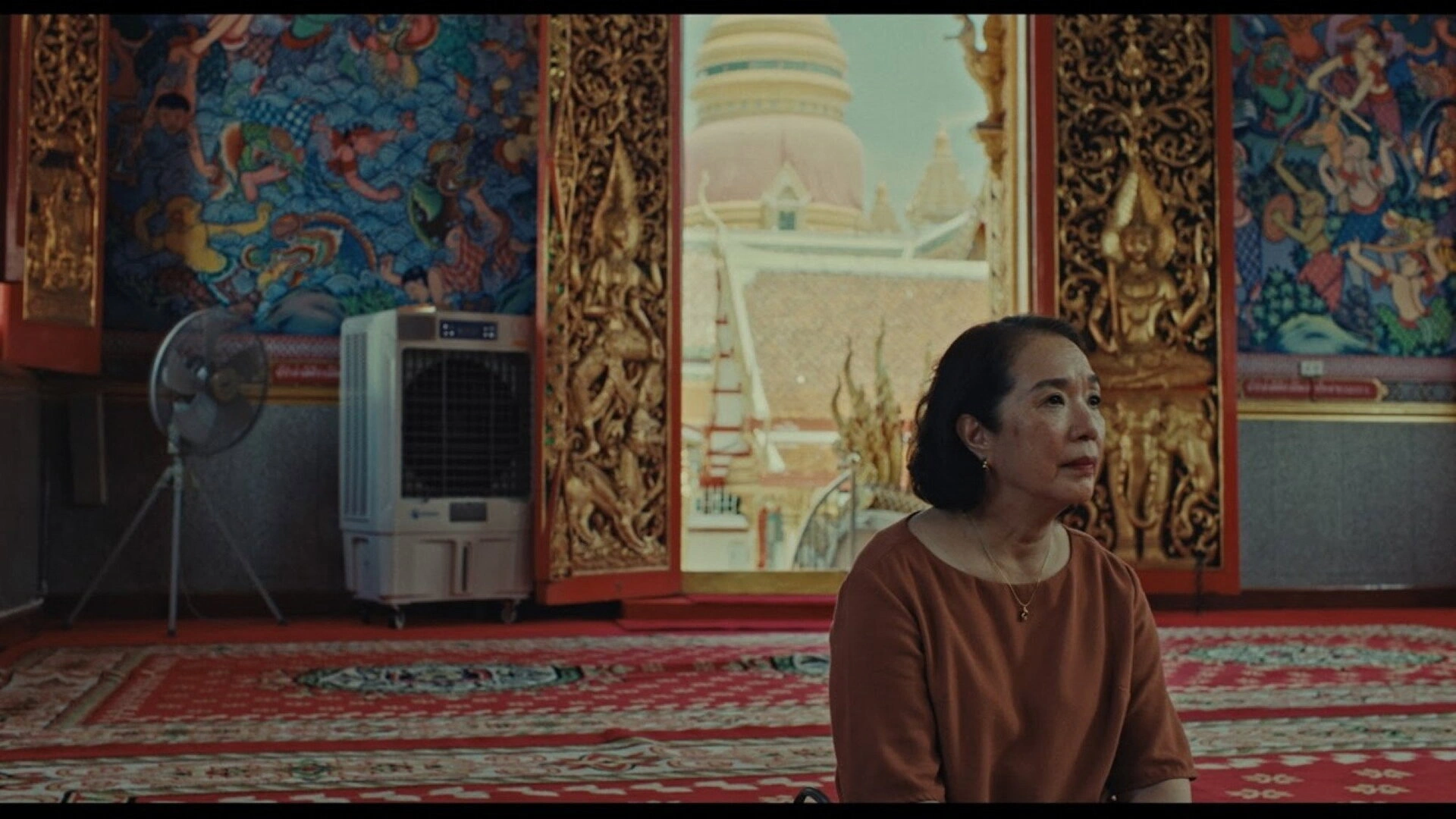
Amara Ramnarong gives Grandma Saluay a magnificent, weary stillness. Her resistance is quiet, bodily, almost tectonic. She has zero appetite for purchased cosmic extensions. The couch at home and television game shows hold far greater appeal than another draining temple stop.
Chidgasornpongse introduces her through indirect staging. The camera first observes her from behind as the Thai landscape blurs through a car window. Before access to her private thought, we study her frailty, her isolation, the fact of her body in transit. The viewer begins where the family often begins, by seeing her as someone to be moved, managed, protected, and perhaps saved.
Her presence gradually becomes the narrative anchor. When she speaks at length, she offers a blunt memory from her past: she never actually liked or chose her husband, accepting him because he liked her. The remark detonates quietly inside the family’s cherished history. A life previously treated as medical crisis and filial duty expands into something denser, stranger, and historically charged. Grandma Saluay becomes a witness to her own compromises, a woman whose biography has been softened by the myths her children needed.
The grandson’s decision to record her voice on a smartphone gives the film one of its most tender gestures. He senses time shrinking and tries to preserve a digital trace of her existence. Memory becomes an audio file; love becomes preservation technology; grief gets storage space.
Architectural Absurdity and the Mid-Trip Cosmic Pause
Cinematographer Jonathan Ricquebourg uses a steady camera, long uninterrupted takes, and deep-focus framing. The formal discipline lets the large ensemble move through shared space with natural friction. Background arguments and silent glances remain visible through restraint. The viewer becomes a silent passenger in the back seat, trapped among relatives, fatigue, and devotional pressure.
The film’s visual intelligence comes through its spatial juxtapositions. The camera lingers on temple grandeur: painted frescoes, shimmering chandeliers, architectural scale. Everyday objects keep entering the frame beside sacred icons. Plastic chairs, construction scaffolding, and electric fans occupy the same visual field as objects of devotion. Spiritual aspiration keeps meeting maintenance work.
At 140 minutes, the film’s patience creates strain. The repeated temple visits mirror the physical grind of the pilgrimage, turning structure into sensation. That choice has integrity, and it can test patience. Several secondary relatives remain thinly sketched, which makes the repetition heavier than it needs to be. Austerity becomes a virtue, then briefly becomes a seatbelt digging into the ribs.
Two structural choices define the film’s form. The trip is framed by scenes of temple workers arranging plastic chairs and rehearsing a funeral oration. From the start, the merit-making mission carries a fixed destination. Grandma Saluay will die. The tragedy has already been staged, rehearsed, and furnished.
Then, roughly two-thirds through the film, a dark cloud covers the sun during a sudden solar eclipse. The screen turns almost black for several minutes. The characters leave the event unexplained, and the film grants the darkness a strange authority. This cosmic pause sends a wave of quiet unease through the road trip, changing its atmospheric weight just before the family structure begins to come apart.
“9 Temples to Heaven” premiered internationally on May 19, 2026, as part of the prestigious Directors’ Fortnight selection at the Cannes Film Festival. Produced under the guidance of acclaimed filmmaker Apichatpong Weerasethakul, this thought-provoking Thai drama is currently making its rounds on the global festival circuit, with scheduled screenings at major cinematic events including the Sydney Film Festival. Distribution rights are managed by Playtime, making it an upcoming fixture for arthouse platforms and specialty theaters.
Where to Watch 9 Temples To Heaven (2026) Online
Title: 9 Temples to Heaven
Distributor: Playtime
Release date: May 19, 2026
Running time: 140 minutes
Director: Sompot Chidgasornpongse
Writers: Sompot Chidgasornpongse
Producers and Executive Producers: Apichatpong Weerasethakul, Kissada Kamyoung
Cast: Surachai Ningsanond, Amara Ramnarong, Klaichan Phunman, Nichmon Shintadapong, Jirawut Chiwaruck, Yaneenan Jiraphatjittrin, Sompop Songkampol, Poon Sirapob, Yada Karnjanisakorn
Director of Photography (Cinematographer): Jonathan Ricquebourg
The Review
9 Temples To Heaven
"9 Temples to Heaven" is a patient, deeply observant exploration of familial duty and spiritual friction that cleverly balances institutional critique with quiet domestic warmth. While its substantial 140-minute runtime and structural repetition can occasionally test viewer endurance, the film serves as a beautifully staged window into contemporary Thai society and the universal anxieties surrounding aging. It rewards open-minded viewers with exceptional formal precision and profound emotional honesty.
PROS
- Stunning, deep-focus cinematography by Jonathan Ricquebourg that captures architectural grandeur alongside intimate human interactions.
- A masterfully subtle, grounding lead performance by Amara Ramnarong as the weary matriarch.
- A sharp, nuanced script that examines modern religious commodification without slipping into cynicism.
- The inclusion of striking, unexpected moments of cinematic staging, such as the mid-trip eclipse sequence.
CONS
- The deliberate pacing and lengthy 140-minute runtime can feel overextended due to the repetitive nature of the temple routine.
- Several secondary ensemble family characters remain thinly sketched and underutilized throughout the road trip.