

























![Kingdom Hearts Collection [I-III] Review](https://gazettely.com/wp-content/uploads/2026/10/Kingdom-Hearts-Collection-I-III-1-360x180.webp "Kingdom Hearts Collection [I-III] Review: KHII Holds Steady as Newer Entries Fluctuate 37")





The cinematic language of Austrian director Sandra Wollner moves at the frequency of ontological disturbance, where memory and erasure begin to occupy the same room. Her third feature, Everytime, which debuted at the 2026 Cannes Film Festival in Un Certain Regard, approaches sudden death as an abyss that keeps breathing after the event has passed. The opening creates a delicate domestic arrangement in Berlin.
Ella, a divorced mother, prepares the ordinary details of a summer holiday to Tenerife with her daughters, adolescent Jessie and younger Melli. That promised leisure breaks apart when Jessie slips into the city with her boyfriend, Lux, for a night of substance-fueled drifting. On a high-rise rooftop, the wandering ends in a silent plunge.
Wollner cuts through the expected rhythms of grief with a harsh temporal ellipse, leaving the first year of shock outside the image. When the film resumes, it settles inside the flattened architecture of survival. Domestic routine becomes a mechanism, a daily ritual built to keep the eye from resting too long on absence.
The Geometric Fracture of Loss and Accountability
The fatal fall arrives as a collapse of filmic grammar, staged with clinical precision and a quiet terror that seems to drain oxygen from the frame. Wollner and editor Hannes Bruun withhold any stable vantage point that might let the spectator arrange the disaster into meaning. Fragmented cuts, inverted fields, and abrupt shifts in perspective fracture visual certainty. The scene captures cognition in crisis, the mind failing to assemble space, cause, and consequence.
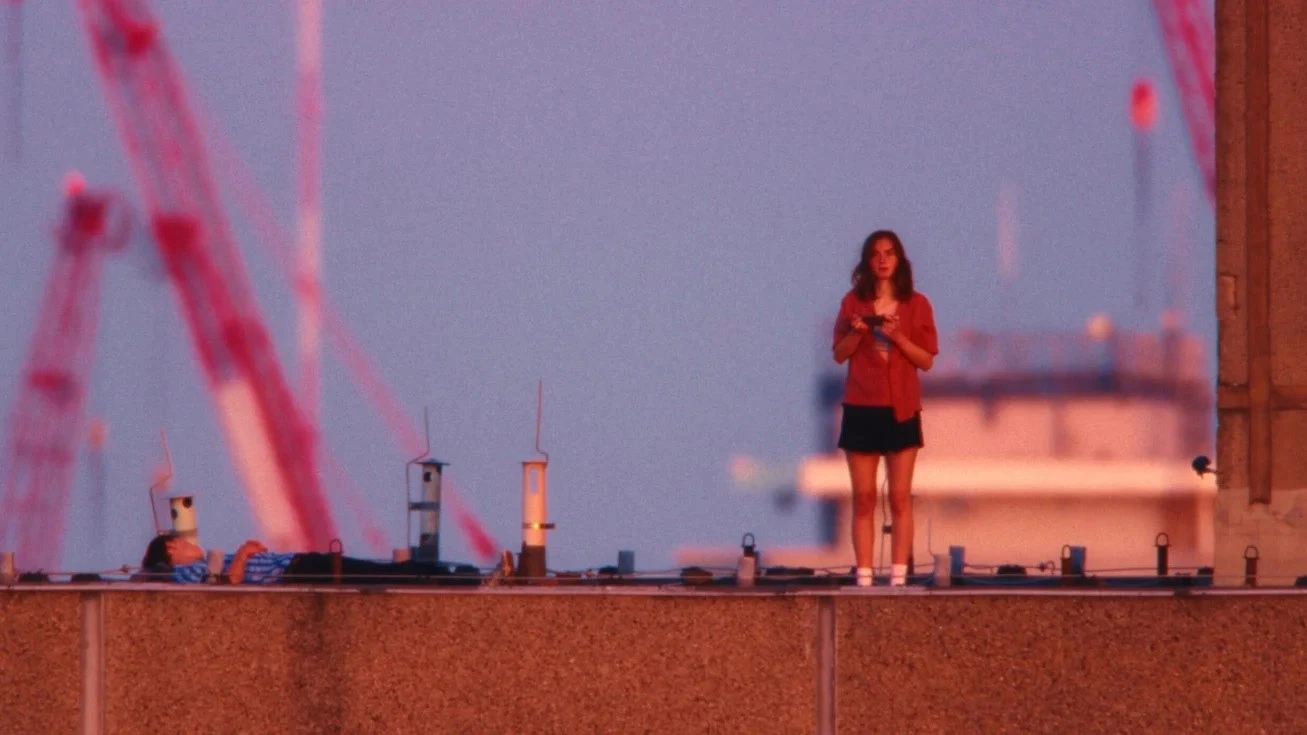
A heavy ambiguity remains lodged inside the wound. Jessie may have misjudged the edge in her altered state. She may have chosen an exit from existence. The film leaves that question suspended, and this suspension becomes its philosophical ground. Death, here, refuses the mercy of explanation.
Twelve months later, the characters move through their surroundings like sleepwalkers rehearsing normal life. Lux’s unexpected return brings a dense atmosphere of unspoken accusation into the household. He carries guilt as an isolated burden, mirroring Ella’s own paralysis. Their shared pain creates contact without communion. The generational split becomes sharp, almost geometric. Trauma turns each consciousness into a sealed island.
That split emerges most painfully when Melli loses her mobile phone in a public space. For the child, the lost device holds the entire pixelated archive of Jessie. It is the place where her sister still appears to answer the present. Ella cannot grasp this digital terror. She reads the panic as a childish outburst. The exchange reveals the household’s hidden structure: a family grieving in close physical proximity while each member remains stranded inside private desolation.
Mechanical Ghosts and the Architecture of Virtual Solace
Formally, the film becomes a study of textures, shaped through Gregory Oke’s cinematography. The light-soaked, early morning 35mm grain of Berlin’s Alexanderplatz stands against the cold, repetitive concrete geometries of the Tenerife seaside resort. These spaces carry different temperatures of sorrow. One seems to flicker with remembered life. The other appears built from impersonal repetition, as if grief has been poured into concrete.
Wollner fills these environments with technological media forms that erode the partition between present reality and stored memory. Digital family videos, low-resolution phone clips, and simulated text streams interrupt the primary film gauge. A chat screen with three flashing typing dots becomes a site of almost unbearable suspense. The smallest sign of delayed response acquires metaphysical weight. In that flicker, the living wait for the dead to speak.
Minecraft’s infinite block-world enters the film as a thematic refuge. Its clean, programmable space offers a counterimage to the terrifying randomness of flesh-and-blood mortality. There, matter follows grids. Structures obey. Death can be revised through construction, repetition, and design. The desire beneath this virtual refuge is painfully human: a wish to replace chaos with rules, loss with manipulable form.
This mechanical alienation seeps into the physical world through surreal, non-linear motifs that unsettle the reality of each scene. In a deserted asphalt parking lot, an unmapped drone appears from nowhere and hovers inches from Ella’s face. Its whirring lens holds her gaze with emotionless attention, then floats away into a dark subterranean shaft.
The image revises the classical cinematic figure of a bird visiting the bereaved. Here, the messenger is metallic, impersonal, and unreadable. It observes suffering with the chill of modern technology, leaving the human condition lonelier than before.
The Sovereign Hallucination and the Flight from Reason
The emotional force of this formal design rests on performances built from compression. Birgit Minichmayr gives Ella a staggering inner density. She externalizes the exhaustion of a woman forced to perform the fiction of functional survival so her remaining child does not collapse completely. Her face becomes terrain marked by endurance. Each silence carries the pressure of a breakdown held just beneath the skin.
Lotte Shirin Keiling offers a remarkably naturalistic Melli, capturing the fragile state of a child old enough to feel the permanent gravity of absence, yet still lacking the emotional language needed to understand her mother’s passive hostility toward Lux. Melli’s grief moves through objects, screens, and gestures. Ella’s grief hardens into atmosphere. Between them, Jessie remains present as a missing shape.
In the final movement at the seaside resort in Tenerife, the trio tries to resume the exact holiday itinerary stolen from them a year earlier. The film’s domestic realism begins dissolving into a parallel psychological reality. Linear time fractures. Physical environments and subconscious longing leak into one another until the visible world feels like a projection of grief’s desire.
The climax abandons logic with quiet severity. An infant version of Jessie is found crawling down a sterile hotel corridor. The image is plain, impossible, and devastating. As the setting sun over the ocean becomes a low-resolution square block echoing video game aesthetics, the characters reject the cruel laws of physical reality.
They choose an impossible, consoling simulation, a place where loss can be overwritten by vision. The universe allowed their daughter and sister to vanish into nothingness. The mind answers by building another universe from need, refusal, and dream matter.
The psychological drama film Everytime held its highly anticipated world premiere on May 18, 2026, screening inside the prestigious Un Certain Regard competition at the 79th Cannes Film Festival. Produced as an international collaboration between production companies Panama Film and The Barricades, this striking feature can currently be seen making its initial festival rounds across international markets, with global theatrical and streaming distributions handled through the Paris-based sales company Charades.
Full Credits
Title: Everytime
Distributor: Charades, The Barricades, Panama Film, ZDF
Release date: May 18, 2026
Running time: 121 minutes
Director: Sandra Wollner
Writers: Sandra Wollner, Roderick Warich
Producers and Executive Producers: Lixi Frank, Viktoria Stolpe, David Bohun, Sandra Wollner, Astrid Schäfer
Cast: Birgit Minichmayr, Tristán López, Lotte Shirin Keiling, Carla Hüttermann
Director of Photography (Cinematographer): Gregory Oke
Editors: Hannes Bruun
Composer: David Schweighart, Timm Kröger, Peter Kutin
The Review
Everytime
Everytime stands as a clinical, hauntingly poetic examination of existence altered by tragedy. Sandra Wollner bypasses structural melodrama to probe the strange reality of trauma. By discarding narrative logic in favor of a sovereign, digital simulation, the film captures the absolute length to which the human mind travels to escape a shattering loss. It is a demanding work of art, presenting an uncompromising aesthetic that rewards those willing to sit within its heavy stillness.
PROS
- Outstandingly precise cinematography by Gregory Oke
- A remarkably naturalistic performance by young Lotte Shirin Keiling
- Brilliant and highly original integration of virtual landscapes and modern text interfaces as thematic devices.
CONS
- The deliberate absence of a traditional linear narrative structure can result in a challenging viewing experience
- Certain contemplative pacing choices test spectator endurance.







