
























![Kingdom Hearts Collection [I-III] Review](https://gazettely.com/wp-content/uploads/2026/10/Kingdom-Hearts-Collection-I-III-1-360x180.webp "Kingdom Hearts Collection [I-III] Review: KHII Holds Steady as Newer Entries Fluctuate 37")





In 1914, Birmingham, Alabama, gave birth to Herman Poole Blount, a child who would later claim a home far beyond the American South. He grew up under segregation and strict social hierarchies. His imagination moved beyond the limits placed on Black life in that era. Christine Turner’s Sun Ra: Do the Impossible traces his transformation from local piano prodigy into the cosmic thinker known as Sun Ra.
He famously said he came from Saturn, sent to Earth with a message of peace and salvation. The film follows his move to Chicago in the 1940s, where he began shaping a personal universe made from myth, music, discipline, and faith in possibility. His belief in imagination as a force for social release made him a community leader and a patriarch to his followers.
By declaring himself outside a race-based society, he claimed a freedom that ordinary civic language could barely contain. Turner’s documentary observes the early life of a man who looked upward and found a homeland richer than the ground below. He became a pioneer of electronic jazz by treating the impossible as a practical artistic goal.
Sonic Architecture and the Arkestra Collective
Sun Ra’s music grew from swing and bebop into a sophisticated language of disruption and renewal. His early inspiration came from Fats Waller’s piano style and Duke Ellington’s orchestral precision. The documentary gives special attention to his command of “tactical piano,” a method in which familiar melodies suddenly break into dissonant, angular clusters.
Through that technique, he could take a song such as “Over the Rainbow” and send it into a space-bound form. His curiosity about technology also placed him among the earliest musicians to use a Moog synthesizer. The film recounts his meeting with Robert Moog, who was astonished by Sun Ra’s ability to draw unheard sounds from the instrument.
The Arkestra lived as a commune under his leadership, disciplined in practice and sheltered by his care. The arrangement recalls the Guru-Shishya tradition in Indian classical music, where artistic knowledge is absorbed through daily proximity to the master. Sun Ra demanded complete commitment from his musicians and gave them security and purpose. Long-time member Knoell Scott describes his care as a “mother’s love,” unconditional and free from judgment.
Vocalist June Tyson brought a vital theatrical force to the collective. Her impassioned singing and costumes gave the performances a ritual charge. Turner shows the Arkestra moving from structured big band arrangements toward experimental sound worlds Ra called “Space Chords.” These sounds were designed to shock the listener into a higher state of consciousness.
Mythology as a Path to Social Liberation
Sun Ra treated mythology as a working instrument for political and spiritual freedom. He believed the historical experience of Black Americans carried a shortage of empowering myths, so he filled that absence with ancient Egyptian imagery and space-age design. His idea of “Pharaonic Blackness” allowed listeners to imagine themselves within a divine, intergalactic lineage.

This use of grand mythic symbols has a kinship with Indian mythological cinema, where ancient stories give modern moral identity a visual and emotional structure. His status as a conscientious objector during World War II led to imprisonment and alienation from his family. Society’s rejection pushed him toward an “otherwise” ethos.
He wanted to stand apart from every existing artistic cliché. The documentary addresses his fluid approach to gender and sexuality, framing it as another sign of his resistance to fixed human categories. He used film, poetry, and ritualized dance to prepare his followers for a future beyond earthly suffering. He urged people to discover their “impossible selves” as a route out of the trauma of oppression.
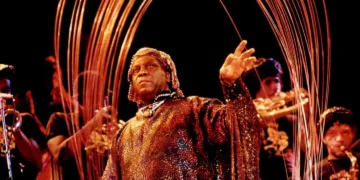
By placing mystery above history, he built a world where identity became a choice, free from biological sentence. His headdresses and lamé robes worked as emblems of that liberated existence. Turner presents his message as a call to change the self as a way of changing the world. His art offered sanctuary to people who felt displaced within their own country.
Visual Echoes and Scholarly Analysis
The visual style of Christine Turner’s film reflects the fractured, layered quality of Sun Ra’s thought. Archival footage and home movies create the feeling of a cosmic scrapbook, with memory arranged through flashes, fragments, and performance. The psychedelic editing follows the improvisational movement of the music.
Rare clips of the Arkestra performing at the Giza pyramids give vivid form to his Egyptian-inspired philosophy. This experimental handling of image and sound recalls Indian director Ritwik Ghatak, who used cinema to express displacement and cultural memory. Turner also includes scholars Fred Moten and Louis Chude-Sokei, whose commentary clarifies the density of Ra’s ideas.
Their insights show that his claims of Saturnian origin operated as a deliberate act of protest. The documentary’s auditory world comes entirely from Sun Ra’s own compositions, keeping attention on his sonic inventions across several decades. Subtitles describing “static noise” and “disturbing music” acknowledge the difficulty of documenting an artist who challenged ordinary listening habits.
His message about imagination retains force as people face current political and ecological crises. Turner’s film preserves his legacy within a formal archive and presents him as an artist ahead of his time, still capable of inspiring listeners. His life unfolded as an endless story without repetition. The film captures one fragment of that mystery for a new generation.
This documentary debuted at the Tribeca Festival in mid-2025 before joining the American Masters series on PBS earlier this year. As of May 2026, the film is available for streaming through the PBS app and website for those with a Passport membership. It provides a detailed look at the life and philosophy of the jazz icon, focusing on his claim of Saturnian origins and his leadership of the Arkestra. The film uses a massive archive of performance footage to ground his cosmic theories in musical reality.
Full Credits
Title: Sun Ra: Do the Impossible
Distributor: PBS, Firelight Media
Release date: June 15, 2025 (Tribeca Festival Premiere), February 20, 2026 (PBS National Broadcast)
Rating: TV-PG
Running time: 84 minutes
Director: Christine Turner
Writers: Christine Turner
Producers and Executive Producers: Christine Turner, Stanley Nelson, Marcia Smith, Keith Brown, Michael Kantor, Bradford Smith, Talia Moore, Peter Nauffts
Cast: Sun Ra, June Tyson, Marshall Allen, John Gilmore, Knoell Scott, Louis Chude-Sokei, Fred Moten, Harmony Holiday, Jayna Brown, Brent Hayes-Edwards
Director of Photography (Cinematographer): Othello Banaci
Editors: Steven J. Golliday, Adam Kurnitz
Composer: Sun Ra
The Review
Sun Ra: Do the Impossible
The film succeeds by allowing the viewer to experience the myth without stripping away the magic. It captures a spirit of defiance that mirrors the transformative power of art found in both jazz and global parallel cinema. By treating its subject as a celestial force, the documentary provides a deep look at a man who changed the definition of possibility.
PROS
- Access to rare performance clips and archival footage.
- Insightful interviews with original Arkestra members.
- Rhythmic editing that reflects the tempo of the music.
- Score composed entirely of the subject's own work.
CONS
- Short runtime feels somewhat rushed.
- Brief look at his later career and mainstream appearances.
- Standard documentary format for a radical artist.







