



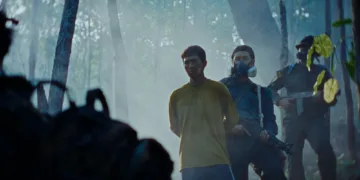





Nine years after her stark examination of frontier friction in Western (2017), German director Valeska Grisebach returns to the outer edge of Eastern Europe with The Dreamed Adventure. The film fixes its gaze on Svilengrad, a scorched border outpost fading into the point where Bulgaria, Greece, and Turkey meet.
The place seems built from transit noise and institutional neglect: cargo trucks grind across asphalt veins, borders absorb motion, and local infrastructure decays with the calm patience of concrete. Into this parched threshold comes Said (Syuleyman Letifov), a taciturn contractor pursuing a black-market diesel exchange with a figure called The Raven. The plot splinters early.
Local thieves take Said’s ancient car, drawing him into uneasy contact with Veska (Yana Radeva), an old acquaintance overseeing an archaeological excavation at a nearby medieval fortress. Then Said disappears from the frame. Veska takes up his illicit obligations, and a small transactional accident turns into an inquiry into survival, memory, and regional moral bookkeeping.
The Cinema of Postponement and Noir Dissolution
Grisebach shapes narrative progression as controlled demolition. She removes Said for a huge portion of the 164-minute running time, shifting the film onto Veska, who inherits a story she never set in motion. The move scrambles the viewer’s contract with the thriller. Suspense arrives, looks around, finds the machinery missing, and waits.
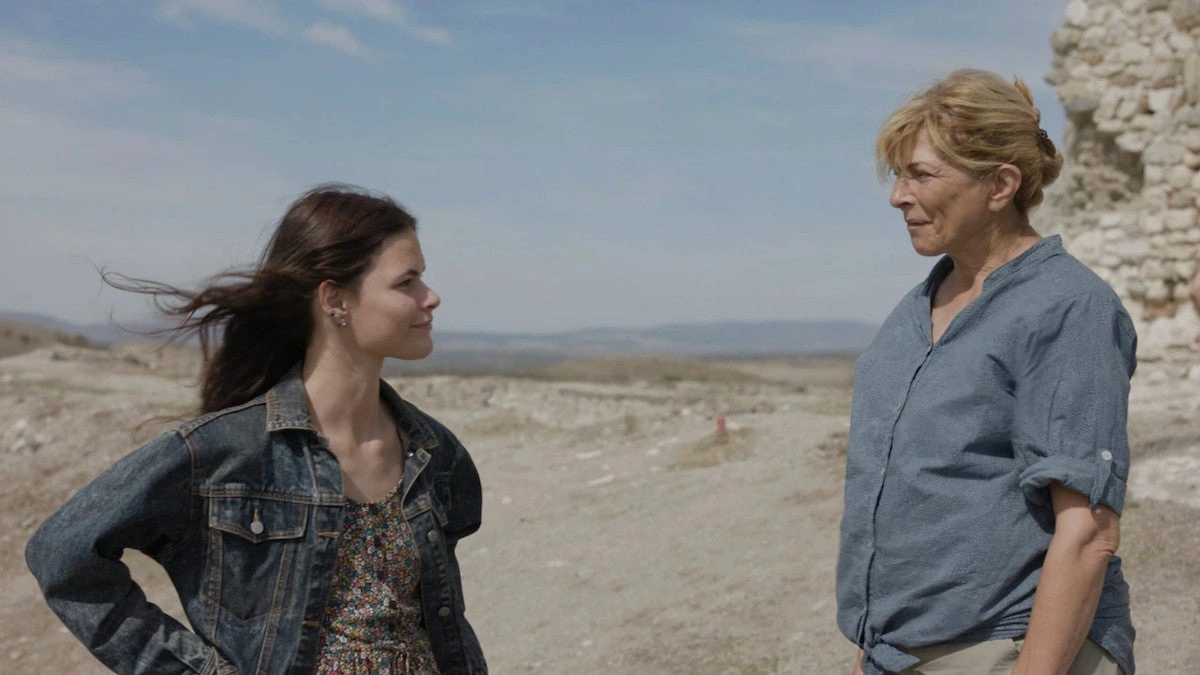
The pacing follows an ambling, episodic rhythm, built from extended tracking shots, real-time drift, and documentary-style conversations over food and alcohol. Plot development seems to dry out under the sun. What remains is duration: bodies sitting, walking, bargaining, drinking, pausing. The camera movement turns patience into pressure. Every held shot asks the viewer to study faces, distances, hesitations, and the spatial negotiations of strategy.
This vacancy becomes the film’s psychological snare. Grisebach gathers the familiar tokens of neo-noir: clandestine fuel deals, stolen sedans, human trafficking networks, and an unpolished handgun that appears with all the glamour of a bad plumbing fixture. The expected violence never erupts. The film drains classic thriller expressionism of its usual voltage, replacing sharply carved chiaroscuro and melodramatic angles with a flat, sun-stunned realism.
Confrontations slide into circular arguments across plastic tables. Said’s disappearance stays unresolved, hanging over the later passages like heat that refuses to break. By denying closure, Grisebach makes structure answer to territory. This is a world governed by inertia, where history keeps getting revised and a tidy ending would feel like a clerical error.
Weathered Geometry and the Currency of Presence
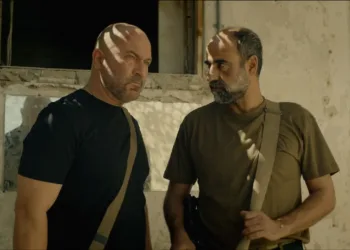
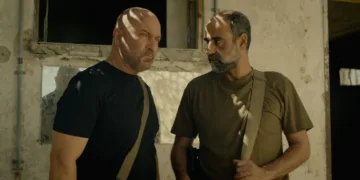
The film draws its force from Grisebach’s use of non-professional actors, whose bodies carry a pressure that polished casting rarely manufactures. Syuleyman Letifov anchors the opening movement with a face that seems quarried from the eroded Bulgarian hills. Hooded eyes, deep lines, and a guarded posture suggest long acquaintance with compromise. Then a boyish smile cuts through the severity and rearranges him completely. It is a startling modulation, almost unfair to the nearby dust.
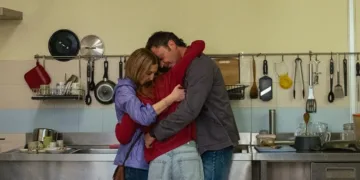
Yana Radeva brings Veska a comparable density. Her movements are slow, grounded, almost ponderous, as if each step tests the reliability of the earth beneath her. That physical logic suits her geological expertise and gives the performance a severe elegance. Veska meets aggression with laconic wit, using verbal stillness as a blade. Panic would waste energy. She knows energy is expensive.
Her encounters with Iliya (Stoicho Kostadinov), a burly local crime boss who controls the local economy through threat and wealth display, give the film its sharpest social geometry. Veska carries a complicated personal history with him from the lawless post-1989 capitalist transition, and she treats his menace with a dry indifference bordering on amusement. Her caution sharpens around his mindless henchmen, whose stupidity has blunt menace.
This dynamic revises the usual crime-thriller gender arrangement. Veska occupies the frame as a self-possessed figure whose authority comes from memory, intelligence, and a refusal to perform fear on command. Her protection of Maria, a younger neighbor exposed to the predatory realities of the border town, extends that authority into ethical action. The film’s gray zone sits here: survival demands compromise, yet identity persists through the choices a person still makes under pressure.
Digging in the Ruins of the Future
Cinematographer Bernhard Keller rejects stylized studio polish and records the arid terrain with naturalistic severity. The film finds its noir lighting scheme in the hard glare of the southern sun against white dust and in the gray pockets of shadow cast by concrete ruins. Chiaroscuro survives, strangely, as overexposure. Expressionistic framing gives way to compositions that flatten people against roads, tables, trenches, and walls, making the landscape feel like a system of containment.
The absence of a musical score leaves the frontier acoustically exposed. Distant trucks hum like industrial weather. Gravel snaps under tires. Wind scrapes across empty plains. These sounds manipulate perception with quiet cruelty, stretching attention until ordinary noise begins to feel accusatory. The tension comes from waiting for genre payoffs that Grisebach keeps placing just out of reach. A thriller can sweat, apparently.
This sensory austerity sharpens the metaphor of the archaeological dig. Veska’s excavation of medieval fortress walls becomes a parallel excavation of the region’s recent past. The trenches yield ancient pottery shards and expose lingering trauma of the post-Soviet transition, a period that exchanged state control for aggressive, mafia-style capitalism. Grisebach lets these histories move through the edges of the film, with quiet references to cross-border human smuggling and the systemic forced assimilation of the Pomak Muslim minority.
The Dreamed Adventure studies a national identity crisis through people trapped in durable limbo. Its characters return to Svilengrad’s damaged roads after success elsewhere, unable to shake the pull of a place that keeps its dead eras close. They live between a past that resists burial and a future that never quite arrives. In that suspended terrain, survival and dreaming blur until each begins to resemble the other.
The Dreamed Adventure premiered on May 22, 2026, in the main official competition of the 79th Cannes Film Festival, where it was honored with the prestigious Jury Prize. This international co-production between Germany, France, Bulgaria, and Austria is currently making its rounds on the global festival circuit, including competitive screenings at the Sydney Film Festival. Since it is a fresh festival release distributed internationally by The Match Factory, wide theatrical distribution and streaming platform availability are expected to follow its initial specialized festival runs.
Full Credits
Title: The Dreamed Adventure (Das geträumte Abenteuer)
Distributor: The Match Factory
Release date: May 22, 2026
Rating: Unclassified 15+
Running time: 162 minutes
Director: Valeska Grisebach
Writers: Valeska Grisebach, Lisa Bierwirth
Producers and Executive Producers: Jonas Dornbach, Janine Jackowski, Maren Ade
Cast: Yana Radeva, Syuleyman Halil Letifov, Stoicho Kostadinov, Denislava Yordanova, Velko Frandev, Nikolay Shekerdjiev
Director of Photography (Cinematographer): Bernhard Keller
Editors: Bettina Böhler
The Review
The Dreamed Adventure
The Dreamed Adventure successfully rejects the quick thrills of standard neo-noir, operating instead as a slow, haunting study of geographic and psychological paralysis. By stripping away conventional action and relying on the quiet strength of its non-professional cast, Valeska Grisebach crafts a challenging piece of social realism. The film demands extreme patience during its lengthy runtime, yet it rewards viewers with an atmospheric exploration of survival on the fringes of Europe. It stands as a brilliant exercise in subverting expectations.
PROS
- The selection of non-professional actors brings a rich texture and heavy physical realism to the screen.
- Bernhard Keller utilizes natural light and the barren landscape to establish a profound sense of isolation.
- The unexpected protagonist switch challenges traditional Hollywood storytelling and enhances the thematic focus on female resilience.
- The clever parallel between historical archaeology and the excavation of post-Soviet social trauma provides intellectual weight.
CONS
- The 164-minute runtime features extensive, ambling stretches where narrative momentum stops completely.
- Audiences expecting a traditional, action-packed crime thriller will find the lack of violence and resolution frustrating.
- The late-film revelations regarding character backstories occasionally lack dramatic impact after prolonged narrative lulls.