





























The morning sun in Northern California has a heavy charge when it signals your last hours in town. Stacey Rockford exists inside a private world of magnetic tape, distorted guitars, and headphones that drown out the quiet of the place she calls the Big Suck. The year is 1998. The world feels small, touchable, and stubbornly analog. Status comes from landing a skate trick or finding alcohol for a beach party that, for one night, feels like the whole map.
Stacey plans to leave for New York at dawn. Her goal is to become a music supervisor, someone who turns songs into emotional architecture. That ambition creates a quiet split between her and her friends. They once had a fantasy of an endless road trip. Now they have a single night to sort through ten years of shared history.
The game turns that pressure into playable friction, filtering it through teenage sarcasm, private panic, and the awful knowledge that childhood has reached its final save point. This is a coming-of-age story built from objects, songs, and memories, all tied to the person Stacey was before she became the person she is trying to be.
The Friction of Authentic Adolescence
The writing works because it keeps the rough texture of being seventeen intact. Stacey leads the group with a confidence that covers a real fear of what waits beyond town. Her identity comes from the albums she owns, the opinions she defends, and the persona she performs for people who know her too well to fully buy it.
Slater gives the trio its softer tension. He is a musician who hides his work, carrying the fear of having potential before the world has tested it. Cassandra brings chaotic, rebellious force. As the daughter of a police officer, she turns each impulsive act into resistance against a home life that feels like a cage.
Their relationships give the game its engine. The script understands the uneven rhythm of real teenage conversation. These friends insult each other, make dumb noises when they feel safe, and drift into oddly serious debates while doing ordinary things. They argue about the original Alien and its sequel while skipping stones. They call a T. rex the Barry Manilow of dinosaurs. The jokes land because the game treats them as social mechanics. They are how these characters regulate fear, affection, embarrassment, and loyalty.
The performances help the group feel lived-in. The voices carry friendship history through quick jabs, pauses, and shared silences. Emotional vulnerability arrives through deflection. These teenagers use sarcasm as armor, and the subtext underneath their banter carries the stress of a friendship nearing a major break. They are awkward, loud, irritating at times, and deeply loyal. That honesty gives the final night its weight without forcing melodrama into every scene.
Interactive Memory as a Narrative System
The experience plays like a chain of interactive music videos. Compared with RPGs built around skill trees, dense inventories, and stat management, this game builds progression through participation. The player moves from cluttered bedrooms into stylized memory sequences activated by physical keepsakes. Each vignette uses its own mechanics to match the emotional shape of the moment.

A skateboarding sequence lets Stacey roll through suburban streets and perform simple flip tricks at sunset. A police raid turns into high-speed spectacle as the group escapes a house party in a shopping cart, flying downhill with reckless teenage logic. The camera keeps changing the player’s relationship to the action. One scene uses a familiar third-person view. Another shifts to the perspective of a news helicopter watching the group scramble across an interstate.
The game gives ordinary tasks the same design care as its louder set pieces. You make custom slushies at a convenience store. You move furniture to build a hangout spot. The first-kiss sequence uses both analog sticks to control separate tongues, creating a moment that is intentionally gross, tactile, and funny. The presence of a “That’s Enough” button matters because it places player comfort directly inside the scene’s design. The game understands that awkwardness can be interactive without trapping the player inside it.
Traditional fail states are absent. A missed skating move or failed escape beat rewinds smoothly, keeping the scene’s momentum intact. That choice reveals the design philosophy clearly. Mechanics serve memory. Challenge matters less than emotional rhythm.
The player is asked to feel the event, inhabit the embarrassment, thrill, and tenderness of it, and then move with the story. For an indie narrative game shaped around choice and consequence, the meaningful decisions live in tone, comfort, and presence. The consequences are emotional, tied to how the player experiences Stacey’s final night and the friendships she is preparing to leave behind.
A Visual and Aural Mixed-Media Wonderland
Music is the frame holding this world together. The licensed soundtrack includes major names like The Cure and The Smashing Pumpkins, paired with lesser known tracks that create discovery. The songs shape editing, movement, and mood. Stacey often breaks the fourth wall to address the player with details about release dates or artist origins, giving the game the feel of a guided musical education from someone who treats taste as identity.
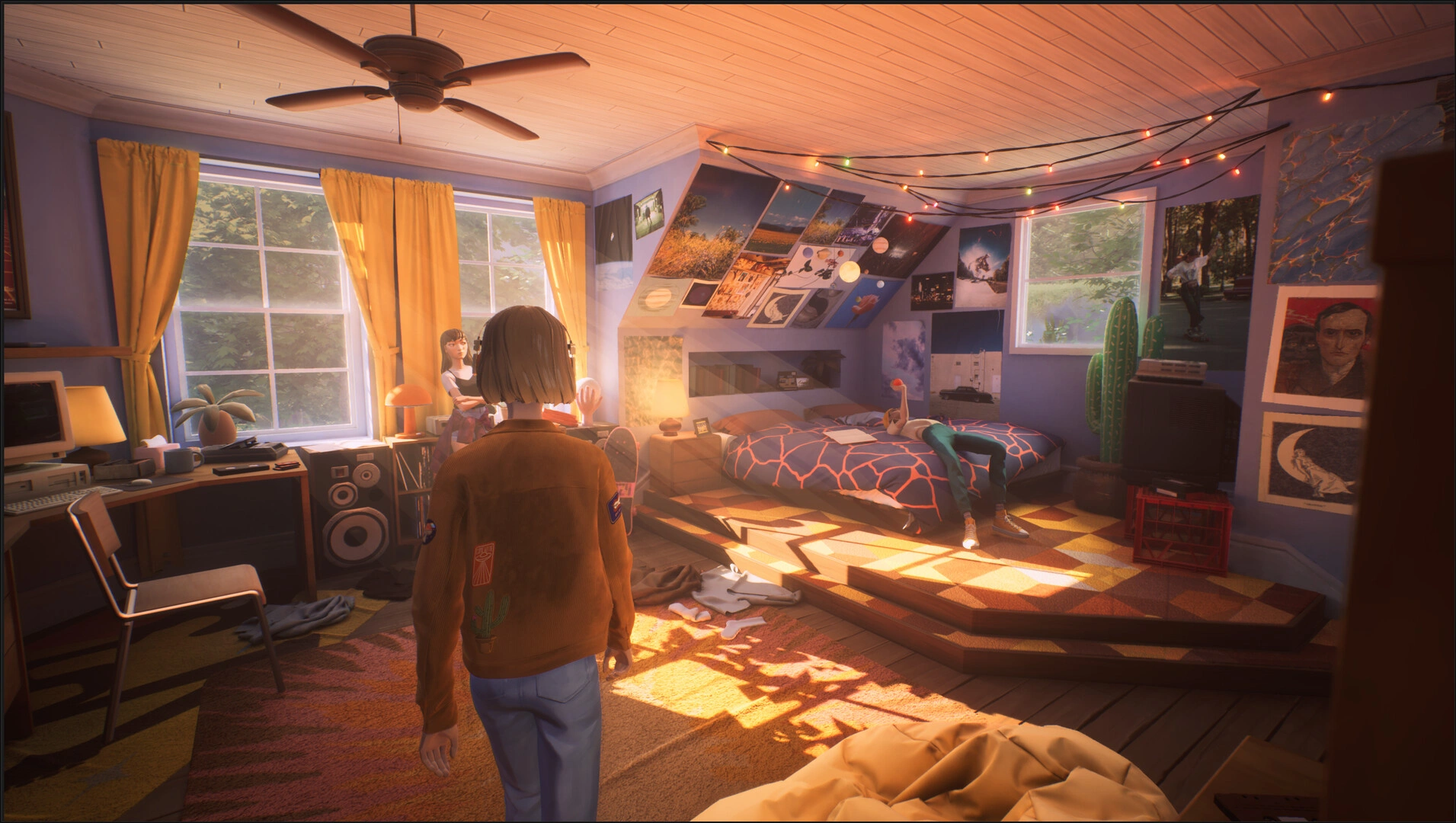
The visuals reinforce that curated quality. The art style has a hyper-stylized look that suggests claymation mixed with stop-motion animation. It gives the characters a handmade quality and avoids the stiff models often seen in this genre. Unreal Engine lighting gives many frames the finish of a painted image. Grainy live-action stock footage appears during transitions, tying the presentation to memory, media, and late-90s texture.
The animation often has the fluid quality associated with modern independent film, and the soundtrack turns that style into a time machine. A single track can transform backyard softball practice into a huge, dreamlike stadium fantasy.
The shift happens without a loading screen, letting the space reshape itself around a character’s internal state. Stacey’s bedroom becomes a playable archive of taste and self-definition, with album analysis presented through the same obsessive lens a cinephile might bring to a favorite film.
That attention to detail gives the game the feel of a polished indie film with interactive systems built into its emotional grammar. Sound drives narrative. Images bend around memory. Mechanics translate nostalgia into action. The game captures how youth looks in hindsight: exaggerated, distorted, embarrassing, funny, and achingly precise in the moments that mattered most.
The Review
Mixtape
Mixtape captures the fleeting energy of youth through a precise integration of sound and interactivity. It rejects traditional challenge to focus on emotional impact. The characters feel grounded in reality. The aesthetic choices elevate the simple mechanics into something that stays with the player. While the brief runtime and specific teenage tone might alienate some, the sincerity of the writing makes it a strong entry in the narrative genre. It transforms a licensed soundtrack into a living history of a specific moment.
PROS
- Authentic character writing and vocal performances.
- Exceptional licensed soundtrack integration.
- Creative, ever-shifting gameplay vignettes.
- Stunning, stylized visual presentation.
CONS
- Brief duration.
- Minimal mechanical depth for traditional players.