












Julian Schnabel’s In The Hand Of Dante is an adaptation of Nick Tosches’ novel, a story constructed on two planes of existence separated by seven hundred years. The film’s engine is a singular object of desire: the original handwritten manuscript of Dante Alighieri’s The Divine Comedy. Its existence, long thought to be a myth, sets in motion a pair of narratives that run on parallel tracks.
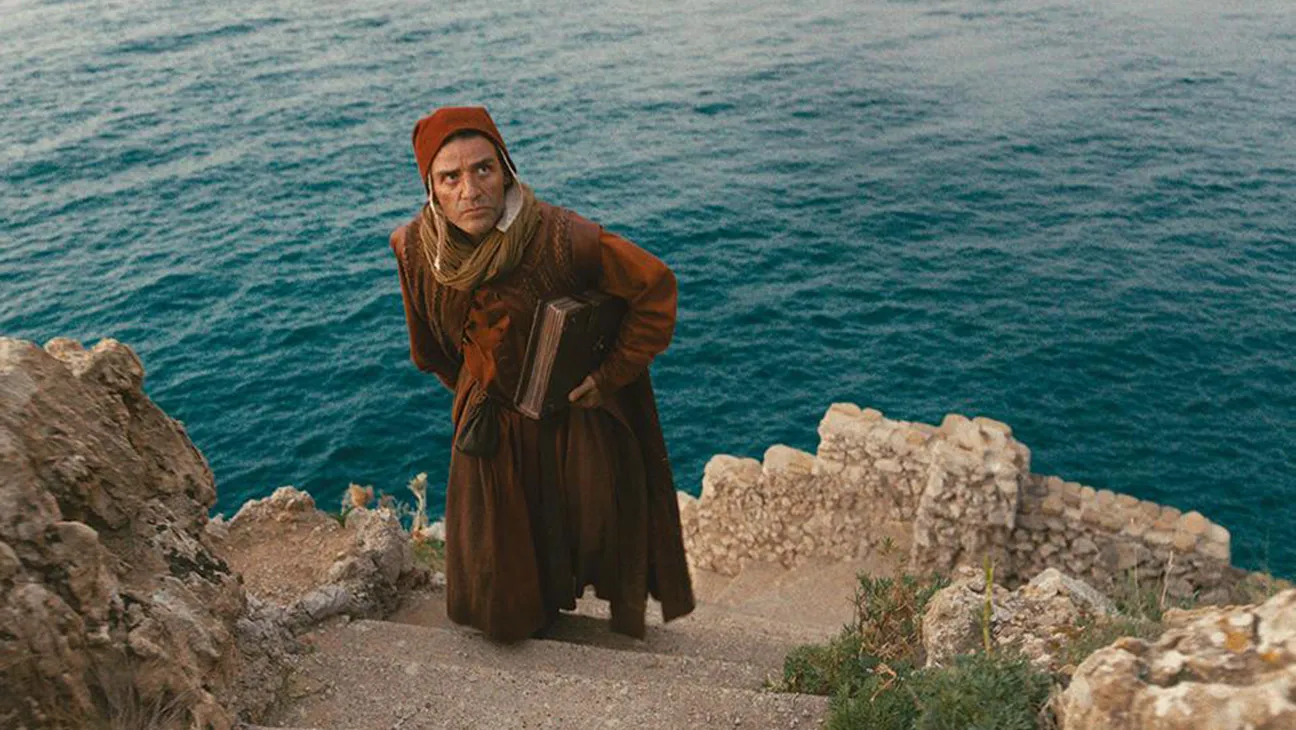
In the 21st century, we follow Nick Tosches, a writer and Dante expert portrayed by Oscar Isaac. He is pulled from his life into the criminal underworld, tasked by a mob boss with authenticating the priceless artifact. This mission quickly descends into a violent, high-stakes thriller. Simultaneously, the film transports us to the 14th century to witness the life of Dante Alighieri himself, also played by Isaac.
This storyline is one of spiritual and creative struggle, a quieter exploration of the poet’s life, his famous unrequited love, and his search for divine inspiration. The structure immediately presents its central thesis: a story about the collision of sacred art with profane greed, connecting two men across time through one monumental work.
An Opus in Black-and-White and Color
The film’s dual narratives are so stylistically opposed they feel like two different movies occupying the same runtime. Schnabel makes a clear visual delineation between them. Nick Tosches’ modern-day gangster plot is shot in gritty, widescreen black-and-white. This choice does more than signal a time period; it washes the world in a cynical, washed-out gray, creating a chaotic and propulsive atmosphere that mirrors the violent energy of its characters.
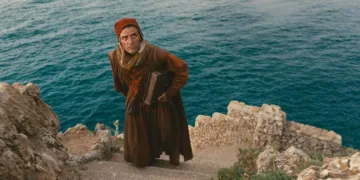
The camera feels restless, as if it can barely keep up with the brutality it is witnessing. In stark contrast, the historical sequences depicting Dante’s life are rendered in full color and a more constrained, squarer aspect ratio. Here, the compositions are painterly and deliberate, each frame arranged like a Renaissance tableau. This approach is often beautiful, but it also gives the 14th-century world a theatrical, stilted quality that holds the viewer at a distance.
The pacing of the two stories is equally divergent. The modern plot functions as a high-end suspense thriller, full of momentum and menace. The historical plot, however, is a slow, meditative character study that prioritizes philosophical musings over external action. Schnabel further complicates the film’s tone with his signature free-associative style, dropping in needle drops like Sam the Sham and the Pharaohs’ “Wooly Bully” during a moment of tension, or cutting to time-lapse shots of flowers.
These choices feel born of impulse rather than narrative necessity, sometimes providing a jolt of strange energy but more often disrupting whatever rhythm the film had managed to build. Paki Meduri’s production design and Mariano Tufono’s costumes work diligently to create two distinct worlds, yet the film’s structural ambition consistently works against its coherence. The constant switching between timelines fragments the experience, leaving one to wonder if this ambitious device enriches the story or simply leaves it feeling undisciplined.
One Actor, Two Souls
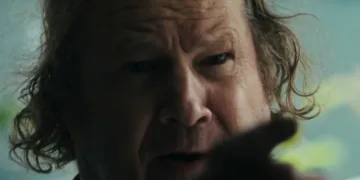
The sprawling architecture of In The Hand Of Dante rests almost entirely on the shoulders of Oscar Isaac. His dual performance is the anchor that keeps the film from drifting into total incoherence. As Nick Tosches, Isaac is magnetic. He portrays the writer with a volatile, streetwise energy, making him a compelling figure caught in circumstances far beyond his control.
He perfectly captures the internal conflict of a man whose scholarly passion is forced to coexist with the grim reality of his mission. Whether he is delivering a rapturous speech on Dante’s genius in a diner or reacting with stunned horror to an act of brutality, Isaac makes Tosches feel grounded and real.
His portrayal of Dante Alighieri is a different matter. Isaac’s Dante is a gentle, haunted, and morose figure, his performance more stylized and Shakespearean in its delivery. He looks the part of the canonical poet, yet the character often feels inert, less a man of flesh and blood and more a symbol weighed down by the film’s philosophical aims.
This is perhaps a deliberate choice, meant to portray a man consumed by his internal world, but it makes the historical scenes a challenge to connect with. The film suggests a spiritual connection between the two men, and Isaac works to create that thematic link through subtle shifts in his gaze and bearing. Still, it is his modern-day performance that carries the narrative. His ability to hold the screen in both roles is undeniable, and his work is the primary reason to follow the film’s tangled threads.
Saints, Sinners, and Stunt Casting
Surrounding Oscar Isaac is a large, eclectic, and wildly uneven ensemble cast. In the criminal storyline, several actors deliver memorable work. Gerard Butler is a genuine surprise, disappearing completely into the role of Louie, a vulgar and terrifyingly psychopathic hitman.
With blond hair, a stone-hard voice, and a commitment to the character’s absolute rottenness, he is nearly unrecognizable and provides a frightening, intense energy. John Malkovich brings a familiar menacing calm to the part of the art-collecting mob boss, while Al Pacino shines in a brief but sharp cameo as Tosches’ uncle, dispensing worldly wisdom with an understated authority that commands the screen.
In the historical sections, Martin Scorsese appears as Dante’s wise mentor, Isaiah. Sporting a massive white beard, he provides a warm, calming presence, though one cannot help but notice the subtle humor in a legendary director taking a note from Schnabel.
Other casting choices are less successful. Gal Gadot, playing dual roles as Dante’s wife and Nick’s love interest, seems out of her depth. She struggles with the poetic dialogue of the 14th-century scenes, and her line readings in the modern timeline lack a casual, grounded energy. Jason Momoa appears late in the film as another mobster, a presence that feels more like a strange casting decision than a necessary addition to the story.
The film’s gimmick of having actors play parts in both timelines, such as Butler also appearing as the Pope, is a curious device. It gestures toward the theme of reincarnation, but in practice it often functions as a distraction that pulls the viewer out of the story, questioning whether its thematic payoff is worth the cost to the narrative’s integrity.
A Journey Without a Map
The film’s central thematic idea is its most potent: the deep irony of men committing heinous, violent acts in pursuit of a sacred text that offers a guide to living a pure and spiritual life. This conflict between worldly greed and artistic soulfulness is a powerful concept.
The film also touches on the struggle of the creator against the demands of commerce and the search for beauty across centuries. Yet, these ideas are often obscured by a screenplay that is both overstuffed and underdeveloped. The plot takes turns that feel more suited to a soap opera, and lines of dialogue like “I put a hole where his soul used to be” land with the weight of cliché rather than profundity. Its long runtime is filled with repetitive scenes that stall its momentum.
In The Hand Of Dante is unquestionably the product of a singular, uncompromised vision. It is the kind of ambitious, messy, and personal filmmaking that is rarely seen today, a work destined to provoke strong reactions.
The film is a flawed creation, one that frequently stumbles over its own narrative ambitions. Its audacity, however, is memorable. Boosted by its visual flair and a commanding central performance from Oscar Isaac, the movie offers a cinematic experience that is never dull, even when it is completely off the rails. It is a journey into a creative inferno that is fascinating to witness, even if it never quite finds its way to paradise.
In the Hand of Dante premiered out of competition at the 82nd Venice International Film Festival on September 3, 2025. The film does not have a confirmed United States distribution plan yet and is currently seeking distribution. Therefore, it is not yet available for streaming or watching online. The movie is based on the 2002 novel of the same name by Nick Tosches.
Full Credits
Director: Julian Schnabel
Writers: Julian Schnabel, Louise Kugelberg, Nick Tosches
Producers and Executive Producers: Jon Kilik, Gabriele Bebe Moratti, Vito Schnabel, Olmo Schnabel, Francesco Melzi d’Eril, Robert K. MacLean, Martin Scorsese, Oscar Isaac, Drake, Charles M. Barsamian, Matthew Budman, Moises Agami, Justin Ardalan-Raikes, Moises Chiver, Gregory P. Cimino II, Galen Core, Svetlana Dali, Luke Daniels, Konstantin Elkin, Tatiana Emden, Simon Fawcett, Ralph Haiek, Matt Hartley, Gena Konstantinakos, Arno Krimmer, Paula P. Manzanedo, Michael Paletta, Garrett Patten, Patricio Rabuffetti, Jeff Rice, Leon Salame, Jason Shrier, Arun Thapar, Joyce Zylberberg
Cast: Oscar Isaac, Gal Gadot, Gerard Butler, John Malkovich, Louis Cancelmi, Sabrina Impacciatore, Franco Nero, Benjamin Clementine, Paolo Bonacelli, Lorenzo Zurzolo, Martin Scorsese, Al Pacino, Jason Momoa, Mohamed Zouaoui, Alessandro De Simone, Lolita Chamah, Howard Thomas Ray, Duke Nicholson, Vincenzo Leto, Guido Caprino, Fortunato Cerlino, Claudio Santamaria, Ibrahim Elouahabi, David Agranov, Dora Romano, Nico Toffoli, Alessia Pratolongo, Emiliano Brioschi, Ford Leland
Director of Photography (Cinematographer): Roman Vasyanov
Editors: Marco Spoletini, Louise Kugelberg
Composer: Benjamin Clementine
The Review
In The Hand Of Dante
In The Hand Of Dante is a singular cinematic object: ambitious, visually arresting, and profoundly messy. Julian Schnabel’s dual-narrative experiment is a fascinating failure, a film whose parts are more engaging than its fragmented whole. Anchored by a tremendous dual performance from Oscar Isaac and featuring a shocking turn by Gerard Butler, the film has moments of brilliance. Still, its undisciplined structure and uneven screenplay make it a chaotic journey. It is a work to be admired for its audacity, if not for its narrative coherence.
PROS
- Oscar Isaac delivers a commanding and magnetic dual performance as both Nick Tosches and Dante.
- Gerard Butler is unrecognizable and intensely effective in his villainous supporting role.
- The film is visually striking, with distinct and well-realized aesthetics for its two timelines.
- The modern-day gangster thriller storyline is propulsive and suspenseful.
CONS
- The narrative structure is disjointed, making the film feel uneven and fragmented.
- The historical Dante storyline often feels slow, stilted, and dramatically inert.
- Key supporting performances, particularly from Gal Gadot, are a significant weak point.
- The screenplay is overstuffed, with inconsistent tones and some questionable plot developments.