































Otherskin brings to mind a past era of gaming, one filled with ambitious, mid-budget projects that prioritized inventive ideas. This is a sci-fi action adventure with a distinct personality. The game opens in a universe on the verge of collapse, threatened by an all consuming force called the Corruption.
You play as Alex, a volunteer sent on a definitive one way mission to the alien planet Vandermire. Her objective is simple and grim: collect what data she can before the world, and herself, are lost forever. The narrative premise is bleak, but it quickly changes. After a difficult landing, Alex discovers a strange new power. She can absorb abilities from the creatures she defeats.
This transforms her from a passive observer into a potential agent of defiance. Her journey is narrated with full voice acting through conversations with her AI suit companion, adding a personal layer to the desperate mission. The setup effectively establishes the high stakes while providing a spark of hope.
A Constantly Shifting Toolkit
The gameplay of Otherskin is built around its morphing mechanic, a system of absorbing enemy powers that serves as the game’s most engaging and defining feature. These abilities are not simple combat modifiers; they are fundamental tools for interacting with the world of Vandermire. The powers are varied, ranging from traversal aids to defensive measures.
A set of wings allows Alex to glide gracefully across vast chasms, turning what would be impassable gaps into manageable navigational challenges. A grapple tongue provides verticality, letting her swing from designated points or ascend sheer cliffs with a satisfying sense of momentum. Elsewhere, a deployable shield can halt a charging boss in its tracks or serve as a temporary barrier against environmental hazards like energy storms.
These powers are thoughtfully woven into the fabric of the level design, creating intricate environmental puzzles that require the player to use their toolkit in specific sequences. A typical obstacle might involve using one ability to activate a switch, then quickly grappling to a newly accessible platform before it retracts.
The game’s structure introduces a curious and potentially divisive design choice: Alex is stripped of all her accumulated morph abilities at the beginning of each new level. This decision has a profound impact on the player experience. On one hand, it forces constant adaptation. Players cannot rely on a single favored ability to solve every problem.
Each stage becomes a self-contained puzzle box, with its own specific set of tools that must be discovered and mastered. This keeps the gameplay loop fresh and ensures that the level designers can create highly specific challenges tailored to a limited moveset. On the other hand, this system directly conflicts with the sense of persistent character growth that is a staple of the action adventure genre.
The feeling of becoming progressively more powerful is largely absent, replaced by a cycle of empowerment and reset. This can be frustrating, especially when returning to a previously completed level to search for collectibles, as you must start from scratch and reacquire every necessary power.
Some of the game’s most inventive abilities appear for only one or two levels before disappearing entirely. A power that allows Alex to create her own platforms in mid air, for example, is a highlight that feels underutilized, a glimpse of a more complex traversal system that never fully materializes.
An Uneven Arsenal
Combat in Otherskin offers flexibility, allowing players to switch between ranged gunplay and close quarters melee attacks. The two styles are linked through an ammo system that encourages a dynamic offensive rhythm. While ammunition for firearms recharges slowly over time, the process is significantly accelerated by landing melee strikes.
This design pushes the player to mix aggression with caution, closing the distance to recharge resources before pulling back to safety. The arsenal includes a standard peashooter, a close range shotgun, sticky bombs, and a sniper rifle. The weapon balance feels skewed, with the sniper rifle often outclassing the other options in both damage and utility, reducing player choice in many encounters. Enemy designs are a high point, with a diverse cast of corrupted creatures to fight.
You will face everything from small, swarming insects that try to overwhelm you with numbers to larger, mushroom-like beasts that explode if you get too close, creating area denial hazards. Boss encounters are typically large scale battles that test your mastery of both the combat systems and your current morph abilities. These fights are often less about pure reflexes and more about solving a combat puzzle, such as using a specific power to expose a weak point.
For all its flexibility, the combat system is hampered by a general lack of polish. Melee attacks feel insubstantial, lacking the weighty impact and clear audio visual feedback needed to make them satisfying. Enemies will often not react to being hit, continuing their own attack animations without interruption. This makes closing in for melee strikes feel like a risky and unrewarding proposition.
Alex also appears to lack any invulnerability period after taking damage, meaning a single mistake can result in losing a massive amount of health in an instant. The dodge maneuver, which is meant to provide a defensive option, feels inconsistent in its timing and effectiveness.
Aiming ranged weapons is another point of friction, feeling imprecise, particularly when trying to hit smaller, faster moving targets. The character progression system, however, is a welcome and well implemented feature. Players can collect experience to upgrade weapons and stats, but the key is the ability to refund and reallocate these points at any time.
This player friendly design choice encourages experimentation with different builds and removes the fear of being locked into a suboptimal upgrade path. It is a thoughtful feature that stands in contrast to the game’s more unrefined mechanics.
Ambition Meets Instability
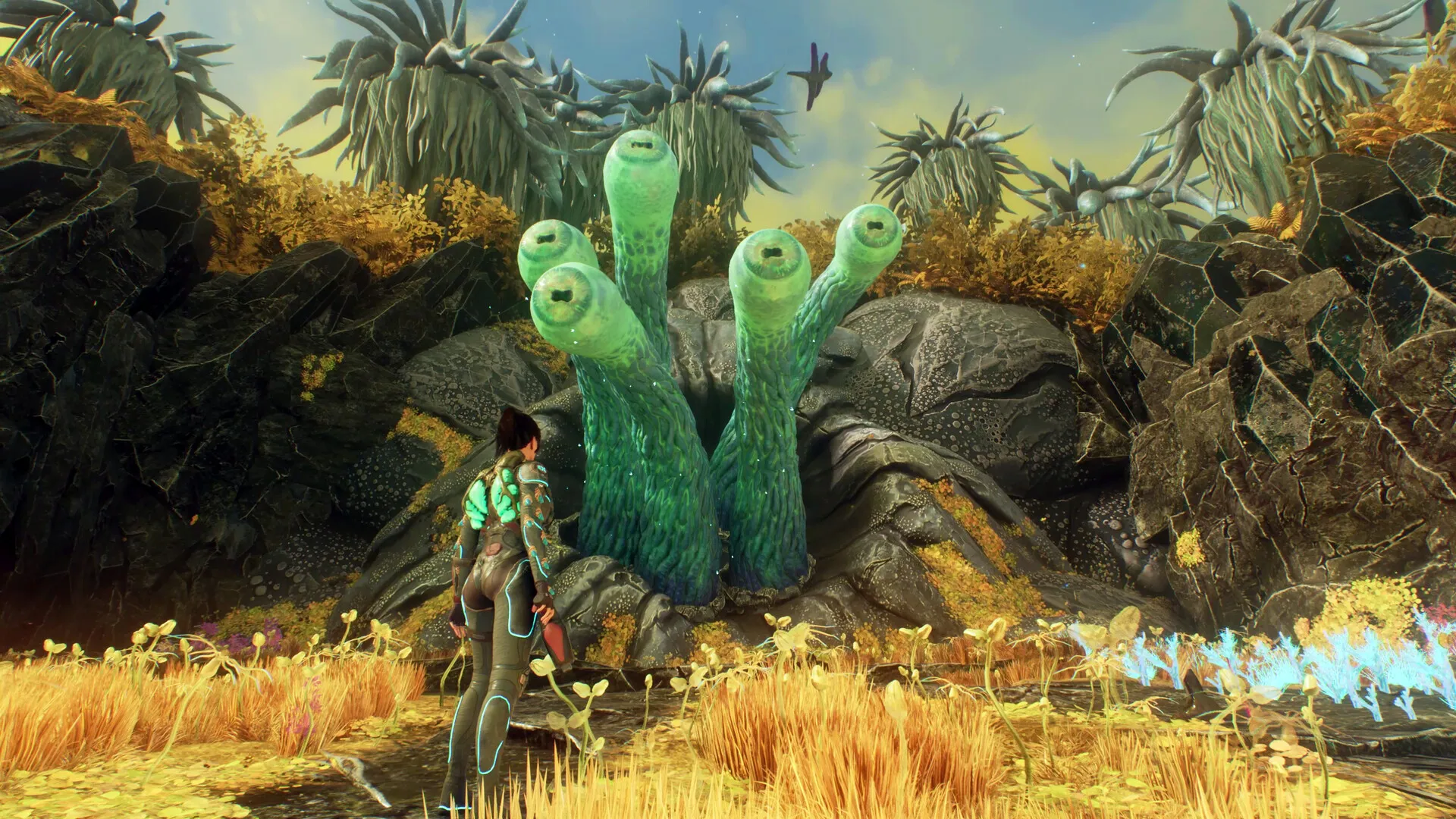
The world of Vandermire is the game’s crowning achievement. The planet is a work of genuine imagination, a bizarre and beautiful alien landscape that sticks in the memory. Every area is filled with strange details, from pulsating, bioluminescent flora that illuminates dark caverns to towering crystalline structures that hum with an unknown energy.

The environments are dotted with striking sights, such as waterfalls that defy gravity and flow upwards into the sky. This creativity is also present in the level design, which frequently presents inventive scenarios that break up the standard flow of gameplay. One memorable stage has Alex leaping between tiny, self contained planetoids, each with its own gravitational pull.
Another features a high speed sequence where Alex grinds on rails of pure energy, recalling classic 3D platformers. These moments showcase a clear and powerful design ambition. This ambition, however, is consistently betrayed by a significant lack of technical polish. The game feels like it is in an early access state, with numerous bugs and performance issues that detract from the experience.
The game’s performance is unreliable. Framerate drops are frequent, especially when the screen is filled with enemies and particle effects. These hitches often occur during the most intense moments, turning a tense boss fight into a frustrating, stuttering affair and making precise platforming a matter of luck. The physics engine is similarly unpredictable.
A standard jump can sometimes send Alex flying uncontrollably across the map, leading to cheap deaths that feel entirely out of the player’s hands. The most persistent technical problem is the poor collision detection. This issue undermines the core of the game, as attacks that appear to connect will often pass harmlessly through an enemy’s model.
At the same time, enemy projectiles might inflict damage even when Alex has clearly dodged out of the way. Puzzles can become exercises in frustration not because of their design, but because a key component fails to activate correctly. The experience is full of moments that reveal a game at odds with itself. The creative vision is apparent in every strange creature and clever level concept, but that vision is constantly fighting against a foundation of instability and unrefined mechanics.
The Review
Otherskin
Otherskin is a game of brilliant ideas and frustrating execution. Its imaginative world and creative morphing abilities showcase a powerful creative vision. This vision is consistently undermined by significant technical problems, including performance drops, physics glitches, and unpolished combat. The result is a memorable sci-fi adventure that is difficult to fully recommend without reservation. It offers glimpses of a fantastic game that is unfortunately buried under a layer of instability.
PROS
- Inventive morphing abilities form a strong core mechanic.
- Highly creative and memorable alien world design.
- Player-friendly system for upgrading and respeccing skills.
CONS
- Numerous technical issues and a general lack of polish.
- Combat feels unrefined and lacks impact.
- Losing all abilities in each new level can feel repetitive.