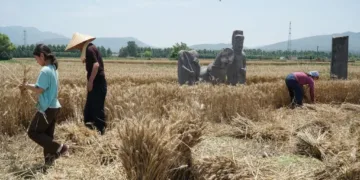


























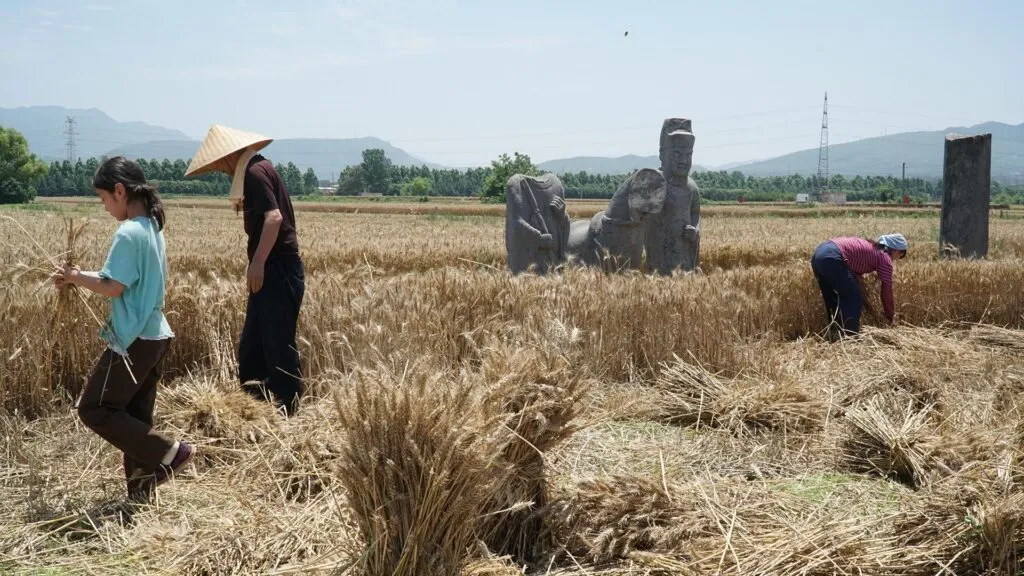

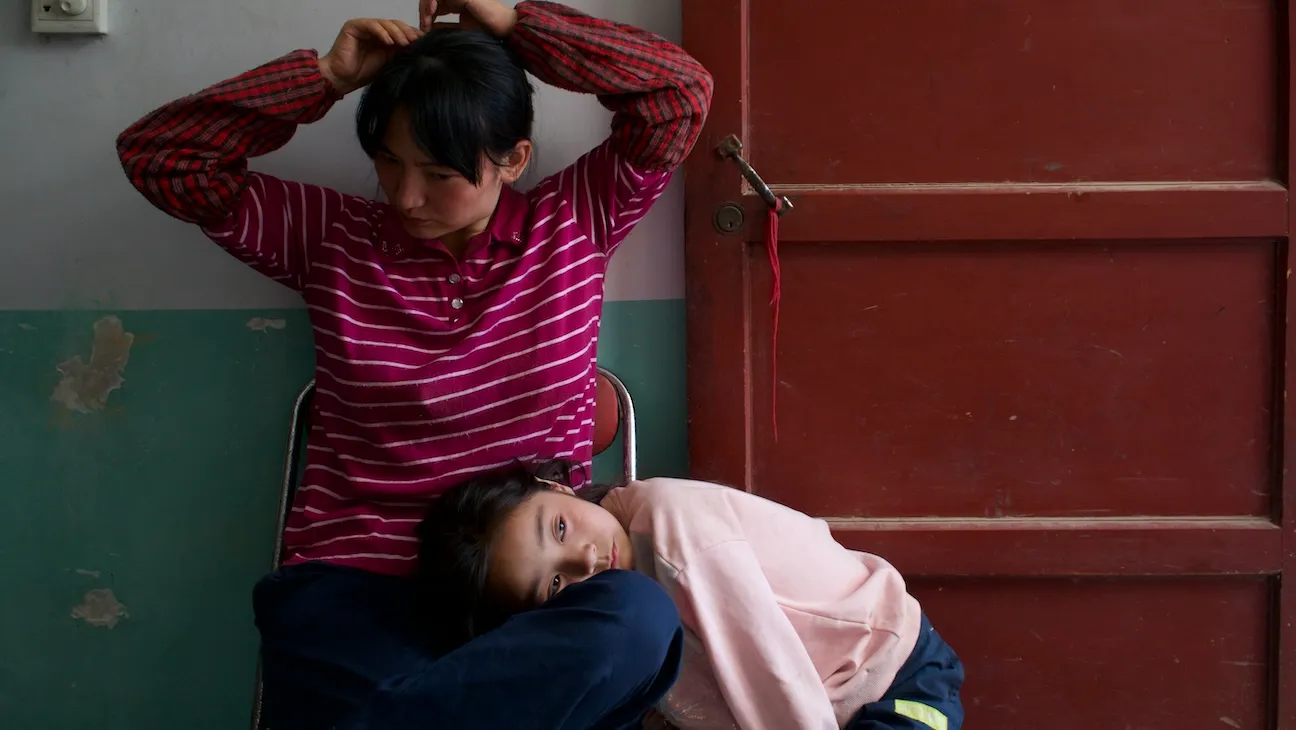
Maozhuang feels like a small stretch of land caught in an argument with time. Eight-hundred-year-old Song Dynasty statues hold their posts with the patience of stone, while industrial smoke stacks rise nearby, exhaling a present that never stops moving. Inside that uneasy coexistence live eight-year-old Mao Qing and her mother, Hongmei.
Their home carries a hollowed-out quality, shaped by a father gone to urban labor and by the silence his absence leaves behind. Rural isolation settles over daily life, and then a mysterious child arrives: Bai Hai. He searches for a mother who seems to have evaporated, and he lingers in a threshold state that Qing appears able to sense with a clarity no one else shares.
Director Zhang Zhongchen uses their meeting as the hinge for a story rooted in magical realism. The film turns its gaze toward the wreckage left by social policy and the locked-in hierarchies of patriarchal tradition. The village registers less like a refuge and more like a chamber where emotional fallout collects. Stillness sits on the surface, and something restless presses beneath it, like history refusing to sleep.
The Texture of a Living Silence
The camera observes a world that keeps changing shape. It shifts from wide views of wheat fields to the jitter of handheld closeness, as if the film is searching for a stable angle and keeps discovering there is none. Seasons slide from green into a muddy, decaying brown, and that visual drift echoes the inward wearing-down of the people living here. Sound takes on a physical presence.
Mechanical hums churn in the distance, and faint voices seem to leak from the porous stone of the Song sculptures, turning the air into a kind of haunted medium. The sensory detail becomes almost oppressive in its intimacy: damp earth seems to cling to the skin, and rotting vegetation feels sharp enough to taste. Light moves across worn walls, catching grit and fatigue without flinching.
Surreal images arrive with quiet certainty. A raincoat floats through the air without a body inside it. Mysterious lights pulse in the sky. These moments carry sorrow as their primary temperature, a soft chill that spreads instead of striking. The film builds a bridge between ordinary labor and metaphysical unease, letting the everyday and the uncanny share the same breath.
Echoes of the Discarded
The Song Dynasty statues stand as witnesses to a long history of structural exploitation, watching generation after generation of women endure expectations built to restrain them and extract their labor. That endurance gathers weight, and the film connects it to transgenerational trauma linked to the one-child policy.
Hongmei’s parenting shows a jagged favoritism toward her younger daughter, Wenwen, and Qing drifts through the household with the quiet desperation of a child trying to earn a gaze that keeps sliding away. The pressure of lineage and gender surfaces with brutal clarity during a village wedding, where a groom vows to produce a son, transforming a promise of love into a public contract with patriarchy.
The grandmother’s memories of her years as a midwife place the story inside a legacy of controlled fertility, where bodies become sites of regulation and moral accounting. Wenjuan, treated by the community as the local madwoman, carries another register of this same abandonment.
She becomes a vessel for needs that go unspoken, a living reminder of how easily a village can exile someone while still using her as a cautionary tale. The film keeps returning to these women as the unacknowledged builders of the world around them, denied recognition for the inner lives that keep them upright.
Shadows in the Slow Weather of Time
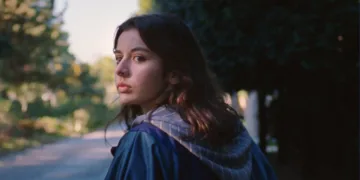
Li Yanxi gives Hongmei a steely, repressed intensity that reads like a lifetime of swallowed words. Resentment burns cold through the tightness of her posture and the precision of her movements, suggesting a person who has learned to survive by turning feeling into armor. Chen Halin, as Qing, provides a counterweight grounded in intuitive grace. She anchors the film’s spectral touches in a longing that feels immediate and painfully human.
Bai Hai serves as a companion for Qing, and he also embodies fantasy as a survival instinct, something the mind produces when reality offers little space to breathe. Rigid indoctrination and monotonous toil shape the environment, and imagination becomes a private refuge for anyone left unmoored.
Zhang Zhongchen draws on his rural roots to keep an observational distance that feels ethically alert, as if the film refuses to exploit suffering for easy catharsis. Days pass like a slow weather system, and meaning gathers gradually, accumulating in glances, textures, and withheld speech.
The final image of the ancient statues draped in heavy sheets lands with a chilling clarity. Stone faces go blind beneath the fabric, and the gesture exposes something grim about what has been allowed to happen to the innocent. The past stays present here, pressed into the soil, repeating itself in quieter forms, leaving the viewer with questions that remain unresolved even as the screen goes dark.
Nighttime Sounds is a lyrical Chinese drama that premiered on the international festival circuit in late 2025, with notable screenings at the San Sebastián International Film Festival and the Red Sea International Film Festival. Directed by Zhang Zhongchen, the film follows an eight-year-old girl in a rural village who encounters a ghostly child searching for their mother, a meeting that unearths buried family secrets and explores the marginalized experiences of women in rural China. As of late 2025, the film is primarily available through limited festival screenings and specialized arthouse distributions, with a digital release on platforms like MUBI expected to follow its theatrical and festival run.
Full Credits
Title: Nighttime Sounds (original title: Ni de yan jing bi tai yang ming liang)
Distributor: HKIFF Collection (World Sales)
Release date: September 19, 2025 (San Sebastián International Film Festival Premiere)
Running time: 88 minutes
Director: Zhang Zhongchen
Writers: Zhang Zhongchen, Li Zhigang
Producers and Executive Producers: Midi Z, Chen Kunyang, Wang Hongwei, Xie Haochi, Zhao Yuyan
Cast: Chen Halin, Li Yanxi, Gu Hanru, Nan Cui, Wang Lanhua, Wang Chaobei
Director of Photography (Cinematographer): Chang Reagon
Editors: Zhang Zhongchen, Huang Bingjie
Composer: Chen Retoy
The Review
Nighttime Sounds
Nighttime Sounds is a haunting meditation on the weight of history and the silent persistence of human longing. Zhang Zhongchen avoids the trap of sentimentality, opting instead for a sensory realism that captures the crushing stillness of rural existence. The film treats the ghosts of the past and the shadows of modern policy as equally tangible, forming a vision where memory is both a sanctuary and a burden. While the pacing mirrors the slow decay of the fields it depicts, the emotional payoff is profound, leaving the viewer with a lingering ache for characters trapped between stone and smoke.
PROS
- The sound design and handheld cinematography create a visceral sense of place.
- Li Yanxi delivers a powerful, restrained portrayal of maternal resentment.
- The imagery of floating raincoats and ancient statues creates a surreal beauty without spectacle.
- Offers a nuanced look at the lasting psychological effects of the one-child policy and rural patriarchy.
CONS
- The meditative tempo may feel stagnant for those seeking more traditional narrative momentum.
- Some surreal elements remain unresolved, which might frustrate viewers preferring clear explanations.