












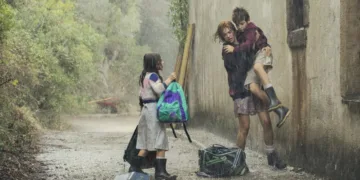


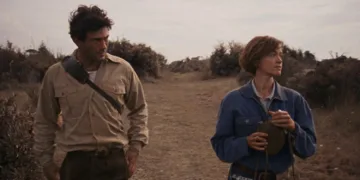













The Arkansas landscape of 2002 sits here like a pinned specimen, preserved from the era before constant digital static, back when connection carried an analog weight and silence could stay intact for a full afternoon. In North Little Rock, status plays out in the open, measured in rituals that leave evidence behind. The yard-rolling tradition turns toilet paper draped over tree branches into a public ledger of attention, a signifier that says someone matters enough to be marked.
Minnie lives inside that system in a particular position: close enough to the light to feel its heat, far enough away to remain unread. Callie supplies the glow. Her life reads as a sequence already arranged for applause, and her preparation for Juilliard gives that trajectory an official stamp. Minnie, by comparison, has learned the craft of orbiting. She watches, she listens, she stays steady beside her friend’s brightness, and the film treats that steadiness as its own form of character, a posture shaped by habit and by a school culture that rewards visibility.
Then a car accident ends Callie’s story with the bluntness of a closed door. The film refuses the usual softening devices grief often receives on screen, the montage smoothing, the sentimental time-lapse, the tidy catharsis. What arrives is immediate and serrated: a teenager whose primary anchor has vanished, faced with a world that keeps moving while her internal calendar stops. The absence becomes the story’s organizing force. Minnie has ceded space for so long that inhabiting her own life begins to feel like an unfamiliar task, a role written for someone else and handed to her without rehearsal.
Domestic Fractures and the Search for a Surrogate
Katherine Mallen Kupferer plays Minnie with an arresting stillness, the kind that suggests constant arithmetic behind the eyes. The performance keeps sorrow specific, stripped of decoration, and that choice gives the film its steadier pulse. Silence becomes a language here, and it meets its match in Sophie Okonedo’s Helen, a woman whose grief has tightened into something brittle and immaculate.

Minnie moves through two homes that embody two forms of displacement. Her own house, overseen by her mother Barbara, operates as a chaotic refuge: rescued animals, half-eaten meals, the sense of a life lived in fragments and patched together by care.
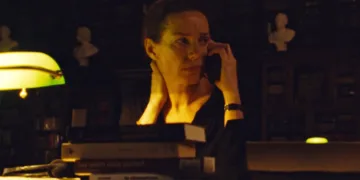
Helen’s residence offers the opposite sensation, a cultivated hush, sterile in its order, inviting in its promise of calm. Minnie’s attraction to that world carries a sharp logic. Callie lived there. To spend time inside those rooms is to touch the edges of Callie’s life, to borrow the atmosphere that once surrounded her, to occupy a space still haunted by the idea of her.
That pull shapes Minnie’s search for a surrogate self, a replacement skin that might keep her tethered to what was lost. The film is careful with the psychology here. It does not treat Minnie’s movement toward Helen as a melodramatic betrayal of Barbara, and it does not sentimentalize Helen as a saintly figure of bereavement. It presents a teenager making an improvisational choice in an emotional emergency, reaching for the place that feels closest to the vanished person.
The result is friction between the two mothers that builds into a confrontation with real sting. Barbara’s love arrives messy and active, full of doing. Helen’s suffering arrives aloof, refined, almost ceremonial, with the sharp edges of self-containment.
Their clash exposes two adult strategies that fail in different ways and succeed in different ways, and Minnie watches with a clarity that refuses the easy label of victim. She reads the room. She manages the temperature. She carries the weary wisdom of someone who has already learned that grown-ups can be generous and insufficient in the same breath.
By the time Minnie begins to accept that neither home can protect her from the fact of Callie’s death, the film has quietly argued for a difficult truth about loss: it produces hunger. That hunger looks for connection wherever it can find it, and it does not respect the clean borders of the traditional family unit. The adults may want rules. Grief wants proximity.
The Performance of Loss in the High School Ecosystem
At school, bereavement becomes a public sport. Minnie has the right phrase for it: the grief Olympics. In the wake of Callie’s death, students treat mourning as a stage, and the social order reorganizes itself around who can claim the most visible relationship to the tragedy. Cara, the social climber, moves in to colonize Callie’s memory, converting loss into status within the senior class. Her mourning has the sheen of piety and the function of a weapon. It presses control onto a narrative that never belonged to her, and it turns Callie’s death into a tool for dominance.
The upcoming senior variety show becomes Cara’s chosen monument. She shapes it as if it were an official memorial, and Minnie finds herself shoved toward the edges of a friendship that once defined her daily life. This is the particular cruelty of teenage hierarchy: the past can be rewritten in real time by whoever speaks loudest, and sincerity has no formal protection.
David Hyde Pierce enters as Mr. Murdaugh, the drama teacher, bringing a necessary sobriety to the chaos. His presence carries the relief of an adult who can see through performance without mocking the kids performing. In a school full of hollow tributes, he registers as a small pocket of honesty. The film does not overstate his role. He does not arrive as a savior. He functions as a point of sanity, a reminder that adults can still recognize artifice even when a community prefers comforting theatrics.
Minnie’s decision to participate in the cabaret works as her quiet refusal of erasure. She chooses to perform a song associated with Callie, and that choice acts as an attempt to reclaim something private from the public machinery of grief. It is not an act of showmanship. It is an act of ownership. Minnie reaches for the bond that existed before the tragedy became school property, before a clique could package it into a narrative for the auditorium.
The film captures how high school cliques harm without needing open cruelty. Indifference can cut as deep as malice, and social convenience can flatten a person’s interior life into a role. Minnie is forced to define herself against expectations that never cared to know her. In that pressure, she starts to locate a voice that does not depend on proximity to the popular crowd. It exists on its own terms, smaller, quieter, real.
Analog Nostalgia and the Low-Light Path to Self-Possession
The film’s visuals lean into warm, tawny light, the lingering heat of a Southern summer rendered through a soft, low-lit palette. That aesthetic grounds the story in a tactile world, lived-in and sharply local, even as the plot stays cold with its central fact of sudden death. The sensory warmth does not soften the pain; it makes the environment feel tangible, like grief unfolding inside a real place with dust in the corners and light settling on skin.
The soundtrack, packed with early-2000s pop, functions as a time-stamp and a kind of social memory. It recalls a moment when identity took shape through physical media, through local record stores, through objects that could be held and traded and hidden in a bedroom drawer. The film uses that period texture with care. The music does not exist as a wink. It exists as part of the architecture that shaped these characters.
Within that setting, Minnie’s relationship with Kat, played by Iman Vellani with an easy spark, opens a new lane in Minnie’s development. The connection arrives without strain, and the film refuses the expected set of cinematic alarms. Minnie’s queer awakening appears as a quiet fact, folded into her life with the same plainness the film grants her grief. It is part of her expansion into a world that must continue without Callie, part of the slow work of discovering what remains possible.
That development ties back to the story’s deeper preoccupation: self-worth built through one’s own experience. Minnie has spent years reflecting someone else’s shine, living in the shadow cast by a more luminous friend, letting that light define her place in the room.
Here, growth comes through small, awkward movements toward autonomy. There are no grand epiphanies, no triumphant speeches, no tidy conversion of pain into wisdom. Maturity arrives in increments, in moments that feel a little uncomfortable, a little clumsy, recognizable in their lack of polish.
By the time the credits roll, Minnie has shifted toward quiet independence. The film keeps faith with its understated realism. Grief remains present, not as a lesson, not as a resolved arc, but as a continuing condition. New connection carries weight, and that weight matters. It gives living a counterbalance, something solid enough to hold while the absence stays.
Mouse is a 2026 independent drama directed by the acclaimed filmmaking duo Kelly O’Sullivan and Alex Thompson. Set in North Little Rock, Arkansas, in the summer of 2002, the narrative follows 17-year-old Minnie as she navigates the sudden loss of her vivacious best friend, Callie. The film explores themes of identity, grief, and the complex bonds between mothers and daughters. It made its world premiere in the Panorama section of the 76th Berlin International Film Festival in February 2026. Following its critical success at the festival, the film is expected to secure a distribution deal for a wider audience later this year.
Full Credits
Title: Mouse
Distributor: Premiere at the Berlin International Film Festival (Berlinale), Currently seeking wide theatrical and streaming distribution
Release date: February 2026 (World Premiere)
Running time: 120 minutes
Director: Kelly O’Sullivan, Alex Thompson
Writers: Kelly O’Sullivan
Producers and Executive Producers: Bonnie Comley, Pierce Cravens, Steven A. Jones, Ian Keiser, Kelly O’Sullivan
Cast: Sophie Okonedo, Katherine Mallen Kupferer, Chloe Coleman, Tara Mallen, Iman Vellani, David Hyde Pierce, Audrey Grace Marshall, Addisyn Grace Cain, Beck Nolan
Director of Photography (Cinematographer): Nate Hurtsellers, Luke Dyra
Editors: Michael S. Smith
Composer: Hamilton Leithauser
The Review
Mouse
Mouse is a precise, unsentimental examination of the voids left by loss and the quiet labor of filling them. By centering on the internal life of an introverted protagonist, the film avoids the clichés of the coming-of-age genre, opting instead for a grounded, authentic portrayal of grief and identity. It is a work of intellectual depth and emotional honesty that values the small, lived experience over grand cinematic gestures.
PROS
- Katherine Mallen Kupferer and Sophie Okonedo provide a masterclass in understated, powerful acting.
- The 2002 Arkansas setting is captured with a vivid, nostalgic texture that feels lived-in rather than decorative.
- The dialogue avoids exposition, favoring realistic, often humorous interactions that reflect genuine human behavior.
- Minnie’s development is subtle and earned, avoiding forced epiphanies or dramatic personality shifts.
CONS
- The deliberate, naturalistic tempo may feel slow to those accustomed to more plot-driven dramas.
- The character of Cara occasionally borders on a caricature of high school self-absorption.