

























![Kingdom Hearts Collection [I-III] Review](https://gazettely.com/wp-content/uploads/2026/10/Kingdom-Hearts-Collection-I-III-1-360x180.webp "Kingdom Hearts Collection [I-III] Review: KHII Holds Steady as Newer Entries Fluctuate 40")


Sinsin And The Mouse moves with the quiet rhythm of someone trying to breathe after loss. Directed and written by Yukinori Makabe, with Noriko Kato as co-writer, the film adapts a short story by Banana Yoshimoto into a Japanese-Taiwanese drama of grief, loneliness, and brief human contact. Its scale is small by design: one woman, one city, one day, one meeting that gently shifts the emotional weather.
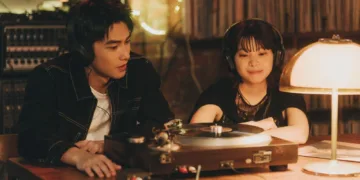
Chizumi, played by Yukino Kishii, travels to Taipei after the death of her mother. She accepts an invitation from a musician friend, yet her trip feels less like escape than suspension. Taipei surrounds her with streets, rooms, food, noise, and passing faces, while memory keeps pulling her inward. Then she meets Sinsin, played by Tseng Jing-hau, a Taiwanese-Japanese man carrying his own private ache from childhood and maternal absence.
Their connection unfolds through walking, talking, hesitating, and listening. The film has a faint romantic pulse, though Makabe keeps grief and recognition in the foreground. Like the best slow cinema, it asks the viewer to settle into emotional tempo instead of chasing plot momentum.
Grief, Loneliness, and the Shape of a Small Encounter
The story is intentionally modest. Chizumi wanders through Taipei, meets Sinsin through mutual acquaintances, and spends time with him before a gig later that night. In a conventional drama, that setup might serve as the first act. Here, it becomes the whole emotional system. The film works almost like a narrative-driven game with minimal input: movement through space, conversation choices, memory triggers, and small shifts in trust. Nothing explodes. The reward loop is internal.

Chizumi’s grief is handled with rare softness. She is sad, listless, and visibly haunted by the sudden absence of her mother, yet she never becomes a symbol of collapse. She understands that she is hurting. She moves toward recovery in tiny, conscious steps, which gives the film much of its emotional maturity. Her memories surface through places and gestures, suggesting how mourning can turn the ordinary world into a field of hidden prompts.
Sinsin carries a different wound. His glamorous, often absent mother left him with a childhood shaped by waiting and imaginative survival. His old attachment to mice in the walls, drawn from a children’s picture book, gives the film its central image. The mouse becomes a figure of smallness, hiding, and the need to be noticed without making too much noise.
Their bond grows because both characters recognize that kind of quiet injury. Their conversations are intimate without becoming theatrical. They do not solve each other. They create a space where pain can finally be spoken with a little less fear.
Two Performances Built From Pauses
Yukino Kishii gives Chizumi a delicate emotional clarity. Her performance is full of controlled softness: lowered eyes, careful smiles, pauses that feel heavier than dialogue. Chizumi’s kindness never reads as weakness. She has a gentle awareness of her own sorrow, and Kishii makes that awareness visible in the way she moves through Taipei, as if every street might suddenly open into memory.
Tseng Jing-hau’s Sinsin is awkward, tender, and faintly strange in a way that feels rooted in damage rather than affectation. He has the shy rhythm of someone who has spent too much time inside his own head. His fascination with the idea of Chizumi as mouse-like is part of that oddness, and the film does not erase the discomfort of it. His attention to her small stature can feel uneasy, depending on how the viewer reads it. Makabe treats it quietly, perhaps too quietly at times, yet Tseng keeps Sinsin from turning into a mere quirk machine. There is loneliness behind the fixation.
Together, Kishii and Tseng give the film its pulse. Their chemistry is soft rather than sparkling. They make shared silence feel active, almost like a gameplay mechanic where trust builds through restraint. A glance, a clumsy phrase, a hesitant confession, each one becomes a tiny progression marker. The film depends on those details, and both actors understand the assignment with impressive sensitivity.
Stillness, Space, and the Risk of Slow Pacing
Makabe directs with patience and restraint. He lets scenes breathe, sometimes to the point where the viewer becomes sharply aware of time passing. That choice can be beautiful, especially in a film about grief, where time often feels thick and strangely elastic. The 4:3 Academy ratio adds intimacy, keeping Chizumi and Sinsin close within the frame instead of turning Taipei into postcard scenery.
Wayne Lo’s cinematography gives the city a clean, composed presence. Taipei feels open and crowded at once, a place where people can drift beside each other without truly meeting. That urban anonymity matters. Chizumi and Sinsin are surrounded by life, yet their solitude remains almost tactile. The film’s attention to small details, nails, socks, clothing, remembered rooms, awkward descriptions, gives emotional texture to scenes that might otherwise feel too slight.
The editing handles flashbacks with care, using memory to fill in emotional gaps rather than forcing backstory into heavy exposition. Some timeline shifts can feel a little unclear at first, and the film’s slow pace will test viewers who need sharper narrative escalation. There is a great deal of walking, staring, and talking in low emotional registers.
For those willing to meet it at its chosen speed, Sinsin And The Mouse offers a tender study of two people learning how to name old hurt. Its power comes from gentleness, stillness, and the fragile warmth that appears when strangers stop performing and start listening.
Sinsin and the Mouse is a gentle Japanese-Taiwanese co-production drama film that made its world premiere at the Glasgow Film Festival on March 6, 2026, ahead of its scheduled nationwide theatrical release in Japan on June 26, 2026. Adapted from a short story by popular author Banana Yoshimoto, the poignant narrative follows a grieving young Japanese woman who travels to Taipei after the sudden passing of her mother. There, she meets a thoughtful local young man of mixed heritage, setting off a quiet, day-long stroll through the city streets that allows both individuals to vulnerably explore their personal traumas and navigate the complexities of deep emotional healing. Independent film enthusiasts looking to watch this tender indie production can catch its upcoming screenings across East Asian cinema circuits and various upcoming international film festival programs.
Full Credits
Title: Sinsin and the Mouse
Distributor: Culture Publishers, Flash Forward Entertainment
Release date: March 6, 2026
Running time: 107 minutes
Director: Yukinori Makabe
Writers: Noriko Kato, Yukinori Makabe
Producers and Executive Producers: Daisuke Toyama, Brendan Huang, E.N. Lee
Cast: Yukino Kishii, Tseng Jing-Hua, Kisetsu Fujiwara, Seina Nakata, Tokio Emoto, Kayo Ise, Kisuke Iida, Lin Chen-Xi, Angel Lee, Lin Mei-Zhen, Kimiko Yo
Director of Photography (Cinematographer): Wayne Lo
Editors: Yukinori Makabe
The Review
Sinsin And The Mouse
Sinsin And The Mouse is a tender, patient drama that finds emotional force in small gestures, quiet conversations, and two wounded people learning to speak honestly. Its slow rhythm will test some viewers, and one character detail feels uneasy, yet Yukino Kishii and Tseng Jing-hau give the film a soft, memorable ache. Makabe’s restraint turns grief into something intimate, humane, and quietly healing.
PROS
- Beautifully restrained lead performances
- Gentle, emotionally mature treatment of grief
- Strong use of Taipei as an isolating yet warm setting
- Intimate 4:3 framing supports the character focus
- Small details give the story texture and tenderness
CONS
- Very slow pacing may frustrate some viewers
- Timeline shifts can feel slightly unclear
- Sinsin’s fixation on Chizumi’s small stature may feel uncomfortable
- Minimal plot momentum limits its accessibility