














The Ōoku of Edo Castle is less a home than a beautifully lacquered box, designed to hold jewels and conceal poisons. Within its paper walls, tradition provides a thin veneer over a simmering broth of ambition and resentment.
The central mechanism of this world is the production of a male heir, a high stakes game that turns women into instruments of state. Into this pressurized environment step two opposing forces: the favored, low born concubine Fuki, a disruptive element of raw appeal, and Botan, the Ōoku’s new manager, a woman who believes in the sanctity of the rules.
Their friction provides the initial spark. Then people begin to burn. The mysterious Medicine Seller returns to this gilded cage, tasked with diagnosing a malevolent spirit feeding on the palace’s very human darkness. A supernatural mystery, born from political rot.
An Architecture of Hysteria
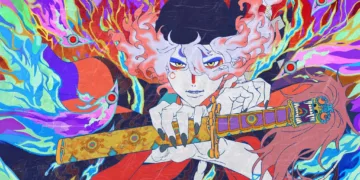
To watch this film is to be submerged in a fever dream rendered on parchment. The aesthetic aggressively rejects photorealism, instead opting for a style that feels like a possessed ukiyo-e print, animated with a terrifying and hypnotic fluidity.
Every surface pulses with a palpable paper like texture, while characters are defined by soft blue contours instead of stark black ink, giving them an ethereal, almost spectral presence. The camera refuses to be a passive observer. It glides through walls and adopts expressionistic angles, trapping characters in claustrophobic compositions that mirror their psychological confinement.
This visual strategy is not mere decoration. The hallucinatory color palette functions as a kind of psychological chiaroscuro; brilliant fields of gold and crimson cast deep, unnatural shadows, creating a profound sense of menace in even the most brightly illuminated scenes.
The constant stream of visual information is a deliberate assault on the senses, designed to make the audience feel the same oppressive, hysterical pressure as the Ōoku’s inhabitants. The sound design completes this immersion. The delicate diegetic sounds of rustling silk and sliding screens are constantly undermined by a disquieting electronic score, creating a soundscape of pure paranoia.
The Ghost in the Machine is Us
Beneath the psychedelic surface lies a cold, philosophical examination of a corrupt system. The film meticulously details the political machinations of the Ōoku, a world where distant men like Councilor Ōtomo orchestrate power struggles, using women as proxies in their dynastic games.

This raises unsettling questions of agency. Are the women making choices, or are their actions merely predetermined responses to the patriarchal architecture that contains them? The narrative presents the rivalry between Fuki and Botan not as a simple clash of personalities, but as a collision of survival tactics within a rigged system.
Fuki is the fierce outsider, a masterless ronin defying the rules that would erase her. Botan is the system’s product, a tactician wielding the rules as both shield and sword, her faith in order a prison of its own making. The film finds its thematic core in this ambiguity.
The true horror is not the supernatural, but the insidious nature of unchecked power and the destructive potential of jealousy in a structure that offers women advancement only through the negation of their rivals. The mononoke, the so called “Fire Rat’s Children,” is not an invading demon. It is a symptom, a psychic projection of the sickness already present. It is a spirit meant to protect new life, twisted into an agent of destruction by a world that seeks to control and consume.
A Procedure of Unflinching Clarity
As the second act of a trilogy, the film displays a rare and welcome narrative discipline. The structure is surprisingly linear, a direct procedural that benefits from its sharp focus. Where its predecessor meandered through dense, atmospheric exposition, this chapter grants the Medicine Seller immediate authority.

This choice allows the story to dispense with preliminaries and cut straight to the investigation, which unfolds with the clean logic of a classic thriller. A crime occurs, the detective arrives, he gathers clues—the mononoke’s Form, Truth, and Reason—and he moves toward a confrontation.
This familiar structure provides a grounding sense of order amidst the visual chaos, creating a compelling tension between the narrative’s form and the phantasmagoria of its content. The pacing is relentless, building tension not from slow dread but from the mounting body count of a ticking clock.
It succeeds brilliantly as a self contained story, presenting a complete mystery that resolves itself without resorting to a lazy, frustrating cliffhanger. It is a confident middle installment that builds anticipation for the finale not by leaving plot threads dangling, but by deepening the trilogy’s central questions. It manages this with an integrity that feels almost novel.
“Mononoke the Movie: Chapter II – The Ashes of Rage” is a Japanese animated supernatural psychological horror film that was released in Japan on March 14, 2025. It is the second film in a trilogy, following “Mononoke the Movie: Phantom in the Rain” (2024), and is based on the 2007 “Mononoke” anime series, which is a spin-off of the “Ayakashi: Samurai Horror Tales” anthology series. The film became available for worldwide streaming on Netflix on August 14, 2025.
Full Credits
Director: Kiyotaka Suzuki, Kenji Nakamura
Writers: Yasumi Atarashi
Producers: Kimiaki Sato, Yūki Sudō
Cast: Hiroshi Kamiya, Haruka Tomatsu, Tomoyo Kurosawa, Yoko Hikasa, Yukana, Yuki Kaji, Chō, Kenyu Horiuchi, Ryō Horikawa, Yoshiko Sakakibara, Atsumi Tanezaki
Editors: Shigeru Nishiyama
Composer: Taku Iwasaki
The Review
Mononoke the Movie: Chapter II - The Ashes of Rage
A staggering work of psychedelic horror and sharp political critique. The film marries its singular, breathtaking animation to a focused, procedural narrative, creating a thriller that is both a feast for the senses and a sobering examination of systemic rot. While its visual intensity may prove demanding for some, its unflinching clarity and thematic depth are undeniable. It is a confident, masterful middle chapter that burns brightly, standing as a high point for the medium.
PROS
- Visually singular animation that masterfully serves the narrative's psychological depth.
- A focused, linear plot that is both accessible and intellectually satisfying.
- Rich thematic exploration of power, patriarchy, and human fallibility.
- Functions as a strong, self-contained story while effectively building anticipation.
CONS
- The overwhelming sensory information and constant motion may be jarring or fatiguing for some viewers.
- Full appreciation of recurring character dynamics benefits from familiarity with the first film.