


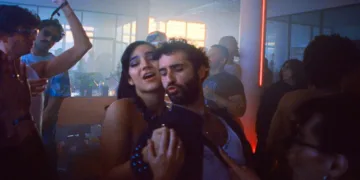




















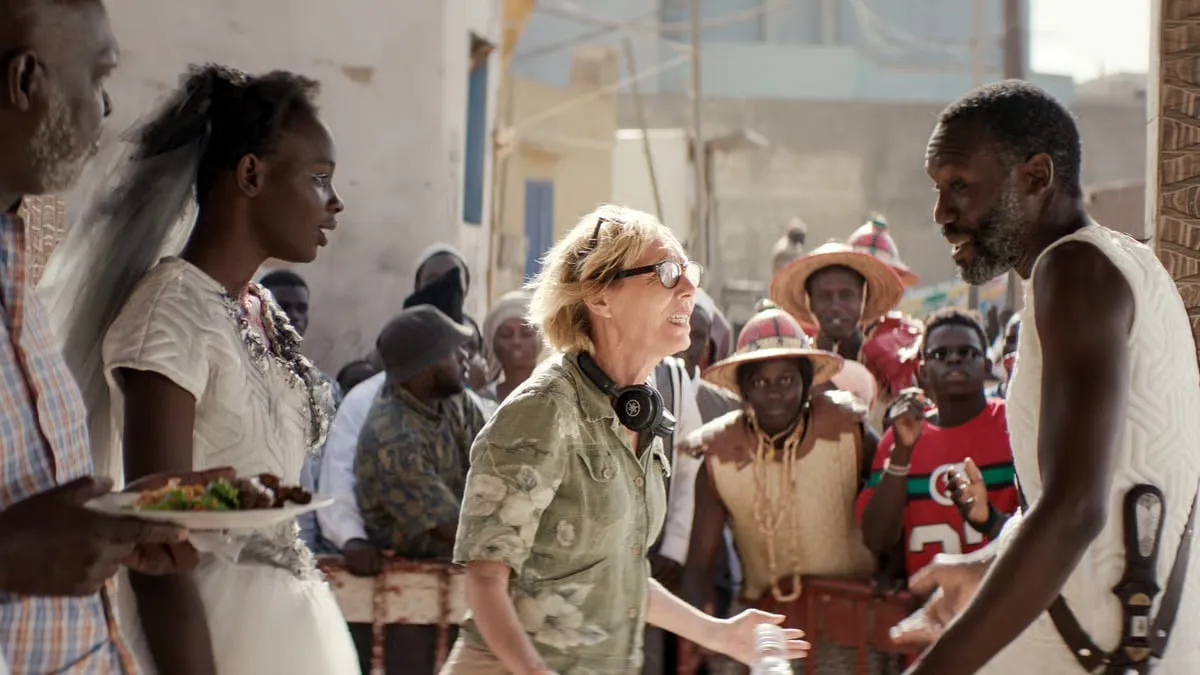

There are movies that give you answers, and then there are movies that leave you with better questions. I find myself drawn to the latter, the ones that map the spaces between people and the static that prevents a clear signal from getting through. Ulrich Köhler’s Gavagai is precisely this kind of film. It presents what looks like a backstage drama: a European film crew is in Senegal, attempting a bold new version of the ancient Greek play Medea.
The director, a high-strung French woman named Caroline, has cast a white German actress, Maja, as Medea, positioning her as an outsider oppressed by the Black society of her husband, Jason, played by the French-Senegalese actor Nourou. But the film’s actual interest is in the messy, unscripted moments between takes, where a secret affair between the leads simmers. The story then pivots, leaving the heat of Dakar for the stark cold of the film’s Berlin premiere, a move that changes everything.
The Unmaking of a Myth
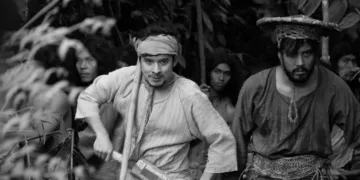
The film’s opening act in Senegal is a brilliantly dry satire of the art world’s self-importance. We watch as the crew attempts to stage Caroline’s grand vision, a project drowning in both ambition and practical absurdity. The Medea they are shooting is all dramatic pronouncements and overwrought symbolism, but the reality of its production is a series of small disasters.

In one unforgettable moment, Caroline erupts with frustration because the child actors playing dead bodies are wearing life vests for a scene on the water. Her artistic purity cannot accommodate basic logistics, a perfect metaphor for her entire enterprise. Her behavior on set, a mix of creative passion and petty tyranny, feels achingly real. I’ve seen that dynamic play out on smaller projects, where the weight of the “vision” crushes the people tasked with realizing it.
Amidst this chaos, the affair between Maja and Nourou feels like the only authentic thing happening. Their connection is a quiet counterpoint to the loud theatrics of the film shoot. Köhler’s camera stays at a respectful distance, using long, unbroken takes that make us feel like observers hiding just out of sight.
This patient style rejects the quick cuts of conventional drama, forcing us to watch awkwardness and intimacy unfold in real time. The sound design is equally restrained; without a musical score to guide our emotions, we are left with the ambient sounds of the set and the difficult silences between characters.
Two Cities, Two Identities
The narrative leap to Berlin is a structural jolt that reframes the entire film. Cinematographer Patrick Orth swaps the vibrant, sun-bleached palette of Dakar for the cool grays and imposing concrete of the German winter. This is more than a change of scenery; it is a complete inversion of the film’s social dynamics.
In Senegal, Nourou moved with the relaxed confidence of a man on familiar ground. In Berlin, he is suddenly an object of suspicion. This shift is crystallized in a tense encounter outside his luxury hotel. A security guard questions him, his politeness barely masking a clear racial bias. The scene is a masterclass in depicting the subtle aggressions that define so many people’s daily experience.
What follows is even more revealing. Maja, witnessing the event, becomes furious on Nourou’s behalf and insists on reporting the guard. Her righteous anger, while well-intentioned, feels performative. She speaks for Nourou, effectively silencing him and making his experience secondary to her reaction. It’s a painfully accurate portrait of how privilege can operate, transforming an act of support into an assertion of control.
The film adds another layer by revealing the guard is Polish, himself a member of a marginalized group within Germany. This detail dismantles any simple binary of oppressor and oppressed, showing instead a complex hierarchy of otherness. It is a sharp reflection on how our identities are not fixed, but are constantly being renegotiated depending on the room we are in.
The ‘Gavagai’ Dilemma
The film’s unusual title is a reference to a philosophical puzzle about translation. If you are in a foreign land and someone points to a rabbit and says “gavagai,” you might assume the word means “rabbit.” But it could also mean “food,” “look,” or “an animal that runs.” You can never be certain you have truly understood. Gavagai applies this dilemma to human experience, suggesting that we are all speaking a private language rooted in our own lives, a language that is never fully translatable.
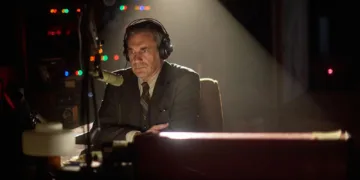
This theme reaches its peak during the Berlin press conference for Medea. We watch the proceedings through the glass of an interpreter’s booth, where the slight delay between question, answer, and translation becomes a physical manifestation of the communication gap. Caroline’s attempts to explain her film are met with questions that challenge her very right to tell such a story, and her justifications sound increasingly hollow.
The performances are crucial in conveying this sense of disconnect. Jean-Christophe Folly gives a powerful, physical performance as Nourou; you can see the character’s ease in Senegal recede into a guarded stillness in Berlin. Maren Eggert is equally strong as Maja, capturing the character’s mix of genuine affection and unexamined privilege.
Köhler’s direction remains rigorously detached, his camera observing without judgment. The spare score, featuring the dissonant work of Morton Feldman, adds to the profound sense of unease. The film offers no neat resolutions, leaving its characters and its audience adrift in the ambiguities of what is said, what is meant, and what can never be truly understood.
Gavagai is a drama film written and directed by Ulrich Köhler that centers on the relationship between two actors, Maja and Nourou, who fall in love while shooting an adaptation of Medea in West Africa. The film explores themes of cultural misunderstanding and social prejudices when, months later at the film’s premiere in Berlin, a racist incident complicates their reunion. The film had its world premiere at the New York Film Festival on September 27, 2025, and is scheduled for a theatrical release in Germany on January 22, 2026. As it is a recent festival and upcoming theatrical release, current viewing options are primarily limited to these screenings.
Full Credits
Director: Ulrich Köhler
Writers: Ulrich Köhler
Producers and Executive Producers: Ingmar Trost, Sutor Kolonko, Good Fortune Films
Cast: Maren Eggert, Jean-Christophe Folly, Nathalie Richard, Homa Faghiri, Demet Gül, Anna Diakhere Thiandoum, Stacy Thunes Krieger, Darja Mahotkin
Director of Photography (Cinematographer): Patrick Orth
Editors: Lorna Hoefler Steffen
Composer: Julien Sicart, Andreas Hildebrandt, Simon Apostolou
The Review
Gavagai
Gavagai is an intellectually rigorous and deeply rewarding film for viewers willing to engage with its challenging ideas. It forgoes easy emotional payoffs in favor of a sharp, nuanced critique of privilege, art, and the deep chasms in human communication. While its deliberately patient and observational style may feel distant to some, the film's incisive social commentary and the superb, lived-in performances from its leads make it a vital and thought-provoking piece of cinema. It’s a film that doesn't give you answers, but leaves you wrestling with important questions long after the credits roll.
PROS
- An intelligent script that explores complex themes of race and privilege with nuance.
- Features a sharp and effective satire of the international art film scene.
- Led by powerful, physically expressive performances from its main cast.
- Confident, patient direction and cinematography that enhance its observational style.
CONS
- The detached, academic approach may feel emotionally cold for some viewers.
- Its deliberate pacing and lack of conventional plot points could test audience patience.
- A preference for ambiguity over resolution might leave some feeling unsatisfied.