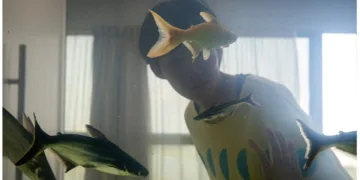


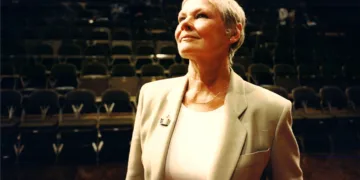









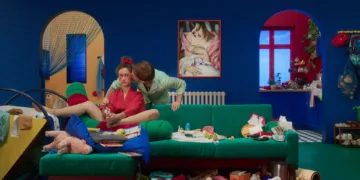


















One arrives. That is the first verb of any journey. For Kai, a young Taiwanese woman ghosted by her boyfriend, the arrival is in Recife, Brazil. She steps into a world that seems indifferent to her heartbreak, a coastal city of imposing oceanfront towers and streets saturated with a color that feels almost aggressive.
It is a place of simultaneous invitation and alienation, where one can sunbathe on a beach but cannot swim for fear of sharks (a metaphor almost too perfect to be real). Director Nele Wohlatz immediately establishes a feeling of being adrift, of a solitude so profound it seems to have its own specific gravity. Kai navigates this new environment not with purpose but with a kind of passive curiosity.
The film sets itself up as a quiet, observational study of transient lives, where the real drama is not in grand events but in the silent negotiation between a person and a place that owes them nothing. It is a story of chance encounters in a world where everyone seems to be in transit from somewhere else.
The Postcard Propinquity
The film commits a kind of narrative abdication, and it is a brilliant move. Just as we settle into Kai’s perspective, the story slips from her grasp, decentering its own protagonist with an almost casual shrug. Our focus is handed off to Fu Ang, a Chinese umbrella salesman waiting for rain that never comes, and then again to Xiao Xin, another woman whose presence is revealed through a found artifact: a box of postcards.
These are not mere souvenirs; they are Xiao Xin’s diary, physical objects bearing the weight of an intangible existence. They are a form of analog social media, creating an asynchronous intimacy between writer and reader. As Kai pores over them, their experiences begin to bleed into one another, creating an echo across time, a palimpsest of shared spaces.
This fractured, polyphonic structure is the film’s central thesis. It is a kind of narrative diaspora, mirroring the unstable, intersecting paths of people whose lives are defined by a state of constant flux. There is no linear plot here because linearity implies a destination.
For these characters, the path itself is the point, a meandering loop of memory, observation, and shared dislocation that defies the logic of a three-act structure. The connections are woven not from causality, but from a shared atmospheric pressure of being other, of occupying a space without fully belonging to it.
A Lexicon for Alienation
How does a film articulate the feeling of displacement without resorting to monologue? Wohlatz’s answer is to make the experience corporeal, to show how alienation colonizes the body itself. The air is thick with languages (Mandarin, Portuguese, Spanish), a globalized Babel where communication is a constant, exhausting act of translation.

“All new words are cold,” Xiao Xin writes, and the film shows us this chill in the hesitant grammar of its characters. Language becomes a phantom limb; Xiao Xin fears losing the Spanish she learned in Argentina, a ghost of a past life she can no longer access. This alienation lodges itself in the body’s deepest anxieties. In a moment of quiet, dryly humorous panic, Fu Ang asks his roommates if his body odor is changing, terrified that the foreign land is rewriting him on a chemical level.
It is a profound, absurd question about whether one’s essence can be sweated out and replaced by something new. The cinematography amplifies this tension, painting Recife in bright, warm colors that stand in stark contrast to the sterile, air-conditioned interiors of the high-rise apartments and the characters’ own inner isolation.
This is the tyranny of the picturesque, a beautiful backdrop for a quiet crisis. The sound design works similarly, with the city’s ambient noise acting as a persistent reminder of a world to which the characters have not yet been granted full access.
Suspended Cinema
The film’s quiet achievement is its portrait of the in-between, a patient observation of the liminal state. Its characters are caught, physically absent from a home that continues to change without them and psychically unable to fully inhabit their new reality.

It is a film that understands perpetual transit as the defining condition of what some sociologists call “liquid modernity,” where stable identities have dissolved into a series of temporary states.
Wohlatz avoids grand pronouncements on the migrant experience, preferring an observational patience punctuated by moments of gentle absurdity. This refusal to sentimentalize or dramatize is its greatest strength.
The story offers no neat resolutions.
There is no sense of arrival because arrival is not the goal; the suspension is the story. This lack of closure is the most honest statement the film could make about lives defined by uncertainty.Identity, it suggests, is not a fixed point of origin but a fluid process of reconfiguration, shaped by foreign sounds and unfamiliar smells.

The film offers a new template for stories about globalization, one that is less about the politics of borders and more about the existential state of being borderless. It presents a world where home is no longer a place on a map but a fleeting sense of balance in a life lived permanently off-kilter.
Sleep with Your Eyes Open is a comedy drama film that follows a young woman from Taiwan named Kai, who travels to Brazil after a breakup. There, her story intertwines with a Chinese migrant who runs an umbrella store, and other Chinese workers living in a high-rise building. The movie premiered at the Berlinale in 2024 and had a theatrical release in New York on September 5, 2025. It is not currently available for streaming.
Full Credits
Director: Nele Wohlatz
Writers: Nele Wohlatz, Pío Longo
Producers and Executive Producers: Emilie Lesclaux, Kleber Mendonça Filho, Justine O., Roger Huang, Violeta Bava, Rosa Martínez Rivero, Meike Martens, Nele Wohlatz, Dora Amorim, Maurício Macedo
Cast: Chen Xiao Xin, Wang Shin-hong, Liao Kai Ro, Nahuel Pérez Biscayart, Lu Yang Zong
Director of Photography (Cinematographer): Roman Kasseroller
Editors: Yann-shan Tsai, Ana Godoy
The Review
Sleep With Your Eyes Open
Sleep with Your Eyes Open is a quiet, patient film that forgoes traditional narrative to capture the sensory and psychological texture of displacement. Its meandering structure and focus on small, corporeal details create a profound sense of modern rootlessness. While its deliberate pace may challenge some viewers, it is a thoughtful, demanding piece of ‘suspended cinema’ that lingers long after the credits.
PROS
- An intelligent and unconventional narrative structure that reflects the film's themes.
- A profound and subtle exploration of displacement, identity, and belonging.
- Excellent use of sensory details and sound design to create a palpable atmosphere of alienation.
- A patient, observational tone that avoids melodrama and respects its characters.
CONS
- The deliberately slow pace and lack of a conventional plot may not appeal to all viewers.
- Its emotionally reserved approach might leave some feeling distant from the characters.
- The fractured storyline can at times feel aimless if one is not fully engaged.