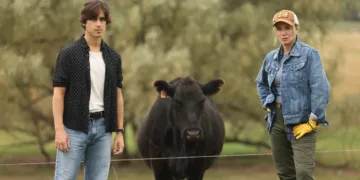





















Loathe Thy Neighbor, directed by Sergio Navarretta and written by Christian Majewski, builds a precise premise over a low hum of inherited dread. Will Larkfield, played by Brennan Clost, works as a city product reviewer and carries fresh grief. He must live for a year on his late father’s rural farm to secure ownership.
The condition forces a change he does not want. The spark arrives next door with Wanda Belrose, a beekeeper performed by Lauren Holly. Proximity breeds hostility. Will worries about a delayed EpiPen, and Wanda greets him with venom and dismissal. A personalized feud takes shape. The opening frames tease a balance of broad comedy and sharp character drama, a tonal calibration the film quickly places at risk.
The Architecture of Antagonism
Will and Wanda power the film like a two-stroke engine. Friction supplies the fuel. Clost renders Will as a man rattled by disrupted routine, his city-nursed neuroses scraping against Holly’s performance. Her Wanda plays as active torment. Fireworks, gunfire, petty skirmishes over property. The setup requires full-tilt leads to sustain a mean-spirited rivalry, and both actors answer that call.

Will’s trajectory springs from loss and discomfort. He reads as allergic to the land and stalled in his feelings. The film gains force when his flaws set the terms, shaping a necessary confrontation with his own closed-mindedness. The supporting cast rounds out a landscape pitched toward mild psychosis. Shaun Benson’s Joe Dickinson provides a moral compass with eccentric edges, the farm’s plainspoken conscience.
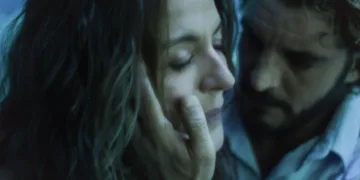
Brittany Raymond’s Valerie, Wanda’s daughter, brings seductive danger. She courts Will, steals, and takes his essential medication. Those layers carry structural weight. The secondary thread forms a domestic noir that complicates Will’s grip on control and self-possession. Even a pompous boss enters like weather, another pressure front designed to grind down the protagonist.
Tonal Drift and the Dramatic Core
The film attempts a genre mix and slips. The comedy leans on Will’s constant misfortune and a culture of rudeness. Repetition sets in. Jokes built from bare antagonism loop with diminishing returns. Comedy requires movement. Here, the rhythm stalls.

The dramatic passages land with more assurance. When the film narrows to interiority and Will’s need for change, the pitch steadies. His shifting connection with Valerie introduces a philosophical charge. Identity sits in an ethical gray zone, and the tension clarifies that crisis. The images would profit from expressionistic framing during these stretches, a visual echo of inner noise.
Structure remains a problem. The narrative wanders. Will’s exterior stance receives a light probe for much of the runtime. Key elements arrive late. A corporate threat to the farm surfaces near the end. The finalization of the cannabis-laced honey business snaps into place with speed. The close feels abrupt, a hard cut where a slow fade would serve.
Framing and Technical Artifice
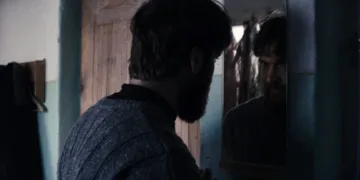
The film wears its low budget on the surface, a snapped-together texture with indie grit. That energy carries charm and cost. Lighting often reads flat. Audio quality shifts and sometimes hints at echo from the environment.
The script reaches for contrivance and trades away plausibility for a quick laugh. Will swims with a shirt so Valerie can deliver a cutting line. Wanda’s immediate, unshakeable hatred lacks the grounding that would support a psychological thriller and functions as a lever to move pieces. A tighter script and a more fixed aim at the psychological warfare between the leads would sharpen the blade.
Technical limits and narrative shortcuts block an ascent to sleeper status. The character work holds interest. The grounded arcs and committed performances keep viewers engaged through structural weakness. The story connects, even as the scaffolding that holds its strongest ideas would benefit from firmer build.
Loathe Thy Neighbor is a Canadian comedy drama film that was theatrically released on August 29, 2025. The movie, which was filmed in Bruce County, Ontario, centers on a neurotic city man who inherits his late father’s farm and finds himself in an escalating psychological conflict with his hostile beekeeper neighbor. The film was produced by the indie outfit Taconic Pictures and distributed in North America by New Mountain Films. Specific streaming platforms for home viewing are not consistently detailed across current results, but the film had its initial run in cinemas.
Credits
Director: Sergio Navarretta
Writers: Christian Majewski
Producers and Executive Producers: Lauren Holly, Brennan Clost, Christian Majewski, Rebeka Herron, Danny Roth
Cast: Lauren Holly, Brennan Clost, Shaun Benson, Brittany Raymond, Paloma Nuñez, Jessica Greco, Luke Humphrey, Patrice Goodman
Director of Photography (Cinematographer): Mathieu Taillefer
Editors: Alex Gans
The Review
Loathe Thy Neighbor
Loathe Thy Neighbor is an admirable effort hampered by structural inconsistency. The core rivalry between Will and Wanda is compelling, fueled by strong, committed central performances that ground the psychological drama. While the film attempts a tricky blend of genres, its humor often feels too repetitive and mean-spirited to land effectively. The most profound thematic exploration arrives too late, leaving the narrative resolution feeling rushed. It succeeds as a character study examining personal transformation against a hostile backdrop.
PROS
- Strong and committed performances from Brennan Clost and Lauren Holly.
- Interesting psychological subplots, particularly with Valerie, that deepen the narrative.
- The dramatic elements effectively highlight the protagonist's need for personal change.
- Admirable, grit-filled low-budget production aesthetic.
CONS
- Inconsistent tonal balance, frequently oscillating between comedy and drama.
- Comedic approach is often repetitive and excessively mean-spirited.
- Pacing issues; critical thematic and plot resolutions arrive too suddenly at the end.
- The script occasionally uses contrivance to force comedic or plot moments.
- Technical limitations (such as audio and lighting) are evident due to the low budget.