













![Kingdom Hearts Collection [I-III] Review](https://gazettely.com/wp-content/uploads/2026/10/Kingdom-Hearts-Collection-I-III-1-360x180.webp "Kingdom Hearts Collection [I-III] Review: KHII Holds Steady as Newer Entries Fluctuate 40")


Bad Influencer arrives from Netflix’s South African slate as a seven-episode crime drama created by Kudi Maradzika and directed with sharp confidence by Ari Kruger and Keitumetse Qhali. The series follows BK (Jo-Anne Reyneke), a resourceful single mother, and Pinky (Cindy Mahlangu), a social-media celebrity whose following offers a brief, volatile kind of power.
Their partnership forms a hazardous enterprise: manufacturing and selling convincingly forged luxury handbags online. That choice tightens a vise. The pair faces pressure from law enforcement and from a powerful criminal syndicate. The show reads as a high-tension study of contemporary aspiration, a modern morality play about the chase for economic survival and digital validation inside a stratified society.
The Architecture of Desperation
BK’s life rests on necessity. She carries significant debt, sharpened by the essential yet often unreachable cost of special education for her autistic son, Leo. The drama states a blunt thesis about the “Class-Caste Dichotomy” operating in many present-day economies. Legal income fails when measured against the price of genuine care.
Pinky supplies the needed distribution for BK’s illicit skill set. A public figure whose value depends on perception, she fights the erosion of influence and income. Her aim to convert fame into tangible wealth fits BK’s mastery of the counterfeit craft. Call it an alliance between old-world fabrication and new-world platforms (a merger both cynical and plausible).
The step from small con to major entanglement happens fast. Danger mounts, and a loan shark named Bheki appears as a proxy for a higher-level operator, Bra Alex. The escalation feels necessary, maybe too rapid for maximum thematic pressure (a recurring quirk of prestige crime). Another layer of threat arrives through Themba, Leo’s seemingly kind science teacher, whose hidden role as an undercover police officer investigating counterfeit operations completes the triangle that traps them.
Contemporary Johannesburg frames the action with force. The show leans into an “Aesthetic Glitch,” a split between influencer opulence and the hard math of the streets where BK works to survive. The city functions like a participant in the plot, reflecting economic fractures that never quite leave the frame.
Performance as Authenticity
Bad Influencer leans on its leads. Jo-Anne Reyneke’s BK fits a “Maternal Picaresque” mold: a sensitive, fiercely protective parent who becomes a quick-thinking swindler. Reyneke channels the steady thrum of fear beneath practiced control, especially in tender, anxious scenes with Leo. Physical detail stands out: BK watches constantly, adjusts posture and attire with near-chameleon precision, and performs for cameras and for survival.

By comparison, Cindy Mahlangu’s Pinky emerges as a creature of the attention economy. She seeks external validation with philosophical intensity. Existence becomes performance, an effort to convert metrics into meaning. The BK-Pinky bond carries the show’s most human current. It looks like shared risk, swings between affection and frustration, and never feels simple.
The supporting cast steadies the frame. Thapelo Mokoena’s Themba matters, lending weight to the police presence. The role runs into familiar genre beats at times, yet Mokoena brings gravitas. Across the ensemble, actors commit to portraying people saddled with very real ledgers and very real shortfalls. You can feel the balances and overdrafts.
The Glaze of Surveillance
The series adopts hyper-real style. Surfaces gleam. Bright filters, sleek cinematography, and the studied display of luxury goods keep the eye locked on presentation. That choice reflects a world where image equals currency (the influencer economy turned into mise-en-scène).
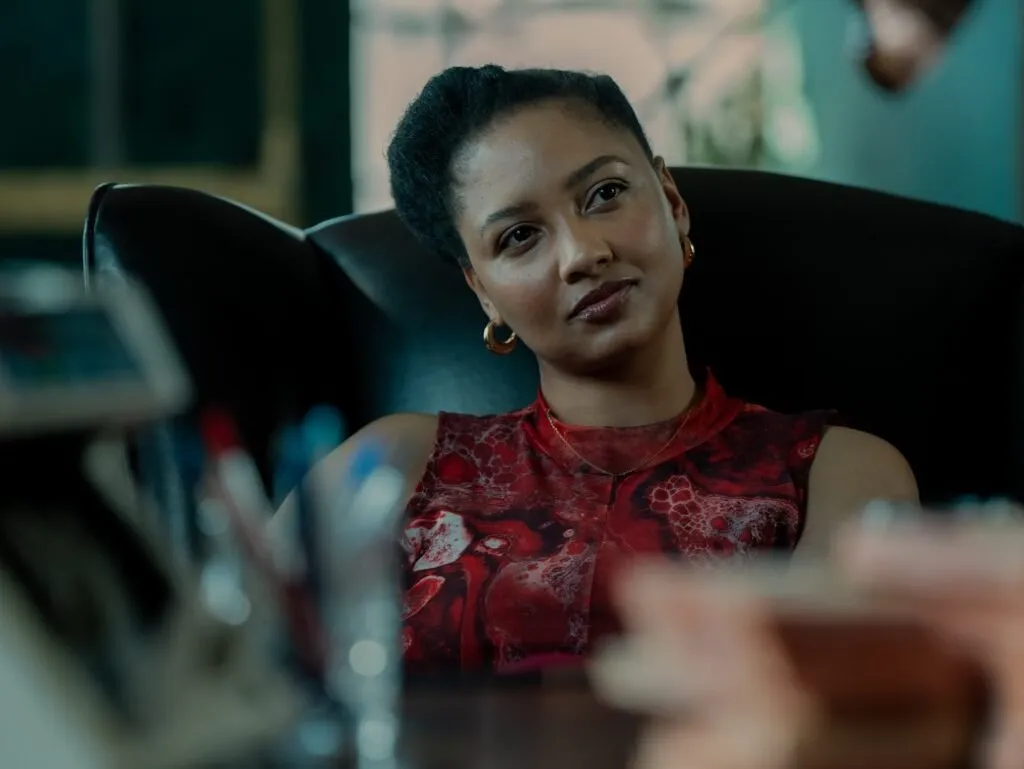
Production quality is high. Costume design, color work, and sets produce a refined, appealing texture. The show looks expensive, a fitting skin for a story about aspiration economics.
Kruger and Qhali deliver tight direction. Pacing stays steady, holding tension without dropping emotional beats. Editing and music collaborate to heighten suspense and keep momentum. A technical quibble belongs on the record: a striking cinematic move (a double dolly meant to signal trauma) loses force when a later title graphic obscures it. This feels like a contemporary TV habit, concept first and final discipline second. The series keeps its footing, yet occasionally trips on ambition’s shoelaces.
Ambition and Its Cost
The most durable element is social critique. The series explores an “Authenticity Crisis” tied to the digital age. Those counterfeit bags serve as emblem and argument. They point to filtered joy, staged perfection, and the work required to preserve a spotless public face. An illegal commodity becomes a mirror for a culture that trains itself on illusion.
Above all, the show remains grounded and humane. It stares past glamour to the fear, insecurity, and emotional strain behind the pageant of success. Bad Influencer sketches a society that assigns heavy value to likes and follower counts while emotional connection and stability slide down the ledger. The narrative studies the moral trade-offs that appear when survival and ambition blur. Errors flow from hope and pressure rather than inherent malice, which makes the spiral uncomfortably recognizable.
The series speaks to a wide hunger for recognition and wealth. It presents the price of ambition without guardrails, the cost of success without integrity. The critique arrives with precision rather than sermonizing, a cultural diagnosis delivered through heists, posts, and the steady hum of a city that keeps score.
The South African crime drama Bad Influencer premiered on Netflix on October 31, 2025. The seven-episode series is rated TV-MA for mature audiences, reflecting its high-tension plot involving counterfeit luxury goods, criminal syndicates, and deep socioeconomic desperation. It stars Jo-Anne Reyneke and Cindy Mahlangu as an unlikely duo—a struggling single mother and a fading social media star—whose risky scheme puts them directly in the crosshairs of both the law and the underworld.
Credits
Title: Bad Influencer
Distributor: Netflix
Release date: October 31, 2025
Rating: TV-MA
Running time: 7 episodes (42–50 minutes per episode, runtime not officially confirmed)
Director: Ari Kruger, Keitumetse Qhali
Writers: Kudi Maradzika (Creator), Sydney Dire, Daniel Zimbler
Producers and Executive Producers: Nosipho Ngoasheng Dumisa, Bradley Joshua, Benjamin Overmeyer, Simon Beesley, Travis Taute, Daryne Joshua, Kudi Maradzika
Cast: Jo-Anne Reyneke, Cindy Mahlangu, Thapelo Mokoena, Mpilo Shabalala, Hamilton Dlamini, Vincent Mahlape, Modise Motaung, Kamohelo Pule, Zozibini Tunzi, Emmanuel Castis, Julia Anastasopoulos, Brendon Daniels, Aubrey Poo, Nat Ramabulana
Director of Photography (Cinematographer): Rick Joaquim
The Review
Bad Influencer
Bad Influencer is a sharp, stylish crime drama that deftly uses the lure of counterfeit goods to expose the economic desperation and performative anxiety of the digital age. The performances by Reyneke and Mahlangu anchor a high-tension plot, which, while occasionally leaning on genre clichés, remains a deeply human story about the high cost of aspiration in a society obsessed with appearances. The series holds a dark mirror to modern economic reality.
PROS
- Effectively uses the counterfeit luxury plot to symbolize the illusion of online fame and wealth.
- Jo-Anne Reyneke (BK) and Cindy Mahlangu (Pinky) provide believable, emotionally complex portrayals.
- Explores the serious, relatable motivations (poverty, protection of a child) that drive the characters to illegal acts.
- Features tight direction, consistent pacing, and a glossy aesthetic that enhances the central theme of appearance.
- The Johannesburg backdrop provides a specific and relevant context for class division and aspiration.
CONS
- Some narrative moments, particularly involving the criminal underworld, adhere too closely to established genre tropes.
- Occasional instances where sophisticated visual techniques are ruined by distracting post-production elements.
- The final episode creates more questions than answers, which may frustrate viewers looking for firm resolution.