































Murder Inc presents a cold world through Anderson’s eyes, framing him as a hitman working inside a city run by criminal factions. It’s a top-down shooter with a defining rule: time is chained to your inputs. Seconds stay frozen until Anderson moves or fires, turning every room into a violent planning exercise where survival leans on anticipation.
The grim tone supports the antihero angle, keeping the pressure constant as you map enemy positions and read bullet paths before committing to a single step. That stillness can feel reassuring for a moment, and the stakes quickly correct it, since one bad call can trigger immediate failure. The result is an infiltration flow built on deliberate pauses and sudden lethality, asking the player to design each approach and then carry it out without hesitation.
The Ballistics of Frozen Time
Combat runs on a dual-analog setup that splits movement and directional fire, and the game treats precision as the main resource. Seven firearms cover the basics, including pistols, rifles, and high-damage shotguns, with the sniper rifle trading reach for strict ammo limits.
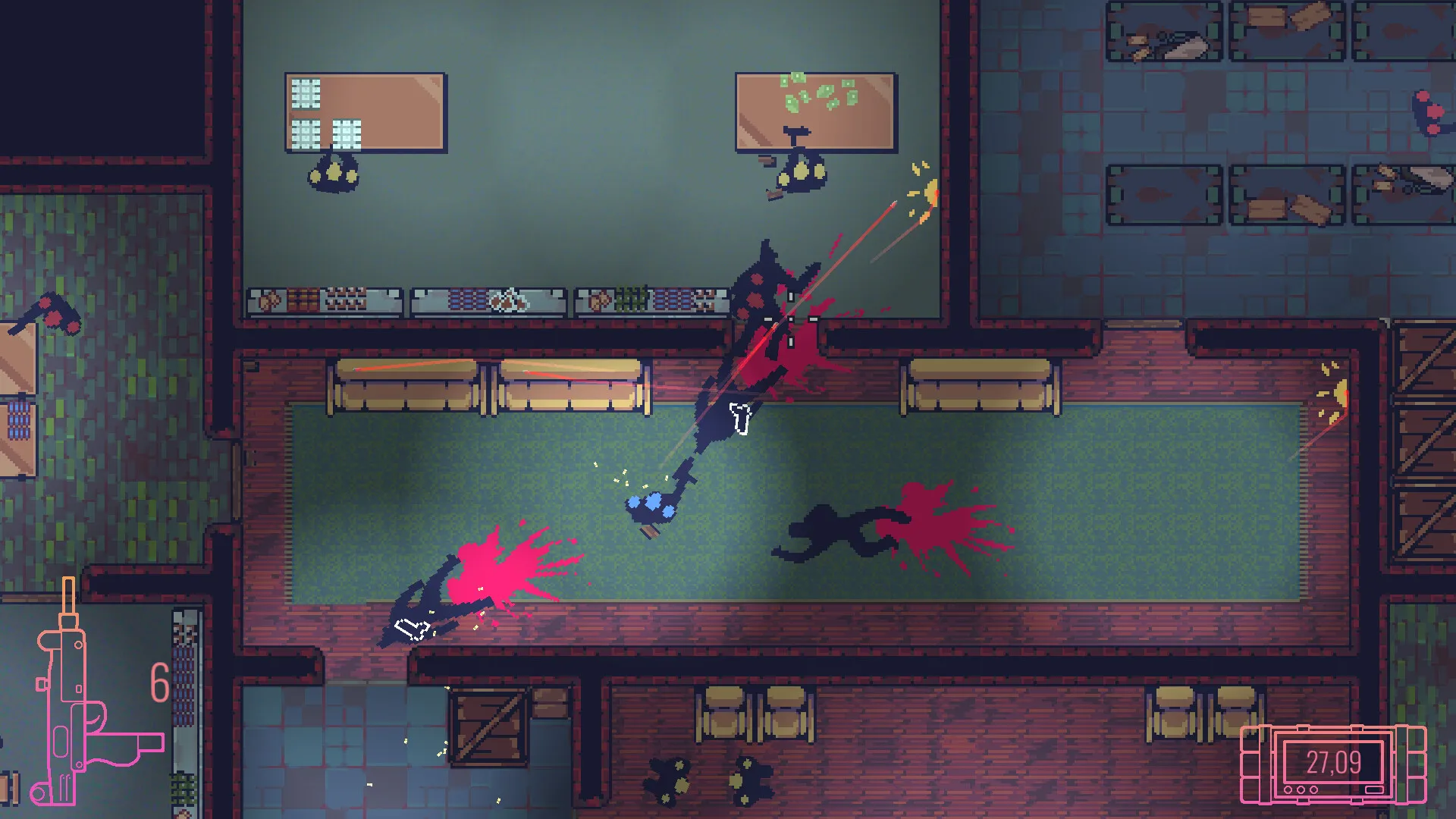
The standout is the SMG with ricochet rounds: shots rebound off interior walls, letting Anderson hit enemies behind cover or around tight corners without stepping into their line of sight. Loadout management stays tactile and situational, since swapping guns means physically dropping an empty weapon and picking up another from the floor.
Gunplay carries most encounters, and melee reads as an emergency lever. Hand-to-hand combat forces you to throw away your current firearm, a decision that can leave you exposed in a room full of armed guards. Planning goes past clean aim and into timing: choosing the exact beat to toss a grenade, or using the lock-on feature to keep pressure on a high-priority target.
The time mechanic sets a particular cadence, with projectiles creeping through space while you search for the safest, fastest route across a crowded kill box. Each input spends time, so crossing a room becomes a chain of lethal choices rather than a simple sprint to cover.
Temporal Narrative and Mission Structure
The story is built around a flashback structure that opens at the end of Anderson’s contract, then rewinds ten days to show how he reached that point. That framing gives the missions a clear context, with the campaign split into a prologue and ten main levels.

Objectives stay direct in most stages, usually asking for total elimination of hostiles before an exit opens. To shift pacing, the game introduces broader arenas and environmental hazards like exploding barrels that can wipe out clustered enemies in one move.
Progression follows a straight line through environments that grow more demanding over time. Some maps run large enough that success leans on memorizing patrol routes and room layouts through trial and error. That repetition sits at the core of the experience, since the size of certain stages pushes you toward a perfect run to reach the end.
Victories feed into a milestone-style track that marks your progress through the criminal underworld. Each level works as a self-contained puzzle box, and the layout shapes your approach, steering you toward either a direct assault or a plan that uses corridors and rooms to funnel enemies into bottlenecks.
The Friction of Technical Execution
On a console controller, these tactical ideas run into practical snags. The crosshair glides freely across the screen instead of staying anchored to the character, which makes it easy to lose the reticle once a fight turns hectic. Sensitivity problems add another layer of risk, since minimal deadzone support can cause aim drift if the sticks are not perfectly centered. Small inconsistencies like these carry real weight in a game that demands near-perfect precision to avoid a restart.
The save system adds its own strain. You can’t leave a mission midway without losing all progress for that stage, and the absence of mid-level checkpoints creates a harsh loop, especially alongside issues like snagging on wall geometry.
Visually, the muted palette matches the grim mood, yet it can blur the read between active threats and downed enemies. The audio supports the action, though it often lacks the high-energy punch found in similar indie titles. Taken together, the game’s sharp time-control concept often collides with a restrictive interface, creating a constant push-pull between smart tactical design and the friction of execution.
The Review
Murder Inc
Murder Inc offers a compelling tactical framework by blending methodical planning with brutal action. The central time manipulation mechanic provides a satisfying sense of control, turning chaotic shootouts into deliberate puzzles. However, the experience struggles with imprecise analog controls and a restrictive save system that often creates unnecessary friction. While the atmosphere and weapon variety offer flashes of excellence, technical inconsistencies frequently interrupt the gameplay flow. It remains a capable choice for fans of the genre who value high difficulty, provided they can overlook the lack of polish in its execution.
PROS
- Engaging time manipulation mechanic
- Satisfying ricochet physics with the SMG
- Strong, gritty atmospheric design
- Rewarding for players who enjoy tactical planning
CONS
- Imprecise aiming and loose crosshair movement
- Lack of mid-level checkpoints or save points
- Frustrating technical glitches and collision issues
- Underdeveloped melee combat system