















![Kingdom Hearts Collection [I-III] Review](https://gazettely.com/wp-content/uploads/2026/10/Kingdom-Hearts-Collection-I-III-1-360x180.webp "Kingdom Hearts Collection [I-III] Review: KHII Holds Steady as Newer Entries Fluctuate 33")









I stood in the cold outside the Egyptian Theatre this year, asking myself if anyone really needed another sex comedy. Then Gail Daughtry popped up on screen and the question shifted. Wilbur, Kansas, plays like a town preserved in a forgotten sitcom frame. Gail works there as a hairdresser, and she carries an innocence that feels hard to locate in the present tense. Her days run on wedding plans and local gossip, the sort of small-bore routine that can pass for safety.
That calm fractures the moment her fiancé, Tom, floats the idea of a celebrity sex pass. It’s the kind of relationship grenade that used to power rom-com arguments two decades ago, and it lands with a thud in Gail’s tidy world. The premise stops being theoretical when Tom bumps into Jennifer Aniston at a bookstore. He uses the pass in a backroom, and Gail watches the life she pictured snap in a single beat.
The Kansas dream collapses fast. Gail answers the betrayal with a clean, forceful need to even the score. She picks Jon Hamm as her target, which pulls her out of the salon and into the sprawl of Los Angeles. She brings her friend Otto with her. Their first steps into the city kick off a frantic pursuit, leaving the Midwest behind for coastal velocity. Gail reads as a fish out of water, hauling small-town manners into a place steeped in cynicism.
A Structural Parody of the Technicolor Musical
The movie clicks into a new rhythm once Gail hits California. David Wain and Ken Marino use the structure of a specific Kansas fairy tale as a skeleton for the chaos. Gail moves through Los Angeles in red shoes, crossing paths with a string of misfits, and that guided stroll gives the film a shape even while it acts like it’s flirting with pure nonsense. The joke, structurally, is that the movie keeps pointing at how rigid Hollywood storytelling can be, then trots out those same familiar beats with a grin.
The comedic grammar leans hard on the Zucker Brothers tradition. The gags love literal wording and slapstick that repeats long enough to feel like an endurance test. One bit with a foot stuck in a door hangs around in your memory and cashes in much later, which is a neat reminder that even the dumbest joke can be engineered with patience.
The film also tosses in a narrator, played by Fred Melamed, and his voiceover comes off hostile and off-kilter. He barges into scenes to complain about his own life and his roofing bills, which yanks the movie sideways at strategic moments. I found that friction genuinely refreshing, partly because it refuses the smooth, reassuring polish that so many studio comedies chase.
Visually, the film copies the look of a mid-budget comedy from the early 2000s. The lighting stays bright and flat, and the sets carry a synthetic sheen. That aesthetic choice turns Los Angeles into something knowingly artificial, like a backlot pretending to be a city that already runs on performance. Wain and Marino treat the medium like a sandbox for meta-humor, ribbing the same clichés they’re actively deploying. The satire aims at the industry itself, using familiar tropes to spotlight how predictable modern entertainment can feel. The craft supports the script’s absurdism, giving a silly premise a sturdy technical base.
Misfits, Paparazzi, and the Slat-Man
Zoey Deutch is the hinge that keeps the movie from flying off its own rails. She plays Gail like a perky figure beamed in from a 1960s movie, all brightness and polite energy. That fixed smile holds even as the world around her gets increasingly vulgar, and that mismatch becomes the motor for a lot of the laughs. Deutch makes Gail readable, which matters because the film keeps escalating into cartoon territory and still wants you to track an emotional through-line.
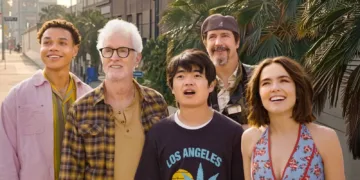
The supporting cast commits to that heightened reality with impressive steadiness. Ben Wang plays Caleb, a failed agent who drifts into the story as a dim companion. Ken Marino plays Vincent, a paparazzo who lost his heart after his career stalled. Each performer treats the material with full sincerity, and that seriousness sells jokes that would collapse under a wink.
The biggest comic imprint comes from John Slattery. He plays a version of himself who hasn’t worked in years, a guy boxing in his garage and stewing over unreturned texts from Jon Hamm that go back to 2017. The desperation plays as pathetic and funny at the same time, and the movie gets a lot of mileage out of his relationship to the idea of Hamm.
Tobie Windham also lands hard as Hamm’s assistant, delivering threats designed to make people feel sick with a ferocious intensity that’s hard to shake. Sabrina Impacciatore enters as Ludovica, a megalomaniac tied to a stolen-briefcase subplot, and she matches the chase’s frantic pitch with loud, aggressive energy.
These characters operate like archetypes dropped into a pinball machine built out of celebrity culture. The cast finds a workable balance between slapstick and character texture, and that balance keeps the strange world feeling inhabited. It’s a strong display of how performers can ground absurdist material through commitment and clarity.
Hollywood Realities and the Man Behind the Curtain
Los Angeles, here, is presented as a collage of tourist traps and neglected landmarks. The film lingers on the grit of Hollywood Boulevard, with maps to the stars and chain restaurants filling out the background. The pacing runs hot, sprinting from joke to joke without much pause, and that speed helps the cameos hit like drive-by punchlines. Henry Winkler and Weird Al Yankovic show up in moments that don’t serve the narrative in any practical way. They exist to make Wain’s version of the city feel stranger and more crowded. Weird Al plays himself as a man obsessed with the second amendment, a detail that fits the movie’s interest in warped public personas.
A secondary mobster plot keeps threatening to crowd out the main thread, and the film uses that pressure to mock the bloat that creeps into modern action-comedies. Joe Lo Truglio and Mather Zickel play goons with a dumbness that plays as nostalgic, like a throwback to comedies that trusted broad stupidity as its own form of rhythm.
Gail’s search for Jon Hamm leads to the Chateau Marmont, and the resolution frames the star as a doofy figure propped up by public relations. Hamm plays himself as insecure and dimmer than his television roles imply, which feeds the story’s interest in cultural disillusionment. The ending exposes the gap between the dream of fame and the reality of it, then lets the movie savor the wreckage for a laugh.
The film reads like a love letter to a version of Hollywood that’s already gone, using silliness to underline how much attention we still pour into celebrity. The main quest and the side plots stay in workable alignment, and the movie charges ahead as an unruly sprint through the entertainment machine.
Gail Daughtry and the Celebrity Sex Pass made its world premiere at the Sundance Film Festival on January 25, 2026. Following its debut in the Premieres section, the film has been seeking wide theatrical or streaming distribution. As of early February 2026, it is primarily available through festival screenings and is anticipated to land on a major platform later this year given the high profile of its lead cast and director.
Full Credits
Title: Gail Daughtry and the Celebrity Sex Pass
Distributor: Likely Story, Oval-5, Seeking Distribution
Release date: January 25, 2026
Rating: R
Running time: 93 minutes
Director: David Wain
Writers: Ken Marino, David Wain
Producers and Executive Producers: Anthony Bregman, Peter Cron, Ken Marino, David Wain, Crystine Zhang, Charles Zhong
Cast: Zoey Deutch, Jon Hamm, John Slattery, Sabrina Impacciatore, Ben Wang, Miles Gutierrez-Riley, Joe Lo Truglio, Mather Zickel, Ken Marino, Tobie Windham, Fred Melamed, Michael Cassidy, Richard Kind, Weird Al Yankovic, Henry Winkler
Director of Photography (Cinematographer): Kevin Atkinson
Editors: John Daigle
Composer: Craig Wedren
The Review
Gail Daughtry And The Celebrity Sex Pass
Gail Daughtry and the Celebrity Sex Pass is an unapologetically silly romp that succeeds through its sheer commitment to the bit. While the narrative occasionally falters under the weight of its own absurdist tangents, the sharp performances from Zoey Deutch and a self-deprecating John Slattery keep the energy high. It is a nostalgic, meta-heavy tribute to a style of comedy that feels increasingly rare in the modern landscape. For those who speak David Wain’s specific language of nonsense, it is a trip well worth taking.
PROS
- Zoey Deutch’s perky and dedicated lead performance.
- John Slattery’s hilarious, self-deprecating turn as himself.
- Fast-paced, absurdist humor and memorable cameos.
- Clever use of The Wizard of Oz as a satirical framework.
CONS
- A baggy narrative that occasionally loses its focus.
- The "goon" subplot feels underdeveloped compared to the satire.
- Some jokes feel like rehashes of better, older parodies.