





















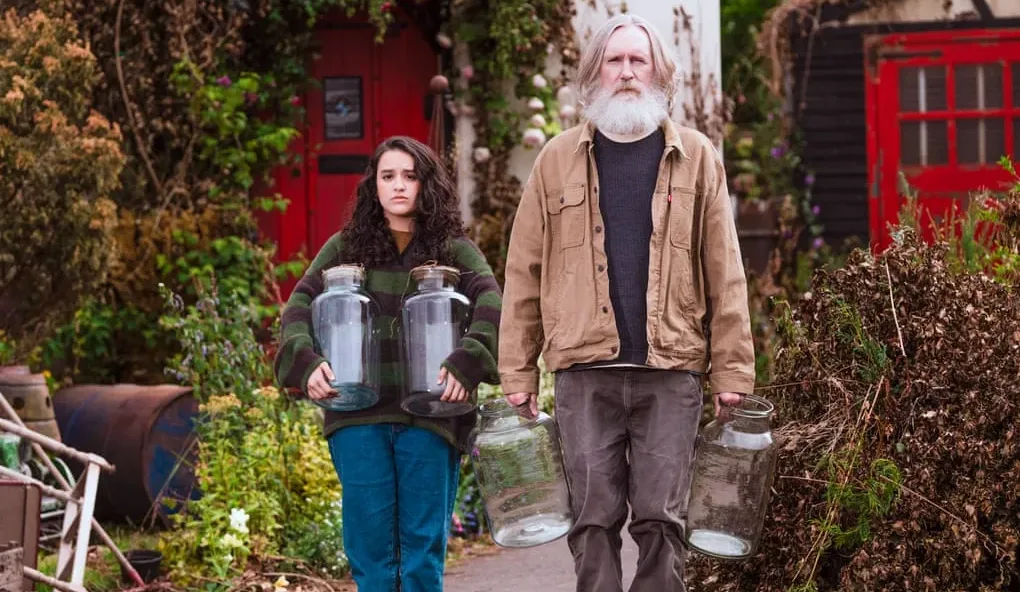

Michael Sleep lives as if someone hit pause on him in a South Manchester cul-de-sac. Seven years earlier, his partner Clea disappeared without a trace, and the absence has turned his days into a loop he cannot break. That locked-in feeling shapes the opening of Small Prophets, a six-part BBC series that signals a clear shift for creator Mackenzie Crook. Where his earlier work leaned into grounded pastoral textures, this one opens the door to magical realism with an almost cheeky calm.
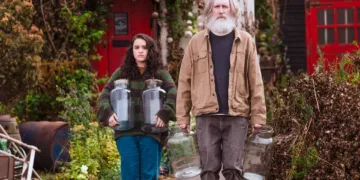
The jolt comes from Michael’s father, Brian, who brings home an ancient alchemical recipe for making homunculi. The method is as specific as it is strange: miniature humanoids grown in glass jars, built for one purpose, to speak the absolute truth. Michael latches onto the idea with a kind of aching logic. If human systems have failed him for seven years, maybe the answer sits inside something smaller, purer, and unavoidably honest. The show treats that impulse as both desperate and understandable, a response to grief that keeps rewriting the rules of what counts as a “reasonable” next step.
Place matters here, and the series commits to it. The drab grey stretch of suburban streets sits alongside the sterile, corporate vacuum of a DIY superstore, two versions of modern life that grind people down in slightly different ways. Crook uses those ordinary spaces as the staging ground for the uncanny, letting wonder sprout in the same places that sell flat-pack shelving and enforce workplace policy with a smile. The result presses domestic drama and high fantasy into the same frame, and the friction becomes part of the point: magic shows up in lives that look forgettable to anyone who only measures stories by spectacle.
The Architecture of Suburban Solitude
Pearce Quigley plays Michael Sleep with a precision that makes stillness feel active. With lank hair, an unkempt beard, and a posture that suggests he’s carrying weight in places his body cannot name, he sells the idea of a man sleepwalking through grief. Michael’s deadpan, mischievous humor becomes a shield he keeps raising during his shifts, a way to keep customers and co-workers at a distance without ever admitting he is doing it. It’s funny, then it stings, then it becomes funny again, the kind of coping mechanism that reads clearly in a workplace that expects cheerful competence on demand.
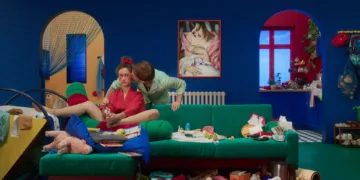
Inside Michael’s home, the grief turns architectural. He keeps the living room trapped in a permanent 1970s Christmas, a frozen time capsule that doubles as a shrine to Clea. That decision lands as more than décor. It’s a refusal to move past the moment his life broke, staged as a room you can physically walk into. The series understands how trauma can make nostalgia feel like a duty, and how that duty can start to resemble self-punishment.
Michael Palin brings warmth to Brian, and that warmth matters because the story asks Brian to carry two things at once: early-stage dementia and a sincere fascination with the bizarre. His condition shows through an obsession with intricate Rube Goldberg-style marble runs and ancient alchemical lore, and the show handles it with sensitivity.
Dementia here isn’t used as a plot gadget; it’s a lived complication, a shift in memory that reshapes family dynamics day by day. It also becomes a hinge between the everyday and the impossible, since Brian’s mind reaches toward patterns, rituals, and old stories that Michael has stopped allowing himself to believe in.
Lauren Patel plays Kacey, Michael’s young colleague, as someone practical enough to spot trouble and kind enough to stay anyway. Their connection carries a platonic, gender-flipped Harold and Maude energy, with Kacey offering the emotional scaffolding Michael lacks as he starts experimenting. The show treats that bond as a form of representation too, a depiction of support that sidesteps romance and still carries intimacy. In a TV environment that often cashes in every meaningful relationship as a will-they-won’t-they engine, Small Prophets finds room for care that isn’t transactional.
The supporting cast tightens the show’s social texture. Crook plays Gordon, an officious manager with a pathetic ponytail, a small-time tyrant who turns procedure into power. It’s workplace hierarchy in miniature, and the humor has teeth because it’s so recognizable.
Paul Kaye’s Roy, Clea’s shifty brother, brings a different pressure. His interest in Michael’s house reads as predatory, as if grief has created a vulnerability he plans to monetize. Neighbors Clive and Bev supply a comic portrait of suburban anxiety, with tidy hedges treated like moral law. Their fussing becomes an accidental foil for the cosmic secrets hiding in Michael’s shed, and the series gets a quiet kick out of that mismatch.
Finding the Fantastic in the Flat Pack
Small Prophets draws beauty out of repetition, and it commits to the dull specifics. Michael’s routine includes a temperamental Ford Capri and the sterile aisles of the DIY superstore, spaces that echo a modern landscape built to exhaust people politely. The series lingers on the rhythms that turn work into a kind of low-level captivity, and it frames that captivity as cultural, not personal. People like Michael don’t get mythic quests handed to them. They get shifts, fluorescent lighting, and the slow erosion of time.
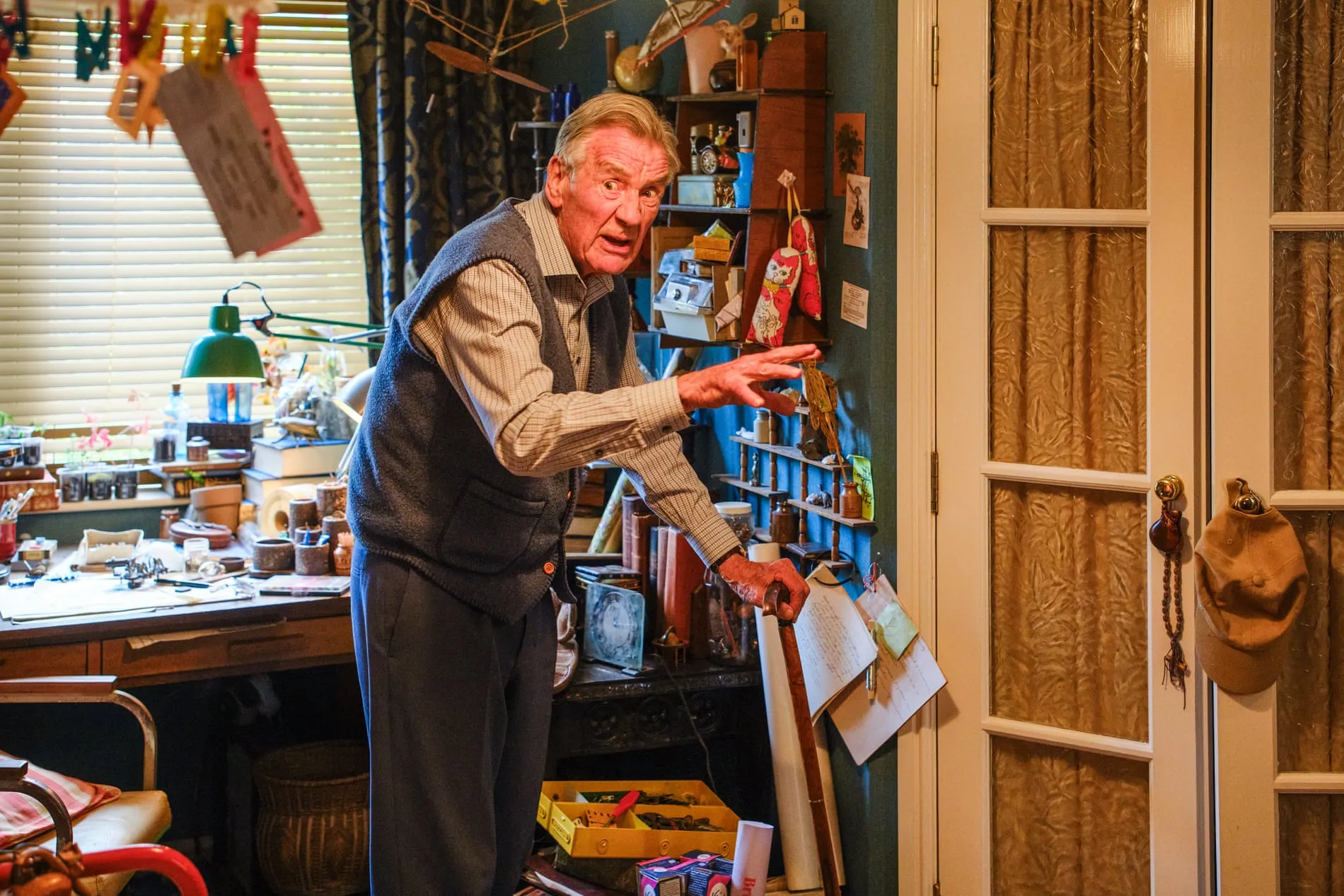
The direction still finds grace in tiny gestures, the swirl of tea, the rhythmic movement of a manager’s hair, the small choreography of bodies trying to stay functional. That attention to the minute sets up the magical turn by grounding the audience in texture and habit. Once the homunculi enter, the show has already built a world where details matter, so the supernatural arrives with an odd credibility.
The alchemy itself stays tactile. The process calls for horse manure, rainwater, and literal ritual work, and the series treats those ingredients with straight-faced seriousness. It becomes easier to accept folkloric creatures living in a Manchester garden shed because the show commits to the mess of making them. It’s not polished. It’s labor. That matters in a story set among people who already spend their lives doing labor that rarely earns respect. The supernatural doesn’t float above the working day; it grows out of it.
The emotional stakes stay sharp because the magic serves a story of loss. Michael isn’t chasing wonder for its own sake. He’s chasing an answer that seven years of ordinary systems have failed to provide. The dialogue helps keep the tone balanced, leaning into tart, sardonic wit that feels earned rather than pasted on.
Michael’s exchanges with customers become highlights of observational comedy, including his insistence that a store full of buckets has no call for them. The line plays like a joke about retail logic, then it lands as something else: a man trying to impose sense on a place designed to sell the performance of sense.
The show also slides into social satire with a steady hand. The corporate blankness of the store, the petty power games, the way people are trained to speak in pre-approved tones, all of it sits right next to a story about truth-telling creatures in jars. That pairing carries irony that feels pointed without turning into a lecture. The series keeps circling a simple idea: profound truths often sit right beside the routines people use to avoid them.
A Palette of Manchester Grey and Gold
Visually, the series leans on muted Manchester greys, then punctures them with imaginative flashes that feel like sunbursts against concrete. Those moments lift the suburban setting into something stranger, almost spiritual, without losing the sense of place. Michael’s home reads like a cluttered museum of the past, packed with textures that imply a life paused and preserved. The design makes memory physical, and the clutter becomes a form of representation too: a portrait of how grief lives in objects, not speeches.
The homunculi designs avoid digital slickness. They feel tangible, ancient, and handmade, an aesthetic that fits the show’s interest in folklore and ritual. That choice keeps the creatures from becoming cute mascots or special-effects trophies. They look like they belong to an older world that has somehow slipped into this one, right through the gap in a shed door.
Sound plays its own part in bridging eras and ideas. Eerie pastoral folk music links the contemporary city with the alchemical traditions Michael is reviving. The score also echoes the sensibility of Crook’s earlier projects, then adjusts it to a more urban environment. The music carries a quiet suggestion that the world has depth beneath the concrete and the retail signage, that mystery persists even in places designed to feel controlled.
Crook’s direction moves with a gentle, unhurried pace. He lets human moments breathe and puts character depth ahead of rapid plot propulsion. That control matters in a series juggling workplace comedy and supernatural mystery, and the transition stays smooth because the camera trusts the actors to hold attention in small beats. The pacing also mirrors the patience demanded by Michael’s alchemical work, pulling the viewer into his emotional tempo rather than racing past it.
The Truth in Small Jars
The homunculi function as a literal expression of the need for closure. Grief becomes a reminder that truth can feel unreachable through ordinary means, and the series gives that feeling a concrete form. The idea of unwrapped gifts runs through the story as a suggestion that surprise still exists inside a world that feels exhausted and predictable. That theme fits a suburban setting where routine often masquerades as safety, and safety often becomes its own trap.
Michael’s plan carries tragic irony. He seeks absolute truth from artificial creatures while the people around him bend, lose, or weaponize truth in recognizably human ways. Brian’s dementia erases pieces of his history. Roy tries to rewrite history for financial gain. Set against that, the small prophets become the closest thing the series offers to reliable narrators. It’s a bleak joke if you tilt your head: the only honest voices belong to beings grown in jars, while everyone else navigates half-truths, denial, and self-interest.
Crook also extends dignity to social outsiders, finding beauty in lives that mainstream culture tends to treat as background noise. The series pushes back against the elitism baked into a lot of high-concept television, where “important” stories often come packaged in expensive spaces and exceptional people. Here, myth-making takes root in working-class suburbs. A garden shed becomes a site of spiritual and scientific inquiry. That choice reads as a statement about who gets to be the subject of wonder, and it lands with a quiet sense of social change.
The genre approach links to a wider shift in television storytelling. The series blends forms, then uses that blend to map psychological states that a single genre might flatten. Comedy doesn’t cancel grief. Mystery doesn’t erase domestic detail. Magical realism becomes a way to hold contradictory feelings in the same scene, which fits a media moment where audiences have grown comfortable with tonal complexity, especially in series built for episodic viewing.
From Stagnation to the Supernatural
The six-part structure tracks Michael’s slow awakening from dormancy. The story moves from grey monotony early on toward the more complicated reality of the finale, and the escalation feels measured. A late shift into horror elements makes a blunt point: the search for truth carries risk, and the series refuses to treat Michael’s quest as a tidy healing exercise. The stakes widen from intimate pain to something closer to existential dread, and the tonal flexibility keeps tension alive.
Subplots involving a local teenager and Kacey’s ambitions reach resolutions through imaginative leaps that still feel grounded in the show’s internal logic. The series ties its threads together without leaning on conventional neatness, and that resistance fits its emotional subject. People living through loss rarely get clean answers delivered on schedule, and the show builds that uncertainty into its structure.
By the final stretch, the world has changed for the characters in ways that feel fundamental. Michael’s personal mystery reaches a resolution handled with restraint, keeping sentimentality on a short leash. The series leaves a lingering provocation: truth can be found in a jar, and facing it still demands courage from the person holding it.
Small Prophets premiered on February 9, 2026, on BBC Two and is currently available for streaming in its entirety on BBC iPlayer. Created by Mackenzie Crook, the six-part series follows Michael Sleep, a man stuck in a state of suspended animation seven years after his partner’s disappearance. The story takes a turn for the surreal when Michael begins growing “homunculi”—miniature prophesying spirits—in jars in his shed, hoping their absolute truth will lead him to his lost love.
Full Credits
Title: Small Prophets
Distributor: BBC Two, BBC iPlayer
Release date: February 9, 2026
Rating: TV-MA (or 15 in the UK, due to its 10:00 PM post-watershed broadcast)
Running time: 30 minutes
Director: Mackenzie Crook
Writers: Mackenzie Crook
Producers and Executive Producers: Gill Isles (Producer), Mackenzie Crook, Lisa Thomas, Christine Gernon, Emma Strain (Executive Producers)
Cast: Pearce Quigley, Sir Michael Palin, Lauren Patel, Mackenzie Crook, Paul Kaye, Sophie Willan, Jon Pointing, Ed Kear, Charlotte Mills, Adam Wright
Director of Photography (Cinematographer): Not publicly listed (Production photography by Matt Squire)
Editors: Not publicly listed
Composer: Cinder Well (Original theme “The Wise Man’s Song”)
The Review
Small Prophets
Small Prophets is a masterful evolution of Mackenzie Crook’s storytelling. By injecting alchemical wonder into the grey reality of Manchester, the series offers a profound meditation on grief and truth. It avoids the traps of whimsy, remaining anchored by Pearce Quigley’s weary, soulful performance and Michael Palin’s heart-wrenching warmth. Despite a jarring final shift into horror, it remains a rare, auteur-driven gem that finds dignity in the overlooked. It is a vital reminder that magic often hides in the most mundane corners of our lives.
PROS
- Superb performances by Pearce Quigley and Michael Palin.
- A highly original blend of social realism and alchemy.
- Deeply empathetic portrayal of grief and dementia.
- Exceptional writing that finds humor in the mundane.
CONS
- The tonal shift into horror in the finale may feel jarring.
- A cackling side character at the DIY store feels caricatured.
- The slow, unhurried pacing may test some viewers' patience.
- Certain subplots rely on highly improbable resolutions.